When an earthquake hits, fear hijacks us. We are alerted, distracted, and locked in a panicked state until the shaking stops. For most, this is a short-lived phenomenon as it is a natural human response in fight-or-flight situations like a sudden earthquake; but for some, the effects linger long after the ground goes quiet.
To start, it helps to have a background understanding of why the Earth shakes during an earthquake. Along the edges of a fault are two blocks that are often stuck together, while the rest of the crust keeps moving. Instead of sliding past each other, they build up stored energy. When the force finally overcomes the friction holding the blocks in place, that energy is released, radiating outward as seismic waves. The seismic waves ripple through the earth and shake both the ground and anything above its surface (Wald 2022).
Moving on to a case study: in March of 1998, a 34 year old woman in Italy wore a 24-hour blood pressure monitor when a magnitude of 4.7 earthquake struck. This enabled real-time recording of what happens to the heart during an earthquake. Before the tremor, her blood pressure showed a normal value of 130/85 mm Hg with a heart rate of 83 bpm. During the “spike” of the earthquake, her blood pressure increased to 150/122 mm Hg. In other words, a 46% rise in diastolic pressure and 20% rise in systolic pressure. On the other hand, her heart rate increased to 150 bpm which showed a 79% rise (Parati et al. 2001).These spikes of cardiovascular activity showcases what happens in the midst of an earthquake, and how the stress can potentially push borderline-hypertensive heart into dangerous territory. The data can be shown in the image below (Figure 1).
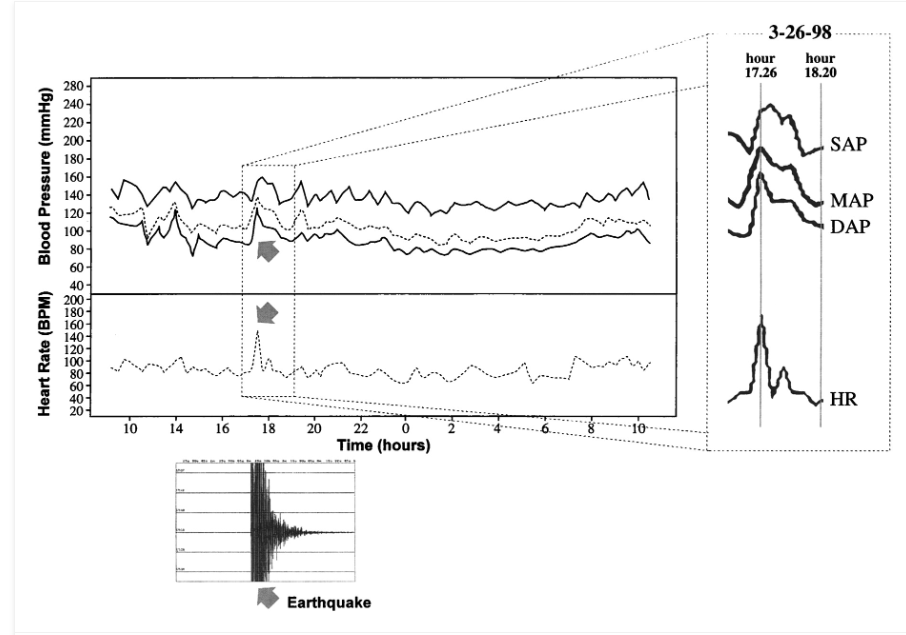
Figure 1 – This graph shows a 24-hour timeline of the woman’s blood pressure and heart rate, with clear spikes at the milder early afternoon of the earthquake and a sudden spike jump at 5:26pm when the strongest tremor hit. This graph is proof of the body’s reaction in real time during the shaking (Parati et al. 2001).
The key takeaway from this case study is that even after the shaking stops, the effects persist. Just 30 minutes later, the blood pressure was still up; 16% above baseline for systolic pressure and 22% for diastolic pressure. Although it finally returned to normal after an hour, it stayed highly variable for the next 6 hours. The stopping of the earthquake does not immediately calm heart activities; rather, it is something that lingers for some time. This is just one of many cases showing that fight-or-flight response is not always short lived.
Across 13 major earthquakes, researchers found elevated cardiac events that lasted anywhere from a few days to weeks, months, and even years. To strengthen this idea, here are some examples of more case studies: the 1994 Northridge quake is where death jumped on the first day, then fell; heart attack deaths stayed elevated for two months after the 1995 Kobe quake; and for three years after the 2004 Niigata quake (Kloner 2019). When the ground goes quiet, the heart may not. For some, the effects linger long after the shaking stops.
References
Kloner, Robert A. 2019. “Lessons Learned About Stress and the Heart After Major Earthquakes.” American Heart Journal 215 (September): 20–26. https://doi.org/10.1016/j.ahj.2019.05.017.
Parati, Gianfranco, Roberto Antonicelli, Francesco Guazzarotti, Enrico Paciaroni, and Giuseppe Mancia. 2001. “Cardiovascular Effects of an Earthquake.” Hypertension 38 (5): 1093–95. https://doi.org/10.1161/hy1101.095334
Wald, Lisa. 2022. “The Science of Earthquakes.” USGS, USGS. https://www.usgs.gov/programs/earthquake-hazards/science-earthquakes.

Leave a Reply
You must be logged in to post a comment.