Imagine the world being plunged into a state of complete darkness, with no way of telling left and right apart. Though this would be an apocalyptic scenario for most people, this is simply just another day for bats. But without one of the most important senses that humans rely on, how do bats navigate through the darkness?
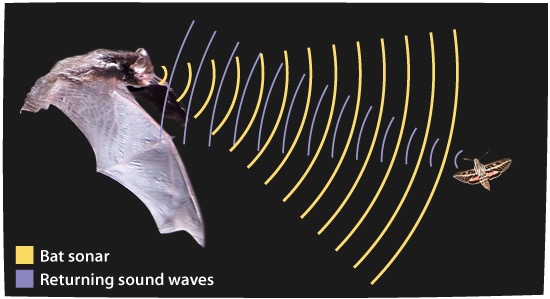
Echolocation is the process of an animal sending out high-frequency sound waves and listening for echos bouncing off objects in the environment. Certain species such as the Horseshoe Bat use their larynx to emit and detect frequencies from ten to hundreds of kilohertz (Salles et al. 2019), virtually undetectable to the human ears. This trait is facilitated by the bats’ use of a doppler shift compensation to differentiate the sounds of moving insects compared to the concurrent echoes from the environment.
The doppler shift describes a change in frequency of a wave produced by a moving source relative to the location of the observer (Bettex 2010). As bats are in motion, any high-frequency noise emitted is returned at an altered pitch. In order to keep the echoes within their narrow sensitivity range, Horseshoe bats will intentionally adjust the frequency of cries to compensate for movement. Factors such as echo return time and intensity of the reflected signal indicate the distance and size of the object (University of British Columbia 2019). This ability is useful for hunting prey, specifically small insects whose beating wings produce deviations in frequency within the bat’s hearing range.
However, how did bats evolve to have such an ability? Scientists theorize that echolocation has been present since the earliest ancestor of all bat species. Some species kept this trait while others such as ancient Fruit Bats subsequently lost this ability, only for a similar technique to echolocation evolving secondarily through tongue clicking (Jones and Teeling 2006). A theory by (Fenton et al. 1995) proposed that the ancestors of bats relied on echolocation for general orientation through short, low intensity calls without much range. The switch to stronger, tonal signals allowed them to locate insects across longer distances, which they attacked while gliding.
Echolocation is not specific to bats; marine creatures such as whales and dolphins also display similar abilities to locate their prey underwater. According to researchers (Li et al. 2010) who looked at the DNA sequences of 25 different animals, including dolphins and bats, both animals had a similar structure of the protein Prestin. Prestin is a motor protein present in the outer hair cells in the ear which contributes to the sensitivity and frequency selectivity of the mammalian cochlea (He et al. 2014). This suggests that the gene has been modified for the ability to hear in ultrasonic frequencies, providing evidence that echolocation is an adaptive trait which manifests through convergent evolution.
Fully equipped with their own navigation tools, bats have evolved to become fearsome hunters in the dead of night. So, though you might not see them coming, they can certainly sense you!
References
Bettex, Morgan. 2010. “Explained: The Doppler Effect.” MIT News, August 3. https://news.mit.edu/2010/explained-doppler-0803.
Dr. Biology. 2009. Bat Echolocation, Visualized. In ASU – Ask A Biologist. November 4. https://askabiologist.asu.edu/echolocation.
Fenton, M. B., D. Audet, M. K. Orbrist, and J. Rydell. 1995. “Signal Strength, Timing, and Self-Deafening: The Evolution of Echolocation in Bats.” Paleobiology 21 (2): 229–42. https://www.jstor.org/stable/2401078.
He, David Z. Z., Sándor Lovas, Yu Ai, Yi Li, and Kirk W. Beisel. 2014. “Prestin at Year 14: Progress and Prospect.” Annual Reviews 2014 311 (May): 25–35. https://doi.org/10.1016/j.heares.2013.12.002.
Jones, Gareth, and Emma C. Teeling. 2006. “The Evolution of Echolocation in Bats.” Trends in Ecology & Evolution 21 (3): 149–56. https://doi.org/10.1016/j.tree.2006.01.001.
Li, Ying, Zhen Liu, Peng Shi, and Jianzhi Zhang. 2010. “The Hearing Gene Prestin Unites Echolocating Bats and Whales.” Current Biology 20 (2): R55–56. https://doi.org/10.1016/j.cub.2009.11.042.
Salles, Angeles, Kirsten M Bohn, and Cynthia F Moss. 2019. “Auditory Communication Processing in Bats: What We Know and Where to Go.” Behavioral Neuroscience (United States) 133 (3): 305–19. PubMed. https://doi.org/10.1037/bne0000308.
University of British Columbia. 2019. “Bats and the Doppler Shift.” UBC – C21: Physics Teaching for the 21st Century, October 16. https://c21.phas.ubc.ca/article/bats-and-the-doppler-shift/.


Leave a Reply
You must be logged in to post a comment.