Imagine looking up at a night sky filled with glowing green, purple, and pink ribbons of light. The aurora borealis, commonly known as the Northern Lights, is often admired for its beauty. Yet, these lights reveal something much more interesting about how Earth interacts with the Sun. The same solar activity responsible for creating auroras can also affect technologies that we rely on every day.
Auroras result from energetic particles interacting with Earth’s magnetic field and atmosphere. The process begins with the solar wind, a continuous stream of charged particles released by the Sun. Its interaction with Earth’s magnetosphere transfers energy that accelerates some electrons along magnetic field lines toward the ionosphere, the upper atmospheric region where auroras occur (Nanjo et al. 2021). There, collisions with atmospheric particles produce the light visible as an aurora (Figure 1). Scientists use spectrometers to measure the wavelengths of this light, helping identify the atmospheric particles responsible for different colours (Mende 2016).
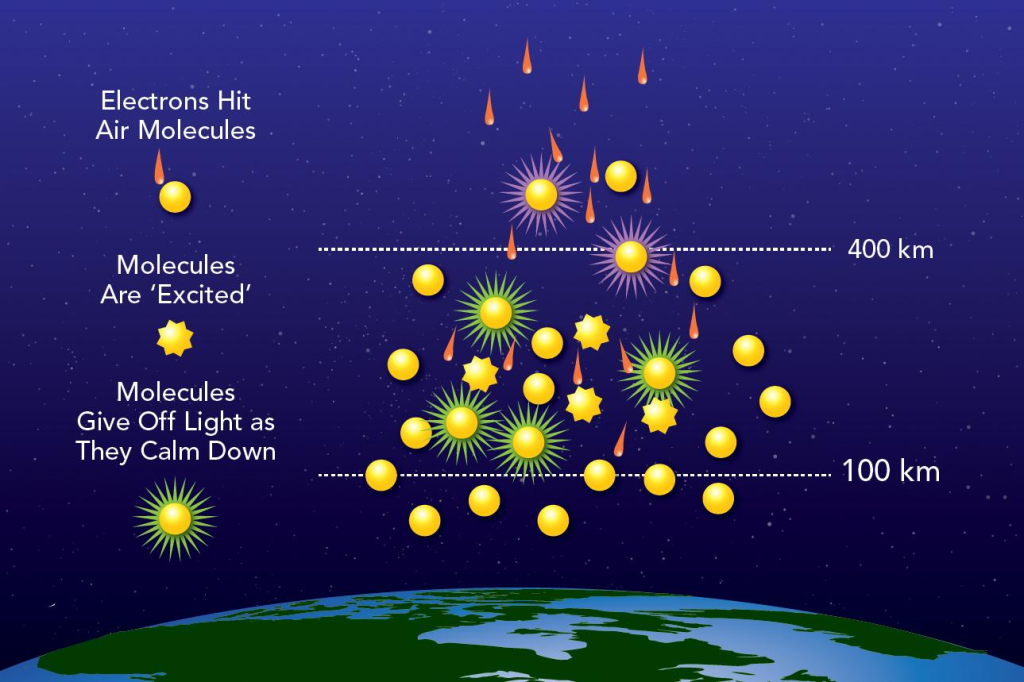
Although the aurora may look like one large display of colour, its different shades depend on the atmospheric particles involved and the conditions in which they emit light. When excited particles release energy, they produce photons at characteristic wavelengths, which we perceive as different colours. For example, excited atomic oxygen produces the familiar green light, while oxygen emissions at higher altitudes can appear red. Nitrogen molecules contribute blue and red emissions that can combine to create purple hues. Thus, colours do not simply indicate which gas is more abundant; they reflect the particles emitting light and their energy transitions. Altitude also matters because atmospheric density changes with height. At lower altitudes, frequent collisions can prevent excited oxygen atoms from emitting certain wavelengths of light. At higher altitudes, fewer collisions allow red oxygen emissions to occur (Lummerzheim 2009, 39).
The Sun also influences Earth through electromagnetic radiation, which contributes to its energy balance and temperature. Solar radiation decreases with distance from the Sun according to the inverse-square law: its intensity decreases with the square of the distance. Earth’s energy absorption also depends on its albedo, the fraction of sunlight reflected, and the greenhouse effect, which influences how much outgoing heat the atmosphere retains (NASA Earth Observatory 2009).
But when does this beautiful display become a warning? Particularly intense solar disturbances, including coronal mass ejections (large releases of plasma and magnetic field from the Sun), can trigger geomagnetic storms by disturbing Earth’s magnetosphere. These storms can interfere with GPS signals, generate electrical currents in power grids, and increase atmospheric drag on satellites in low Earth orbit (NOAA Space Weather Prediction Center n.d.). The March 1989 geomagnetic storm demonstrated these risks, contributing to power-system interference and the Québec blackout, as illustrated in Figure 2 (Love et al. 2026). Although an aurora does not always signal danger, it highlights how solar activity can have consequences far beyond a light show.
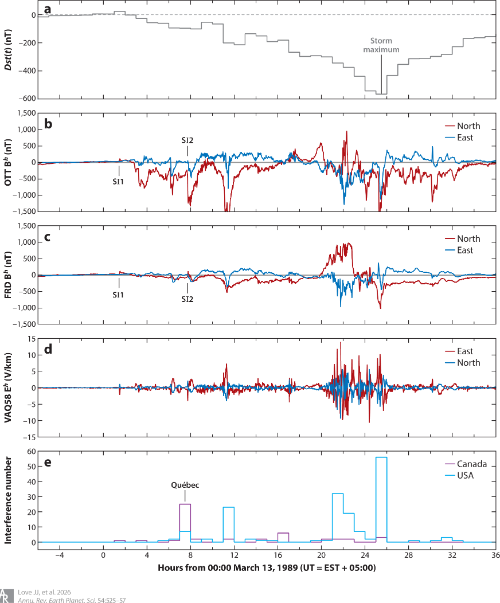
Figure 2. Measurements recorded during the March 1989 geomagnetic storm. Panel (a) shows the geomagnetic disturbance index (Dst), indicating the storm’s intensity. Panels (b) and (c) show changes in the northward and eastward components of Earth’s magnetic field measured at Ottawa, Ontario, and Fredericksburg, Virginia, respectively. Panel (d) shows the calculated geoelectric field, which reached approximately 10–15 V/km during the strongest disturbances. Panel (e) records instances of power-system interference in Canada (purple) and the United States (blue), with the onset of the Québec blackout identified. Together, these measurements illustrate how geomagnetic disturbances can induce geoelectric fields and create hazards for electrical infrastructure (Love et al. 2026).
Ultimately, the aurora demonstrates that Earth’s magnetic field and atmosphere continuously respond to solar activity. By connecting physics, chemistry, and Earth science, it reveals how much we can discover from a phenomenon often viewed simply as a spectacle.
References
Love, Jeffrey J., Paul A. Bedrosian, Anna Kelbert, E. Joshua Rigler, Greg M. Lucas, and Neesha R. Schnepf. 2026. “Magnetic Storms and Geoelectric Hazards.” Annual Review of Earth and Planetary Sciences 54: 525–57. https://doi.org/10.1146/annurev-earth-032524-012356.
Lummerzheim, Dirk. 2009. “The Colors of the Aurora.” Alaska Park Science 8 (1): 36–41.
Mende, Stephen B. 2016. “Observing the Magnetosphere through Global Auroral Imaging: 2. Observing Techniques.” Journal of Geophysical Research: Space Physics 121 (10): 10,638–60. https://doi.org/10.1002/2016JA022607.
Nanjo, Sota, Yuta Hozumi, Keisuke Hosokawa, Ryuho Kataoka, Yoshizumi Miyoshi, Shin-ichiro Oyama, Mitsunori Ozaki, Kazuo Shiokawa, and Satoshi Kurita. 2021. “Periodicities and Colors of Pulsating Auroras: DSLR Camera Observations from the International Space Station.” Journal of Geophysical Research: Space Physics 126 (10): e2021JA029564. https://doi.org/10.1029/2021JA029564.
NASA Earth Observatory. 2009. “Climate and Earth’s Energy Budget.” January 14, 2009. https://science.nasa.gov/earth/earth-observatory/climate-and-earths-energy-budget/.
NASA Goddard Space Flight Center. 2021. “Aurora: Illuminating the Sun-Earth Connection.” NASA Scientific Visualization Studio. https://svs.gsfc.nasa.gov/4934/.
NOAA Space Weather Prediction Center. n.d. “Space Weather Impacts.” https://www.spaceweather.gov/impacts.
Comments
7 Responses to “A Beautiful Warning? What the Aurora Borealis Reveals About Earth’s Relationship with the Sun.”
Hey iSci! I chose this topic because I wanted to look beyond the appearance of the Northern Lights and understand what is truly happening when we see them. I was particularly interested in connecting this to our RP1 physics material, where we explored how a star’s energy affects the planets around it. This led me to wonder how the Sun influences Earth in ways beyond the energy and radiation we receive. Exploring auroras allowed me to connect those concepts with chemistry and Earth’s magnetic field, while learning about a phenomenon I have always found fascinating.
Hi Jhaanvi,
Your blog post on the aurora borealis was really interesting! Here are a few suggestions to keep in mind while you edit:
-Make sure you reference your figure somewhere in your text.
-I don’t think aurora borealis needs to be capitalized in your sentences.
-This is more of a formatting thing, but try to format the figure so that it looks different from your main text. Also, the in-text citation for the figure should be in brackets in author-date format.
– I think you’re missing a citation for paragraph 4
– Also, I think it would be a good idea if you include more scholarly sources. Right now you only have three, and most of them are non-scholarly. I think having some scholarly sources would make your writing more credible
Overall, it was an engaging read! Great job!
Happy editing!
Tessa
Hi Tessa!
Thank you for taking the time to read my post and share your suggestions! I made sure to reference both figures in the main text, adjusted the formatting to distinguish the captions from the body, and corrected the in-text figure citations. I also added a citation to the fourth paragraph and incorporated additional scholarly sources, including Nanjo et al. (2021), Mende (2016), and Love et al. (2026), to strengthen the scientific explanations. I changed the capitalization of “aurora borealis” as well.
I really appreciate your feedback!
Hi Jhaanvi, I found your blog post very interesting, and I enjoyed reading it. Here are some suggestions to improve your post:
– P1S3: make sure to capitalize Northern Lights as it is a proper noun, or simply use ‘lights’ to avoid repetition
-P2S3: awkward wording, I would slightly rephrase to improve the flow: NASA explains that when solar wind reaches Earth…
-P2S3: there is an end quotation at the end of the sentence, but no start quotation, double check if this is a typo
– figure caption: consider rephrasing the beginning to: The formation of auroras from the collision of energetic particles with gases in Earth’s… for better flow.
-P3S2: consider paraphrasing rather than using a direct quote as this is generally preferred in scientific writing (I also noticed another quote in the final paragraph, I would suggest paraphrasing that as well).
– Make the figure caption font size smaller than the rest of the text for a more professional look
– Bold the ‘References’ to make it stand out more
Happy editing,
Hafsah S.
Hi Hafsah!
Thank you for your thoughtful suggestions. I revised some of the wording in the second paragraph to improve the flow and checked the quotation formatting. I also paraphrased the sections you mentioned, adjusted the figure captions and their font size, and bolded the References heading.
I appreciate you taking the time to provide such helpful feedback!
Hi Jhaanvi,
Funny enough, I was just thinking about this topic today before stumbling upon your blog post. Here’s some thoughts that you can implement while editing:
– In your second paragraph: “NASA describes how when the solar wind reaches Earth, it can interact with Earth’s magnetic shield” (NASA n.d.).” I would clarify if you are meaning this is the definition of solar wind. Additionally, this might be a good opportunity to explain solar winds with other peer reviewed sources outside of NASA (though it is still a good thing to use sometimes!)
– If the following “These electrons collide head-on” means that orientation here doesn’t really matter, I would rephrase it
– Also, this whole section is uncited, so I would try to see if there are academic sources that support this explanation for the formation of auroras (for example, what instruments did scientists use to figure this phenomenon out?)
– When you are explaining the sources of different colours, is it the mere presence of oxygen/nitrogen that makes it appear, or that there is more of each element than the others? I am wondering what “oxygen produces green” really means.
– You mention that auroras happen at specific altitudes, is there a reason why?
Happy editing! 🌌
Michelle
Hi Michelle!
Thank you for your detailed feedback! I clarified the explanation of solar wind and added scholarly sources, particularly Nanjo et al. (2021) and Mende (2016), to support the explanation of auroral formation and the methods scientists use to study it. I also changed the wording around electron collisions and explained that auroral colours depend on the specific atmospheric particles emitting light, rather than just their abundance. Finally, I added an explanation of how altitude affects the colours produced.
Thank you for all your feedback!