Ever peacefully sleeping and your body suddenly jerks, making you feel like you’re falling? This experience is called hypnic jerk, also known as a sleep start. Although you are lying safely in bed, your body feels like its reacting to you falling. These movements are common and happen to everyone, but no one really understands the cause behind them. This experience can be explained through the biology, chemistry, physics, and environmental process that are involved in sleep, movement, muscle activity.
Hypnic jerks happen when the nervous system transitions from wakefulness into light sleep. Chokroverty, Bhat, and Gupta (2013) studied intensified hypnic jerks by recordings the brain and muscle activity, they found several different patterns of brain bursts. Their study supports the idea that more than one motor pathway can be involved. Their idea was that a sudden surge of activity in the brains motor region may briefly break through the muscles relaxation that usually comes with falling asleep. Essentially, the body begins to power down but for a split second, the brain sends a signal that it doesn’t get the memo. Rizzo, Garcia-Retortillo, and Ivanov (2022) add to this idea by finding that the coordination between the brain waves and muscle activity changes through different stages of sleep and weakens as sleep gets deeper. Combined, these studies show the connection between brain and muscle is constantly being rewired as we fall deeper in sleep.
Chemistry is involved too as no muscle can move without energy. Muscles work on adenosine triphosphate (ATP). The energy is released when ATP is broken down and this is what enables the muscle proteins to slide past one another and contract. The cell then goes on to respire and rebuild the ATP. That constant cycle of energy release and reformation is a perfect example of thermochemistry in action. The hypnic jerk studies didn’t look at ATP per se but that’s the process which makes the twitching possible at all.
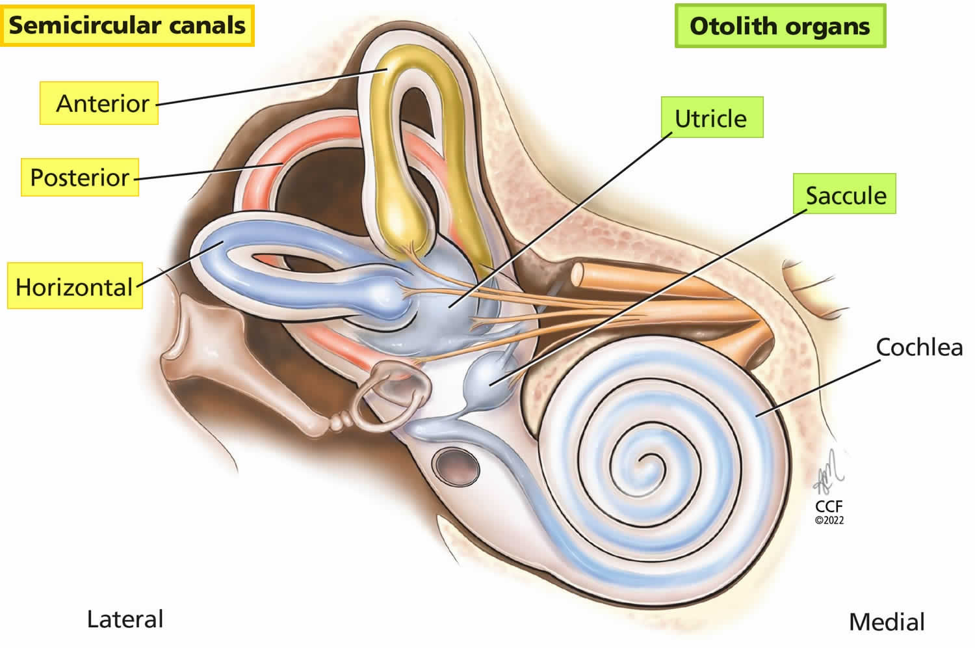
Figure 1. The vestibular system of the inner ear. The semicircular canals detect rotational movement, while the otolith organs detect linear acceleration and the pull of gravity.
The ‘falling’ part of the experience may be due to how the brain keeps track of where the body is in space. The vestibular system in the inner ear is responsible for balance, acceleration and orientation. The otolith organs in the vestibular system detect linear acceleration whereas the semicircular canals detect rotation (Day and Fitzpatrick 2005). The brain integrates all of these inputs (visual, from the eyes, from the muscles and from the joints) to work out how we are moving.
This is where physics and Earth science come in. The otolith organs respond to acceleration and respond to gravity acting on the body. Gravity is always present in the Earth’s gravitational field and so it provides the brain with a constant reference as to which way is down. When that reference is lost as it is for astronauts in microgravity, the brain has to relearn how to interpret motion and position (Carriot et al. 2021). It’s not surprising therefore that our sense of space is so reliant on gravity and that a sudden unexpected signal at sleep onset could well be interpreted as a drop.
One more idea worth mentioning is Dharani (2005) who suggests that the vestibular system and the cerebellum may be involved in the processing of gravity-related information during REM sleep, thus allowing the brain to maintain a sense of body orientation during sleep. That’s a fascinating proposition but again it’s in the context of REM sleep rather than the moment of falling asleep and so doesn’t really address the hypnic jerks.
Ultimately the ‘falling’ sensation of a hypnic jerk is a perfect illustration of the way the body and the environment are so intimately linked. It’s the result of the nervous system (the chemical energy of the muscles), the physics of acceleration and the force of gravity all working in concert. There’s still no single agreed explanation from a scientific point of view, but the fact that it’s a phenomenon that can be understood through the lens of so many different disciplines are what really highlights the complexity of the event.
References
Carriot, Jerome, Isabelle Mackrous, and Kathleen E. Cullen. 2021. “Challenges to the Vestibular System in Space: How the Brain Responds and Adapts to Microgravity.” Frontiers in Neural Circuits 15. Frontiers | Challenges to the Vestibular System in Space: How the Brain Responds and Adapts to Microgravity
Chokroverty, Sudhansu, Sushanth Bhat, and Divya Gupta. 2013. “Intensified Hypnic Jerks: A Polysomnographic and Polymyographic Analysis.” Journal of Clinical Neurophysiology 30 (4): 403–10. Intensified Hypnic Jerks : Journal of Clinical Neurophysiology
Day, Brian L., and Richard C. Fitzpatrick. 2005. “The Vestibular System.” Current Biology. The vestibular system: Current Biology
Dharani, Nataraj E. 2005. “The Role of Vestibular System and the Cerebellum in Adapting to Gravitoinertial, Spatial Orientation and Postural Challenges of REM Sleep.” The role of vestibular system and the cerebellum in adapting to gravitoinertial, spatial orientation and postural challenges of REM sleep – ScienceDirect
Rizzo, Rossella, Sergi Garcia-Retortillo, and Plamen Ch. Ivanov. 2022. “Dynamic Networks of Physiologic Interactions of Brain Waves and Rhythms in Muscle Activity.” Dynamic networks of physiologic interactions of brain waves and rhythms in muscle activity – ScienceDirect


Leave a Reply
You must be logged in to post a comment.