Has Climate Change Increased the Prevalence of a New Fungal Pathogen?

We’ve all heard how human-induced climate change is causing rising temperatures, rising sea levels, droughts, flooding, and other harmful effects. But did you know that it could also be the cause of a new fungal disease, Candida auris, causing infections seen globally today? Rising temperatures have been shown to create ideal conditions for the drug-resistant C. auris to thrive in humans (Casadevall et al. 2019). C. auris is a fungal species that was first isolated in 2009 in Japan from a human ear, where its species name, auris, comes from. However, it wasn’t always classified as a human pathogen; it originated as an environmental fungus, and as human-induced climate change progressed, the fungus was termed a human pathogen (Casadevall et al. 2019).

Mammals are typically remarkably resistant to invasive fungal disease, and this is because they have both a high basal temperature, which creates a thermal restriction zone (the difference between human basal temperature and environmental temperature), and advanced host defence mechanisms in the form of adaptive and innate immunity (Casadevall et al. 2019; Misseri et al. 2019). Human-induced climate change may be responsible for the progressive narrowing of the thermal restriction zone, making fungi able to adapt to mammalian basal temperatures as they become more thermally tolerant (Misseri et al. 2019).

Now, the problem with it being a human pathogen is that it is quite drug-resistant, making it very difficult to treat clinically (Lionakis and Chowdhary 2024). C. auris has been known to frequently cause uncontrollable outbreaks, particularly in long-term care facilities, because it can adhere to human skin and other objects, including medical devices, and persists on these surfaces. It has a particularly strong ability to form multilayer biofilms when exposed to human sweat and to reside within hair follicles and penetrate deep skin layers, thus evading any clinical detection. C. auris has quite a high morbidity and mortality rate in infected patients and has been placed in the “critical” group of human fungal pathogens by the World Health Organization. The fungus effectively evades the body’s natural defence mechanisms, such as phagocytosis and killing by neutrophils, and is most seen in colonies on the skin, in the nares, axilla and groin, and less commonly in the gastrointestinal or urogenital tract (Lionakis and Chowdhary 2024).

The Intergovernmental Panel on Climate Change (IPCC) found that by 2017, human-induced warming reached approximately 1°C above pre-industrial levels and continues to increase at a rate of 0.2°C per decade.  For the decade spanning 2006-2015 (the time of the emergence of C. auris), warming was determined to be 0.87°C above pre-industrial levels (Intergovernmental Panel on Climate Change (IPCC) 2022). With these warming effects of human-induced climate change continuing to increase, the question at hand is: Should we be concerned about increasing C. auris infections? It’s hard to tell. But treatments are being researched, and recently, there has been a discovery of the C. auris-specific adhesion surface colonization factor (SCF1), which is involved in adhesion in biofilm formation, indicating a promising target for therapeutic intervention (Figure 1) (Lionakis and Chowdhary 2024). Maybe new treatments will emerge for C. auris before its infection rate in humans increases with the Earth’s global warming rate?
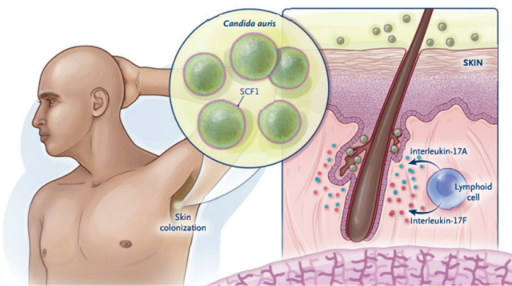
Figure 1: Candida auris skin colonization and host immune response. C. auris cells express surface proteins like SCF1 that facilitate adhesion and colonization on human skin (such as the axilla). In response, host lymphoid cells release inflammatory cytokines, including Interleukin-17A and Interleukin-17F, to mediate the immune defence (adapted from Lionakis and Chowdhary 2024).

References

Casadevall, Arturo, Dimitrios P. Kontoyiannis, and Vincent Robert. 2019. “On the Emergence of Candida Auris: Climate Change, Azoles, Swamps, and Birds.” mBio 10 (4): 10.1128/mbio.01397-19. https://doi.org/10.1128/mbio.01397-19.

Intergovernmental Panel on Climate Change (IPCC), ed. 2022. “Framing and Context.” In Global Warming of 1.5°C: IPCC Special Report on Impacts of Global Warming of 1.5°C above Pre-Industrial Levels in Context of Strengthening Response to Climate Change, Sustainable Development, and Efforts to Eradicate Poverty. Cambridge University Press. https://doi.org/10.1017/9781009157940.003.

Lionakis, Michail S., and Anuradha Chowdhary. 2024. “Candida Auris Infections.” New England Journal of Medicine 391 (20): 1924–35. https://doi.org/10.1056/NEJMra2402635.

Misseri, Giovanni, Mariachiara Ippolito, and Andrea Cortegiani. 2019. “Global Warming ‘Heating up’ the ICU through Candida Auris Infections: The Climate Changes Theory.” Critical Care 23 (1): 416. https://doi.org/10.1186/s13054-019-2702-4.

Comments

4 Responses to “Has Climate Change Increased the Prevalence of a New Fungal Pathogen?”

  1. Audrey Ferris Avatar
    Audrey Ferris

    Hi ISci! I came up with the idea for this post when I was exploring different health effects emerging from climate change. I wanted to see how environmental changes may impact global health outcomes. Any and all feedback is welcome!

    – Audrey

  2. Zara Sarfraz Avatar
    Zara Sarfraz

    Hi Audrey,

    Super interesting topic! Climate change is and has been a really important discussion, and so reading about a new challenge it introduces is really enlightening!

    I have a couple pieces of advice:

    – Consider making your title less literal, and maybe more of a hook to attract readers. This doesn’t mean you have to make it any less informative! For example, “Fungi on the Rise: Is Climate Change to Blame?”

    – P3S2 is a long sentence that may not read so easily. Try breaking it up! For example, “C. auris can adhere to human skin and other objects, including medical devices, and persists on these surfaces. As a result, it has been known to frequently cause uncontrollable outbreaks, particularly in long-term care facilities.”

    – Consider adding another figure to balance out your post a little bit. For example, you could add a picture of C. auris under a microscope after your first paragraph.

    – Lastly, avoid ending your post with a question. Doing so will prevent you from introducing a new topic in your conclusion. Instead, end with something that will wrap up your whole idea effectively. For example, “As our planet continues to warm, understanding how climate change contributes to the emergence of fungal pathogens like C. auris will be crucial in preventing future outbreaks and protecting human health.”

    Overall, well done! I can’t wait to read your final draft.

    Happy editing!

    Zara

  3. Emily Tai Avatar
    Emily Tai

    Hi Audrey,

    Great blog post! I thought the explanation of the thermal restriction zone made the mechanism easy to understand, and the link between climate change and a fungal pathogen made the topic feel relevant. Here are a few suggestions to improve your post.

    P3S4 and P3S5: Terms such as “phagocytosis,” “neutrophils,” “nares,” and “axilla” may be unfamiliar to a general audience. A short plain-language description of each (e.g., “immune cells that engulf pathogens”) would make the paragraph easier to follow.

    P4S2: It would help to explain why 0.87°C of warming matters for the fungus. One sentence connecting this figure to the narrowing of the thermal restriction zone described in P2S2 would show readers why even a small increase is relevant.

    P4S4: “It’s hard to tell” leaves the question in P4S3 without a clear answer, even though P3 gives strong evidence of high mortality, drug resistance, and a “critical” WHO classification. It would be helpful to end with a sentence summarizing what this evidence suggests about the level of concern. Try: “Given its drug resistance and high mortality, C. auris warrants close attention even while the climate link is being studied.”

    Overall, this was a very well written blog post. I look forward to reading your final draft!
    Emily

  4. Gurleen Kaur Avatar
    Gurleen Kaur

    Hi Audrey,

    I enjoyed reading your blog and understanding yet another problem occurring as the result of climate change. It was statistically abundant and interesting to read! Here are a couple changes to create fluidity in your writing.

    Paragraph 1, line 8: You could end the sentence at “It wasn’t always classified as a human pathogen. The species originated as an environmental fungus, and as human-induced climate change progressed, the fungus was termed a human pathogen (Casadevall et al. 2019).” This way, the sentence is not run-on and clearer to read!

    This one is preferential but for P2L1, refrain from using two adverbs consecutively (“typically remarkably”) and possibly replace it with “typically quite” just for the sake of flow. This sentence is also long so consider splitting it. “Mammals are typically quite resistant to invasive fungal disease because of their high basal temperature. It creates a thermal restriction zone (the difference between human basal temperature and environmental temperature), and advanced host defence mechanisms in the form of adaptive and innate immunity (Casadevall et al. 2019; Misseri et al. 2019).”

    Happy editing!
    Gurleen

Leave a Reply