Have you ever gone to cook spaghetti in a pot that is way too small, so you had to break it? Bending both ends, you would expect two clean pieces but you get three or more fragments, with even smaller pieces coming out of the middle. This puzzle has been one that was often discussed in materials sciences for years, and is reliant on flexural waves.
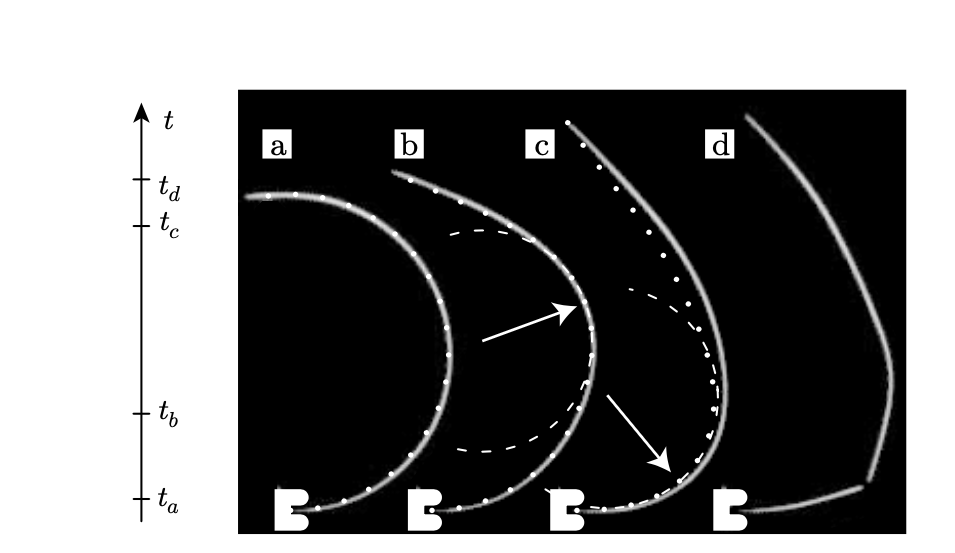
Figure 1. The bending of a dry spaghetti noodle while the bottom end remains clamped. a) ta=0s at the instantaneous point of the initial release. b) tb = 0.0159T, an intermediate frame – arrow points to point of max curvature. c) tc=0.0509T, the frame before full rupture. d)td=0.0596T, the frame after rupture (Audoly and Neukirch 2005).
A spaghetti stick can be assumed to behave like a rod, and you may expect that a break will relieve the stress in a bent rod. Audoly and Neukirch (2005) showed that quite the opposite happens as bending past the limit of curvature actually means that the curvature at the new end (middle) is suddenly released (Figure 1). This energy sends a burst of flexural waves, which are defined as bending waves, travelling along the length of the spaghetti pieces. This creates a cascade of cracks that spread.
Heisser et al. (2018) started studying whether the energy of flexural waves could be reduced. His work showed that lower curvature means that there is less stored energy. Strain energy density per length (U) is given by U=½EIκ², where E is the material’s stiffness (Young’s Modulus), I is the beam’s cross-sectional resistance to bending, and κ is the inverse of the radius of curvature (1/R). As the beam (spaghetti) is twisted, the radius of curvature increases, and κ is therefore decreased by a square factor. That means that if κ is halved, then there is one quarter of the original energy released. This means that by twisting the spaghetti, clean breaks can be made.
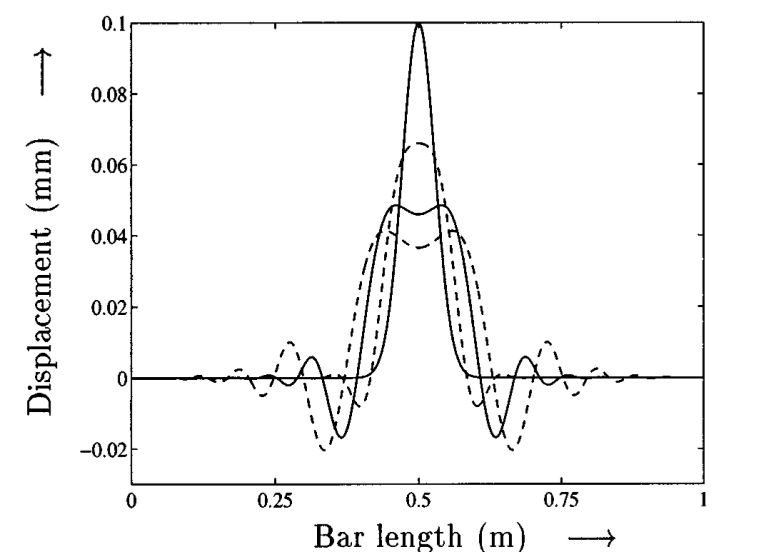
Figure 2. A graph of displacement versus bar length of xylophones (Chaigne and Doutaut 1977).
What is truly interesting is that this same equation shows up in percussion music and can explain why a xylophone sounds the way it does. Chaigne and Doutaut (1977) modelled xylophone bars with a slightly modified version of this equation. A struck bar is essentially a spaghetti stick with both ends to move, so this equation applies to it too. When the instrument is struck, a bar never vibrates at just one frequency. It vibrates at several overlapping frequencies (pitches), but the lowest frequency gives the main pitch that is heard by humans, and all other frequencies provide ‘colour’ or the uniqueness to sound (e.g. the sound of a marimba vs snare drum). Frequency, which is the inverse of the wave period, determines the main pitch heard and doubling it raises the pitch by exactly one octave (Orduña-Bustamante 1991). For a bar material, the sound released when hit is entirely due to the flexural motion of the bar in the vertical plane (Figure 2).
Overall, spaghetti breaking has been a curious phenomenon seen in everyday life, and its chaotic fractures are due to flexural waves. These waves lead to a cycle of fractures that creates micro-breaks. The energy of flexural waves of a rod-like shape can be reduced when the object is twisted. However, these same flexural waves are seen in percussion instruments such as xylophones, where pitch is dependent on the displacement of material due to flexural waves.
References
Audoly, Basile, and Sébastien Neukirch. 2005. “Fragmentation of Rods by Cascading Cracks: Why Spaghetti Does Not Break in Half.” Physical Review Letters 95 (9): 095505. https://doi.org/10.1103/PhysRevLett.95.095505.
Chaigne, A., and V. Doutaut. 1997. “Numerical Simulations of Xylophones. I. Time-Domain Modeling of the Vibrating Bars.” Journal of the Acoustical Society of America 101 (1): 539–57. https://doi.org/10.1121/1.418117.
Heisser, Ronald H., Vishal P. Patil, Norbert Stoop, Emmanuel Villermaux, and Jörn Dunkel. 2018. “Controlling Fracture Cascades through Twisting and Quenching.” Proceedings of the National Academy of Sciences 115 (35): 8665–70. https://doi.org/10.1073/pnas.1802831115.
Orduña-Bustamante, F. 1991. “Nonuniform Beams with Harmonically Related Overtones for Use in Percussion Instruments.” Journal of the Acoustical Society of America 90 (6): 2935–41. https://doi.org/10.1121/1.401768.


Leave a Reply
You must be logged in to post a comment.