Imagine looking up at a night sky that is filled with glowing green, purple, and pink ribbons of light. The Aurora Borealis, commonly known as the Northern Lights, is often admired for its beauty. Yet, every time the northern lights appear, they reveal a fascinating story about how our planet survives the sun’s harsh environment. In fact, the exact same solar activity that is responsible for forming auroras can also affect technologies that our modern society depends on.
We see the aurora as a peaceful light show, but it is actually the result of a massive cosmic battle happening right above our heads. The process begins with the solar wind, which is a continuous stream of charged particles released by the Sun. NASA describes how when the solar wind reaches Earth, it can interact with Earth’s magnetic shield” (NASA n.d.). When solar winds strike Earth’s magnetic field, they channel kinetic energy down toward the poles, accelerating free electrons into the upper atmosphere. These electrons collide head-on with oxygen and nitrogen atoms and molecules, transferring energy and exciting them. As the excited particles return to lower-energy states, they release that energy as photons, or tiny packets of light. When countless collisions occur, they produce the colourful curtains of light that we recognize as the aurora.
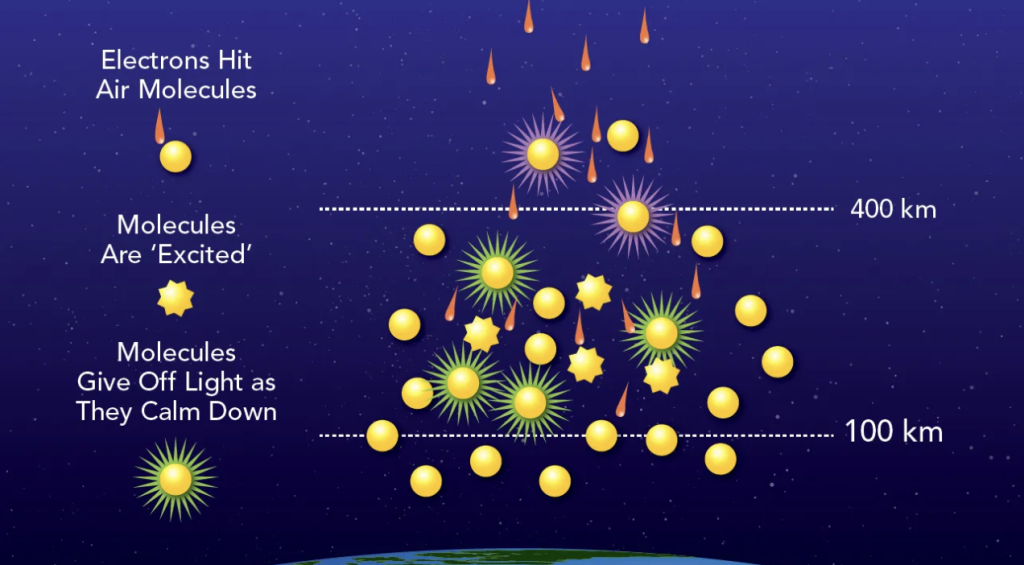
Figure 1. How auroras form when energetic particles collide with gases in Earth’s upper atmosphere. The collisions excite atmospheric molecules, which release energy as visible light when they return to lower-energy states. The diagram also shows the approximate altitude range (100–400 km) where these interactions occur. Source: NASA Goddard Space Flight Center, Scientific Visualization Studio.
Although the aurora may look like one large display of colour, the different shades actually depend on what is happening in the atmosphere. As NASA (n.d.) notes, “the color of an aurora depends on the type of gas that is hit and where that gas is located in the atmosphere”. Oxygen commonly produces green and red light, while nitrogen contributes blue and pink emissions. Each distinct color represents a specific quantum energy transition as excited electrons return to their ground states.
Interestingly, the Sun influences Earth through more than just the charged particles responsible for auroras; it also emits electromagnetic radiation that drives Earth’s entire energy balance and temperature. The amount of solar energy a planet receives is strictly governed by its orbital distance, decreasing sharply with distance according to the inverse-square law. Once this radiation arrives, a planet’s actual temperature is heavily modulated by its albedo, the percentage of sunlight reflected back into space, and the greenhouse effect, which traps thermal energy within the atmosphere. These concepts demonstrate that understanding Earth’s relationship with the Sun requires considering different forms of energy transfer.
But when does this beautiful display become a warning? Strong solar disturbances, like coronal mass ejections, can trigger geomagnetic storms. As The National Oceanic and Atmospheric Administration (NOAA) notes, “Geomagnetic storms also produce the aurora” (NOAA n.d.). While the lights themselves are harmless, the underlying magnetic turbulence poses a severe hazard to modern infrastructure. High in the atmosphere, these storms warp the ionosphere, degrading GPS accuracy and creating satellite-dragging atmospheric friction. On the ground, the fluctuating magnetic fields induce unwanted electrical currents in pipelines and power lines. In severe cases, these surges can overload electrical grids and trigger widespread blackouts, proving that the same phenomenon that decorates the night sky can also disrupt our highly connected world.
References
NASA. 2021. Aurora: Illuminating the Sun-Earth Connection. NASA Goddard Space Flight Center. https://svs.gsfc.nasa.gov/4934/.
NASA. n.d. “Auroras.” NASA Science. Accessed November 4, 2026. https://science.nasa.gov/sun/auroras/.
National Oceanic and Atmospheric Administration (NOAA). n.d. “Space Weather Impacts.” Space Weather Prediction Center. Accessed November 4, 2026. https://www.spaceweather.gov/impacts.

Leave a Reply
You must be logged in to post a comment.