Imagine your gender was determined by the temperature outside rather than your chromosomes. Pretty crazy, right? Well, this is exactly how it works for sea turtles. Unlike humans, a sea turtle’s sex is determined by the temperature of their egg during a specific stage of embryonic development (Woolgar et al. 2013). Unfortunately, rising global temperatures present a risk to this process and the future of sea turtle populations.
There are seven living species of sea turtles in the world, and all seven of them exhibit a process called temperature-dependent sex determination (TSD). This occurs because sea turtles lack the sex chromosomes that determine human sex and instead develop testes or ovaries based on the temperature at which their eggs are incubated (Woolgar et al. 2013). Usually, cooler temperatures produce males, while warmer temperatures produce females, with the pivotal temperature, which is the temperature at which 50% of the hatchlings are female, differing from species to species. It is also important to note that the pivotal temperature is very specific, as an increase of 1 °C can cause around 80% of hatchlings to be female (Blechschmidt et al. 2020).
During sea turtle embryonic development, egg temperatures can influence the expression of certain genes that are responsible for reproductive organ development (Ge et al. 2018). At cooler temperatures, a histone demethylase called KDM6B promotes the transcription of a male sex-determining gene called Dmrt1. It does this by eliminating the trimethylation of H3K27 near its promoter, encouraging testicular development (Ge et al. 2018). At higher temperatures, increased calcium signalling activates a protein called STAT3 through phosphorylation, which in turn binds to the Kdm6b locus, suppressing Kdm6b transcription (Weber et al. 2020). Warmer temperatures can also cause increased production of aromatase, which is an enzyme that converts androgens into estrogens, promoting ovary differentiation and development while also helping to maintain the ovarian structure (Pieau et al. 2001). While this research does grant us insight into how TSD works in sea turtles, it was conducted on red-eared slider turtles, and the exact mechanism could differ between species. This means that further research into this topic is needed for a full understanding.
As global temperatures rise due to climate change, warmer nesting beaches are producing more and more female-biased populations (Blechschmidt et al. 2020). A study on green sea turtles from Australia’s Great Barrier Reef showed that 99.1% of juveniles originating from the warmer northern nesting beaches were female, while turtles originating from cooler southern nesting beaches were approximately 65–69% female (Blechschmidt et al. 2020). As shown in Figure 1, females also outnumbered males across all three life stages (juvenile, subadult, and adult) at a northern Great Barrier Reef foraging ground (Jensen et al. 2018).
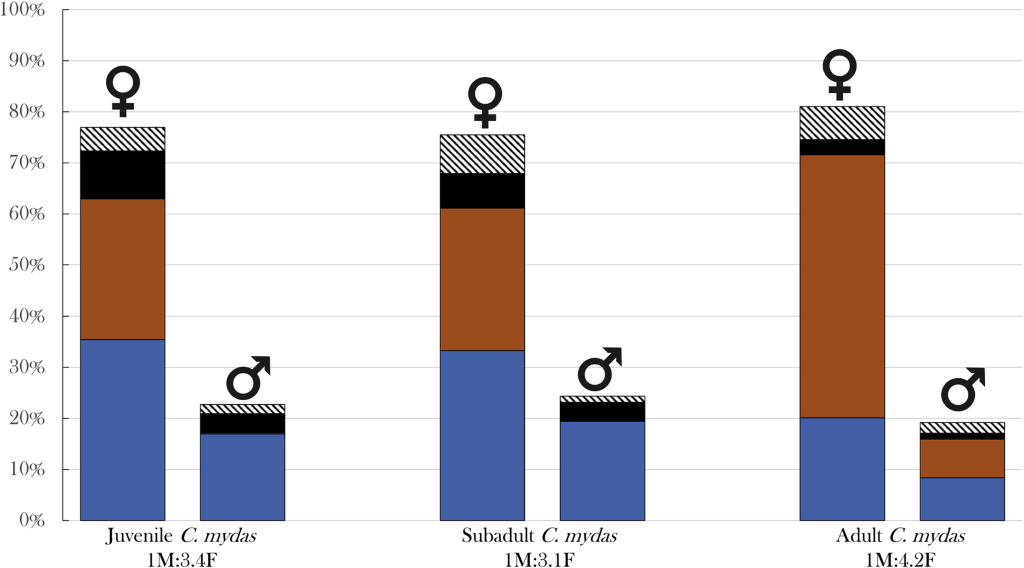
Figure 1. Relative proportions of male and female green sea turtles (Chelonia mydas) at a northern Great Barrier Reef foraging ground, categorized by life stage (juvenile, subadult and adult) and nesting-beach origin. The brown sections represent turtles originating from the northern Great Barrier Reef, blue represent turtles from the southern Great Barrier Reef and Coral Sea. Black sections represent turtles from other nesting populations, and black-and-white striped sections represent turtles whose nesting origins could not be identified (Jensen et al. 2018).
With global mean temperatures expected to increase by 1.0 °C to 3.7 °C until 2100, the population of females could significantly increase and may lead to mate-finding difficulties, reproduction failure, and potential population declines (Blechschmidt et al. 2020). While it is true that female-biased populations are not necessarily harmful for population growth, extreme imbalances could eventually threaten reproduction. Male turtles can mate more frequently than females, meaning fewer males can still support reproduction. However, continued climate warming could eventually produce too few males to sustain populations (Blechschmidt et al. 2020).
Ultimately, as global temperatures continue to rise, it is important to remember that climate change affects more than just humans. Protecting nesting habitats, limiting further climate warming, and continuing research into TSD are important steps towards maintaining healthy sea turtle populations and ensuring their survival.
References
Blechschmidt, Jana, Meike J. Wittmann, and Chantal Blüml. 2020. “Climate Change and Green Sea Turtle Sex Ratio—Preventing Possible Extinction.” Genes 11 (5): 588. https://doi.org/10.3390/genes11050588.
Ge, Chutian, Jian Ye, Ceri Weber, et al. 2018. “The Histone Demethylase KDM6B Regulates Temperature-Dependent Sex Determination in a Turtle Species.” Science (New York, N.Y.) 360 (6389): 645–48. https://doi.org/10.1126/science.aap8328.
Jensen, Michael P., Camryn D. Allen, Tomoharu Eguchi, et al. 2018. “Environmental Warming and Feminization of One of the Largest Sea Turtle Populations in the World.” Current Biology 28 (1): 154-159.e4. https://doi.org/10.1016/j.cub.2017.11.057.
Pieau, C., M. Dorizzi, and N. Richard-Mercier. 2001. “Temperature-Dependent Sex Determination and Gonadal Differentiation in Reptiles.” EXS, no. 91: 117–41. https://doi.org/10.1007/978-3-0348-7781-7_7.
Weber, Ceri, Yingjie Zhou, Jong Gwan Lee, et al. 2020. “Temperature-Dependent Sex Determination Is Mediated by pSTAT3 Repression of Kdm6b.” Science (New York, N.Y.) 368 (6488): 303–6. https://doi.org/10.1126/science.aaz4165.
Woolgar, Lorian, Sabrina Trocini, and Nicola Mitchell. 2013. “Key Parameters Describing Temperature-Dependent Sex Determination in the Southernmost Population of Loggerhead Sea Turtles.” Journal of Experimental Marine Biology and Ecology 449 (November): 77–84. https://doi.org/10.1016/j.jembe.2013.09.001.

Leave a Reply
You must be logged in to post a comment.