Somewhere, a man is boasting about his 3000-calorie diet while presumably ordering a bowl of lettuce for the woman he’s on a date with. His assumption is that women require fewer calories than men, so a salad will do. However, the truth is more complicated than that.
On average, women do have lower daily energy requirements. This is demonstrated by the Mifflin-St Jeor equation, a standard for estimating adult basal metabolic rate (BMR). It uses the same terms for weight, height and age, but subtracts 161 kcal per day for women and adds 5 kcal per day for men (Mifflin et al. 1990).
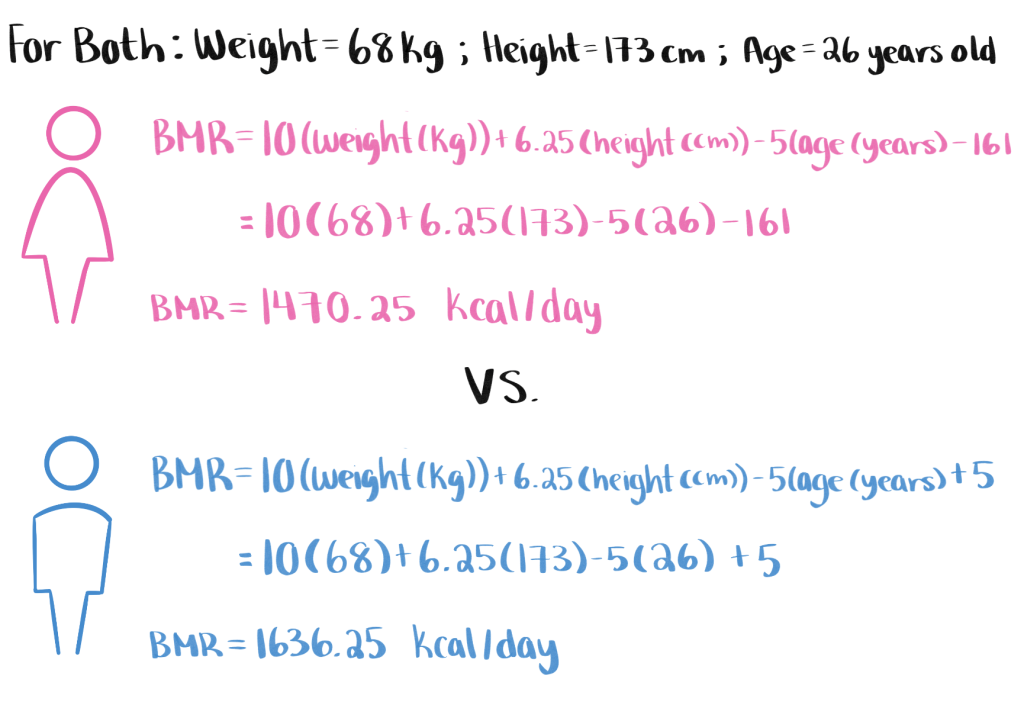
Figure 1. The difference in caloric needs for a man and woman of the same height (173 cm) and weight (68 kg) as calculated by the Mifflin-St Jeor equation (Mifflin et al. 1990). The man has a basil metabolic rate of 166 kcal more than the woman.
It is important to note that the Mifflin-St Jeor equation is more like a line of best fit than an accurate measurement. This is because the caloric gap is attributed to body composition, not sex itself, since our tissues do not burn energy equally. Per kilogram, skeletal muscle tissue expends roughly 13 kcal/day and adipose (fat) tissue about 4.5 kcal/day (Wang et al. 2010). On average, men carry more muscle mass while woman carry proportionally more fat, hence why men tend to have higher BMRs (Wells 2007).
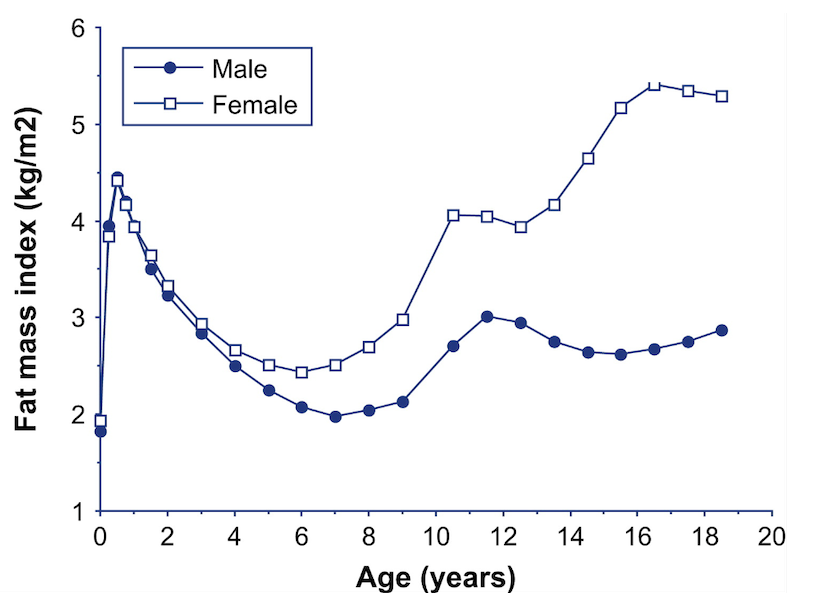
Figure 2. Male vs. female fat mass index as a function of time. This demonstrates how the average female has a higher fat mass index (after infancy) compared to the average male over the course of their life (Wells 2007).
With that said, this doesn’t mean that needing less fuel is the same as needing less nutrition. Salads are a good example of this, as they are not the ultimate diet food that people perceive it to be. Consider its chemistry: Iceberg lettuce is 95% water and contains under 1 gram of protein (FoodData Central 2022). Salad greens are often more than 90% water, and much of their carbohydrate is cellulose, which humans can’t digest. That leaves little protein, which maintains and repairs tissue; little fat, which supplies essential fatty acids, supports hormone production and aids vitamins A, D, E, and K absorption; and little digestible carbohydrates, which are the brain’s main fuel (Institute of Medicine 2005).
Low energy density can help people feel full on fewer calories, but only if the meal also contains enough protein and fat to keep you fed until the next one (Rolls et al. 2004). The irony is that salads often fail in both categories. A plain bowl of lettuce and other greens leaves you hungry within hours; add dressing, chicken, cheese and croutons to fix that, and a “light” salad can easily exceed 600 kcal (FoodData Central 2022).
This isn’t all to say that salad is “unhealthy”, it is simply not a main dish. Add beans, fish or eggs, along with some whole grains or potatoes, and the bowl becomes a meal (Canada’s Food Guide 2019).
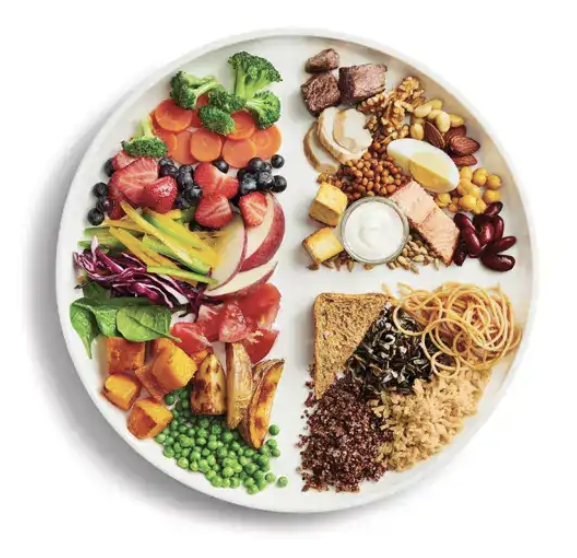
Figure 3. Government of Canada (2019) recommended food guide that depicts a plate of 50% vegetables and fruits, 25% whole grains (e.g., whole grain bread, brown rice, oatmeal, whole grain pasta), and 25% protein foods (e.g., beans, lentils, nuts, seeds, tofu).
Thus, women may need less fuel on average, but they still need quality nutrition. A smaller calorie budget is no excuse for a restrictive plate, nor is a mathematical equation that treats sex as a stand-in for body composition.
References
“Canada’s Food Guide.” Government of Canada , June 29, 2026. https://www.canada.ca/en/health-canada/services/food-guide/explore/snapshot.html.
“FoodData Central.” U.S. Department of Agriculture, October 28, 2022. https://fdc.nal.usda.gov/.
Institute of Medicine. 2005. Dietary Reference Intakes for Energy, Carbohydrate, Fiber, Fat, Fatty Acids, Cholesterol, Protein, and Amino Acids. Washington, DC: National Academies Press. https://doi.org/10.17226/10490.
Mifflin, MD, ST St Jeor, LA Hill, BJ Scott, SA Daugherty, and YO Koh. “A New Predictive Equation for Resting Energy Expenditure in Healthy Individuals.” The American Journal of Clinical Nutrition 51, no. 2 (1990): 241–47. https://doi.org/10.1093/ajcn/51.2.241.
Rolls, Barbara J., Julia A. Ello‐Martin, and Beth Carlton Tohill. “What Can Intervention Studies Tell Us about the Relationship between Fruit and Vegetable Consumption and Weight Management?” Nutrition Reviews (Oxford, UK) 62, no. 1 (2004): 1–17. https://doi.org/10.1111/j.1753-4887.2004.tb00001.x.
Wang, ZiMian, Zhiliang Ying, Anja Bosy‐Westphal, et al. “Evaluation of Specific Metabolic Rates of Major Organs and Tissues: Comparison Between Men and Women.” American Journal of Human Biology 23, no. 3 (2010): 333–38. https://doi.org/10.1002/ajhb.21137.
Wells, Jonathan C.K. “Sexual Dimorphism of Body Composition.” Best Practice & Research Clinical Endocrinology & Metabolism 21, no. 3 (2007): 415–30. https://doi.org/10.1016/j.beem.2007.04.007.


Leave a Reply
You must be logged in to post a comment.