Traditionally, wine quality is assessed through laboratory analyses and using human senses, such as taste, smell, and sight (Basalekou et al. 2023). While these techniques are time-tested and generally reliable, they aren’t perfect. Relying on human sensory perception is subjective, and can be easily affected by fatigue, differences in individuals, and bias. While laboratory testing is more accurate, it can be very slow, costly, and is not easy to perform continually. So, what if there was a way to analyze wine without relying on humans, in real time, and producing an objective chemical “fingerprint”?
This is where the concept of the electronic tongue comes in! An electronic tongue is a collection of chemical sensors that is designed to, in a simplified sense, imitate the part of the human taste system that gathers information (Podrażka et al. 2017). An electronic tongue works by exposing a sample to an array of chemical sensors. On contact, the molecules in the wine interact with the surface of the sensor, which causes measurable changes in some of the properties, such as resistance or electrical current. The system then combines all of the responses from the sensor in order to create a chemical “fingerprint” which can then be analysed (Figure 1) (Chen et al. 2020).
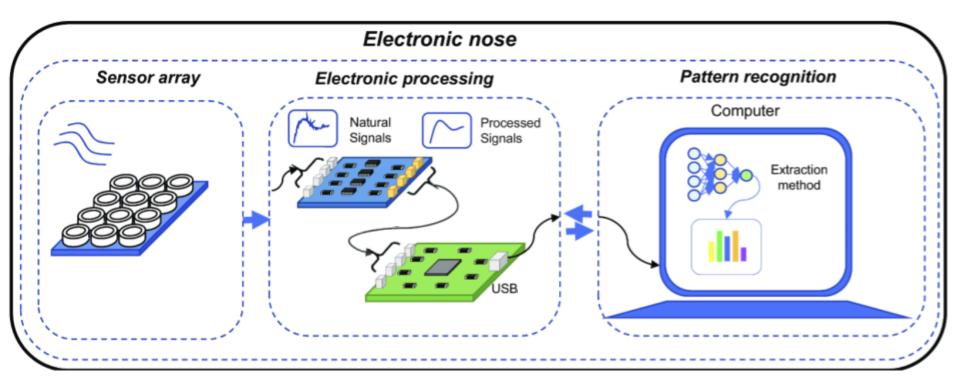
Figure 1. Schematic of how an electronic tongue works. Overarching is the the ‘electric nose’, which is device that mimics the human sense of smell. First, a sample of wine is exposed to an array of chemical sensors.These sensors interact with the chemicals in the wine, and produce measurable electrical signals. Signals then get collected and read to generate a unique “finger print” based on the chemical composition . Adapted from Martinez-Velasco JD et al. (2023).
Wine is particularly well suited for the electronic tongue due to its chemically complex nature. Every wine contains a combination of organic acids, polyphenols, sugars, tannins, and mineral ions, all contributing to its individual characteristics and flavour (Youssef El Rayess et al. 2024). Instead of identifying each individual chemical, electronic tongues detect patterns in combined responses to these compounds (Calvini and Pigani 2022). This makes them valuable in an industry where even the slightest compositional difference can change a whole product.
An interesting application for these tongues is the detection of wine fraud. Certain bottles of wine can sell for hundreds to thousands of dollars a bottle, which makes counterfeit wines quite a concern (IWC 2026). Electronic tongues can offer a solution here, with the ability to compare chemical compositions of wines to original samples. If the sensor detects something chemically different than an expected pattern, this could indicate mislabeling of the wine.
Electronic tongues additionally can provide quality control testing during the winemaking process. They could monitor chemical composition, specifically, levels of chemicals that relate to sweetness and bitterness, among other characteristics, of wine. In this application, they could aid winemakers in identifying variations in batches of wine, and adjusting accordingly, to maintain better consistency between batches.
Of course, these electronic tongues have limitations. Accuracy of the devices depends entirely on calibration, and their sensitivity and sensor responses may change over time (Ross 2021). In addition, while they can chemically analyse wine, electronic tongues cannot fully replicate the complex human sensory experience of drinking wine. All in all, electronic tongues are not here to replace human tasting, but they do propose an interesting way to combine chemical analysis with traditional sensory evaluation, which may guide the future of wine making.
References
Basalekou, Marianthi, Panagiotis Tataridis, Konstantinos Georgakis, and Christos Tsintonis. 2023. “Measuring Wine Quality and Typicity.” Beverages 9 (2): 41. https://doi.org/10.3390/beverages9020041.
Calvini, Rosalba, and Laura Pigani. 2022. “Toward the Development of Combined Artificial Sensing Systems for Food Quality Evaluation: A Review on the Application of Data Fusion of Electronic Noses, Electronic Tongues and Electronic Eyes.” Sensors (Basel, Switzerland) (Switzerland) 22 (2): 577. PubMed Central. https://doi.org/10.3390/s22020577.
Chen, Litong, Zihan Wang, Zhiqiang Wang, et al. 2025. “Application of an Electronic Tongue Combined With Meta-Learning for Rice Origin Detection.” Engineering Applications of Artificial Intelligence 156 (September): 111174. https://doi.org/10.1016/j.engappai.2025.111174.
IWC. 2026. “The Booming Business of Wine Fraud.” https://www.internationalwinechallenge.com/iwc-insight/wine-business/the-booming-business-of-wine-fraud.html.
Martinez-Velasco JD et al. 2023. Figure 1. Fundamental Stages of Operation of an Electronic Nose. March 27. https://pmc.ncbi.nlm.nih.gov/articles/PMC10844804/figure/f1/.
Podrażka, Marta, Ewa Bączyńska, Magdalena Kundys, Paulina Jeleń, and Emilia Witkowska Nery. 2017. “Electronic Tongue—a Tool for All Tastes?” Biosensors 8 (1): 3. https://doi.org/10.3390/bios8010003.
Ross, Carolyn. 2021. “Considerations of the Use of the Electronic Tongue in Sensory Science.” Current Opinion in Food Science 40 (August): 87–93. https://doi.org/10.1016/j.cofs.2021.01.011.
Youssef El Rayess, Nancy Nehme, Samar Azzi-Achkouty, and Sofi G Julien. 2024. “Wine Phenolic Compounds: Chemistry, Functionality and Health Benefits.” Antioxidants 13 (11): 1312–12. https://doi.org/10.3390/antiox13111312.


Leave a Reply
You must be logged in to post a comment.