The rules of preserving common crops should be simple and finite. Most people, when thinking about plant life, consider the basics: sunlight, soil quality, temperature, and sufficient water. But if you look closely in your fridge, you may find some of your produce, like garlic and onions, have sprouted! Did your fridge suddenly learn to farm?
Your fridge did not secretly pick up ancient farming arts: plants like garlic and onions interact with aspects of their storage environment, such as ambient temperature and moisture, leading to biochemical changes that cause sprouting. Garlic (Allium sativum L.) and onion (Allium cepa L.) are the most widely produced Alliums (Desta et al. 2022), affectionately known for their pungent smell and flavour (Ammarellou et al. 2022). These distinct features result from enzymatic production of volatile precursors (Teotia et al. 2025), a secondary metabolite. Over 1100 species exist in the Allium genus, each with diverse combinations of secondary metabolites. Their abundant secondary metabolite production enables a broad spectrum of biological activities that produce beneficial properties, such as antioxidant, anticancer, anti-diabetic, and antifungal properties, leading to many therapeutic and medicinal applications (Teotia et al. 2025). The bulbous trait of Alliums influences them to sprout weeks after harvest, following 3 physiological stages post-harvest (Figure 1).
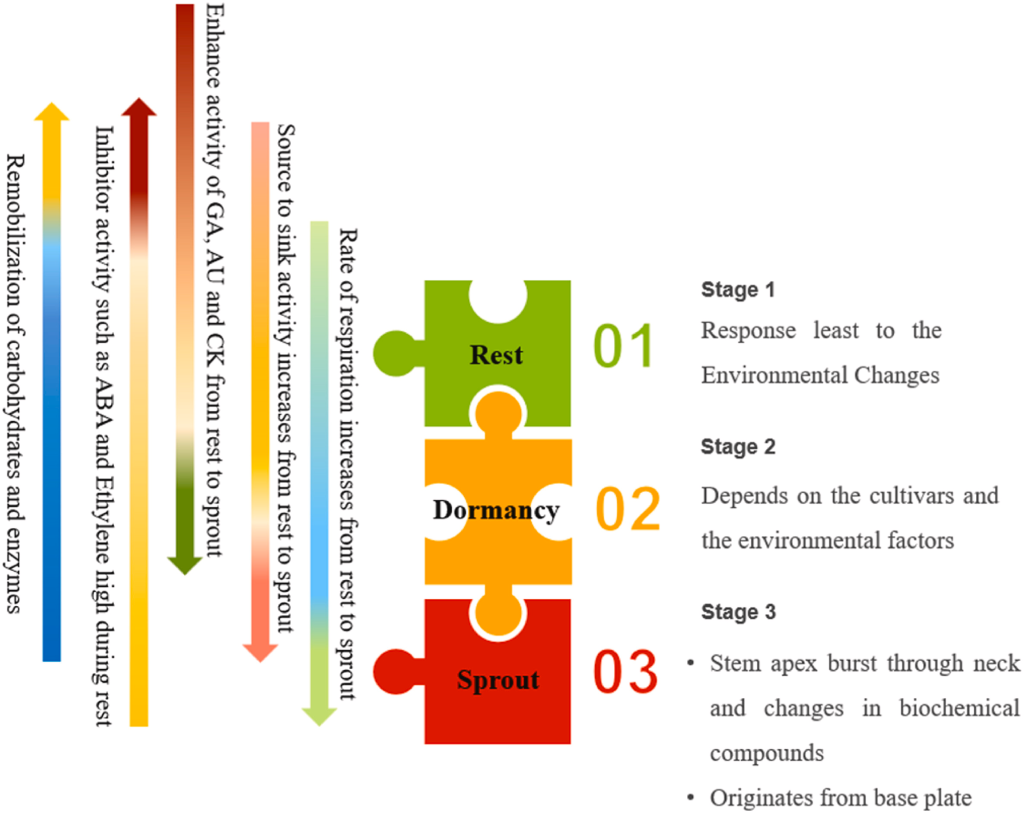
Garlic and onions share a resting period of roughly 4-6 weeks (Desta et al. 2022), where they barely respond to environmental change (Samota et al. 2024). Once this period concludes, they are highly receptive to environmental shifts, and endogenous hormone levels begin to fluctuate as the plant enters dormancy. Cultivar and environmental factors determine dormancy length (Samota et al. 2024); bulbous plants sprout quickest when stored at 5-10 °C (Desta et al. 2022). Enzymatic activity remains low during dormancy, but it primes the bulb for dormancy breakage and sprouting (Samota et al. 2024).
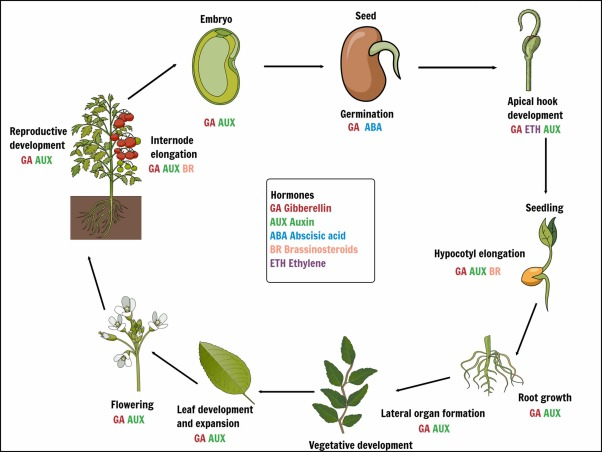
Sprouting proceeds after dormancy breakage, marked by physical changes such as visible stem emergence, and requires nutrients from the plant itself. Gibberellins (GA) are a key class of phytohormones responsible for dormancy breakage, as they trigger an influx of calcium into the cytosol and activate the calcium signalling pathway. The calcium signalling pathway is crucial for seed germination and reproductive development because they control cellular processes that occur before, during, and after dormancy breakage (Samota et al. 2024). GAs also coordinate major biosynthetic plant pathways (Figure 2), contributing to plant source-sink relations.
The source is where carbohydrates are produced, and the sink is where carbohydrates are consumed. In onions, hormones reallocate metabolites and water to the base plate (sink), where sprouts occur, fostering new cell development and elongation (Samota et al. 2025). Source-sink dynamics influence crop yield and nutritional quality, which are economic limitations in agriculture, along with sprouting during storage (Smith et al. 2018).
Plant development is a unique and complex web of interactions that continues to expand with each added study. Even without traditional plant-friendly growing environments, plants have adaptations that allow them to thrive. With a greater understanding of plant hormones and interactions, we can use this knowledge to optimize crop yield, either through environmental interventions or more “artificial” measures, such as genetic editing. And maybe the freezer will be your new best friend.
References
Ammarellou, Ali, Ali R. Yousefi, Moslem Heydari, Daniela Ubeti, and Andrea Mastinu. 2022. “Biochemical and Botanical Aspects of Allium sativum L. Sowing.” BioTech 11(2): 16. https://doi.org/10.3390/biotech11020016
Desta, Bizuayehu, Tena, Netsanet, and Amare, Getachew. 2022. “Regulation of Garlic Bulb Dormancy.” Asian Journal of Research and Review in Agriculture 4(1): 1-5. https://www.researchgate.net/publication/358285571_Regulation_of_Garlic_Bulb_Dormancy
Rahman, Shafeeq, Shabanamol S. Beevi, Fathimath Nishana, et al. 2026. “Gibberellin homeostasis and signaling in plant growth, stress adaptation, and crop improvement.” Current Plant Biology 49:100654. https://doi.org/10.1016/j.cpb.2026.100654.
Samota, Mahesh K., Shilpa S. Selvan, Poonam Choudhary, Amit Nath, Arvind Ahlawat, and Varinda. 2024. “Mechanisms behind the post harvest sprouting of onions (allium cepa) and future implications of prevention strategies.” Journal of Store Products Research 111: 102518.https://doi.org/10.1016/j.jspr.2024.102518.
Smith, Millicent R., Idupulapati M. Rao, and Andrew Merchant. 2018. “Source-Sink Relationships in Crop Plants and Their Influence on Yield Development and Nutritional Quality.” Frontiers in Plant Science: Crop and Product Physiology 9:1889. https://doi.org/10.3389/fpls.2018.01889
Teotia, Deepti, Aman Agrawal, Vivek Kumar, et al. 2025. “Ethnobotany, phytochemistry and biological activities of the genus Allium L.” Environment Conservation Journal 26(3): 2278-512. https://doi.org/10.36953/ECJ.32103049


Leave a Reply
You must be logged in to post a comment.