When a dentist is faced with plaques, the knee-jolt response is to floss more frequently; unfortunately, there is no dental floss to clean out the folds of the brain. Alzheimer’s Disease (AD) is a proteinopathic disease, meaning it is characterized by the accumulation of misfolded proteins in the brain, such as amyloid-β, which forms microscopic plaques (Rukmangadachar and Bollu 2025). The neurotoxic Aβ peptide is produced within neurons and then secreted to the extracellular area, with amino acids 25-35 (Aβ25–35) being the primary neurotoxic domain (Chen et al. 2017; D’Ezio et al. 2021; Naderi et al. 2023). Aβ25–35 will also embed itself in the hydrophobic core of the phospholipid bilayer, as seen in Figure 1, where it disrupts homeostasis (Gastaldo et al. 2020).
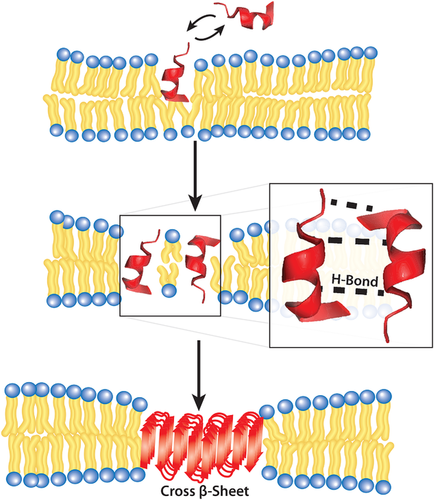
Due to size differences between Aβ25–35‘s hydrophobic domain and membrane width, there is a hydrophobic mismatch which causes membrane deformation (Khondker et al. 2018). This deformation protects hydrophobic domains from exposure, while increasing thermodynamic favourability of Aβ25–35 aggregation. In a 2D model, when a large aggregation and several small aggregations have the same area and shape, the large aggregation will always have a smaller circumference. As such, membrane deformation favours one large Aβ25–35 aggregation since it is more energy efficient, as seen in Equation 1.
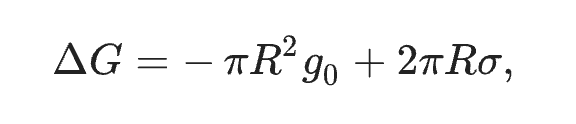
A stiffer and thicker membrane will have a higher line tension; a thicker, stiffer membrane requires more energy to deform, and thus will force a large aggregation, while a thin, flexible membrane has more leeway. Certain compounds, such as acetylsalicylic acid (ASA) and curcumin can alter membranic properties, altering σ and the formation of Aβ25–35 aggregations (Khondker et al. 2018). ASA increases σ, making it more favourable for a larger radius, and, thus, a larger aggregation, since that leads to a negative Gibbs Free Energy (spontaneous reaction) (Khondker et al. 2018). Curcumin, however, decreases σ, making it less favourable to form and maintain an aggregation (Khondker et al. 2018). Unfortunately, curcumin has a low bioavailability, which means very little of it makes it into the bloodstream to be delivered to the brain (Stępnik 2026). A good way to increase bioavailability is by increasing the surface area of a molecule, such as through delivery systems such as Multi-Walled Carbon Nanotubes (MWCNTs) (Nabitabar et al. 2024). This method was proven successful through Pawar and Suvarna, who designed curcumin-loaded MWCNTs which can be delivered nasally (2025).
These sorts of studies provide hope for the future of proteinopathy treatment. From Alzheimer’s, to Parkinson’s, to prion diseases like Creutzfeldt-Jakob disease, millions people across the world suffer from these protein-misfolding diseases. Furthering the knowledge about these diseases—and novel ways to treat them—is the best path towards a cure; after all, just as all roads lead to Rome, there are many paths to a solution in science.
References
Chen, Guo-fang, Ting-hai Xu, Yan Yan, et al. “Amyloid Beta: Structure, Biology and Structure-Based Therapeutic Development.” Acta Pharmacologica Sinica 38, no. 9 (2017): 1205–35. https://doi.org/10.1038/aps.2017.28.
D’Ezio, Veronica, Marco Colasanti, and Tiziana Persichini. “Amyloid-β 25-35 Induces Neurotoxicity through the Up-Regulation of Astrocytic System Xc−.” Antioxidants 10, no. 11 (2021): 1685. https://doi.org/10.3390/antiox10111685.
Gastaldo, Isabella P., Sebastian Himbert, Udbhav Ram, and Maikel C. Rheinstädter. “The Effects of Resveratrol, Caffeine, β-Carotene, and Epigallocatechin Gallate (EGCG) on Amyloid-Β25–35 Aggregation in Synthetic Brain Membranes.” Molecular Nutrition & Food Research 64, no. 22 (2020): 2000632. https://doi.org/10.1002/mnfr.202000632.
Khondker, Adree, Richard J. Alsop, Sebastian Himbert, et al. “Membrane-Modulating Drugs Can Affect the Size of Amyloid-Β25–35 Aggregates in Anionic Membranes.” Scientific Reports 8, no. 1 (2018): 12367. https://doi.org/10.1038/s41598-018-30431-8.
Nabitabar, Masoumeh, Maryam Shaterian, Hossein Danafar, and Morteza Enhessari. “Multi-Wall Carbon Nanotube Surface-Based Functional Nanoparticles for Stimuli-Responsive Dual Pharmaceutical Compound Delivery.” Scientific Reports 14, no. 1 (2024): 12073. https://doi.org/10.1038/s41598-024-59745-6.
Naderi, Soudabeh, Fariba Khodagholi, Hamid Gholami Pourbadie, et al. “Role of Amyloid Beta (25-35) Neurotoxicity in the Ferroptosis and Necroptosis as Modalities of Regulated Cell Death in Alzheimer’s Disease.” Neurotoxicology 94 (January 2023): 71–86. https://doi.org/10.1016/j.neuro.2022.11.003.
Pawar, Shrutee, and Vasanti Suvarna. “Curcumin-Loaded PEG-Functionalized Carbon Nanotubes: A Novel Strategy for Alzheimer’s Management.” Therapeutic Delivery 16, no. 8 (2025): 755–63. https://doi.org/10.1080/20415990.2025.2513213.
Rukmangadachar, Lokesh A., and Pradeep C. Bollu. “Amyloid Beta Peptide.” In StatPearls. StatPearls Publishing, 2025. http://www.ncbi.nlm.nih.gov/books/NBK459119/.
Stępnik, Katarzyna. “Curcumin in Alzheimer’s Disease: From Mechanistic Insights to Translational Challenges and Emerging Curcuminoid Strategies.” International Journal of Molecular Sciences 27, no. 13 (2026): 5754. https://doi.org/10.3390/ijms27135754.


Leave a Reply
You must be logged in to post a comment.