There are many different theories that describe the placebo effect, but in general, the placebo phenomenon uses a subject’s past associations with certain stimuli like smell, touch and sound to shape a patient’s expectations about the effects of an administered treatment (Vase and Wartolowska 2019). Placebos have been most often used as a control group for clinical studies, however there is interesting potential in using this psychological tactic to treat certain conditions in a non-invasive manner (Vase et al. 2002). The efficacy of the tactic varies based on the subject’s previous experiences and the presentation of the treatment. This efficacy measure is known as the placebo response, and it records the change in pain of a patient before and after receiving the placebo treatment (Vase and Wartolowska 2019). Within the sphere of placebo response, the placebo effect refers to the psychobiological factors affecting the patients response (Benedetti and Shaibani 2025).
It has been found that response is highly affected by the verbal explanation that accompanies the placebo administration and prior experience with the treatment the patients are being deceived about. As described by Vase and Wartolowska (2019), patients told that they may be receiving a placebo or a real treatment had a lower placebo response than those told that they are receiving an actual treatment.
This observation relates to the three main methods of placebo delivery: Natural history, where the subjects are told nothing about the treatment they are receiving, Double blind administration, where the participants are told they could be receiving a placebo or an actual treatment, and finally deceptive administration where the patient is fully misled on the contents of their treatment (Pollo et al. 2001).
From a biological point of view, brain imaging shows that the anticipation of a placebo, namely the double-blind administration, activates the lateral prefrontal cortex, which is associated with task selection and decision-making processes. Conversely, pain relief after deceptive placebo administration shows decreased activity in pain processing areas of the brain (Vase and Wartolowska 2019).
This imaging has been substantiated through many clinical trials, including a study by Pollo et al. (2001). Their study recorded doses of pain medication requested by patients who were unknowingly given a saline injection instead of buprenorphine, an opioid painkiller. The trial had three groups separating into the three deliverance methods mentioned above. All three groups originally received the pain killer and were then switched to an alternation of placebo and buprenorphine without their knowledge after three days.
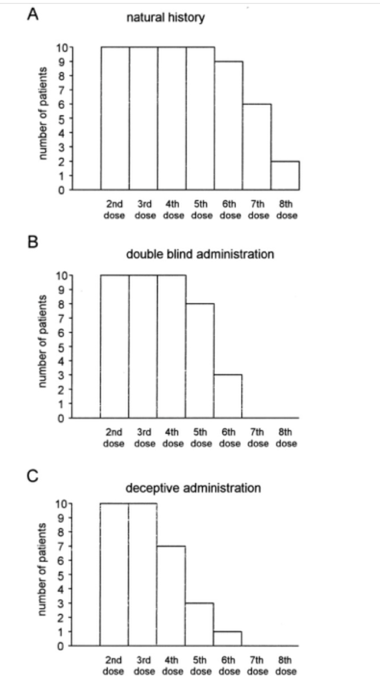
Figure 1: Received doses of buprenorphine by patients in each trial group after requesting additional pain medication over a three day period. In the natural history method, patients were told they were originally receiving a rehydrating solution and requested the most doses of buprenorphine throughout the testing period. The double-blind group was told they may be receiving a pain killer or placebo, and averaged fewer doses than the natural history group. Lastly, the deceptive administration group was told that they were receiving a strong pain killer and requested the fewest number of doses during the trial period (Pollo et al. 2001).
From these results, it Pollo et al. (2001) concluded that deceptive verbal accompaniment to placebo administration is often the most successful in terms of placebo response. This result was taken from the association that fewer requests for buprenorphine correlates to a stronger placebo response. This knowledge is helpful when looking at clinical applications of the placebo phenomenon. Currently, the main clinical applications are highly centred around analgesic responses, however there is also evidence that applying using the placebo effect through mock surgical procedures can yield high placebo response (Vase et al. 2002). This presents innovative gateways into research on potential non-invasive treatments in lieu of some current clinical treatments.
References
Benedetti, Fabrizio, and Aziz Shaibani. 2025. ‘Chapter 1 – A Brief History of Placebo’. In Placebo Effects in Neurology, edited by Fabrizio Benedetti and Aziz Shaibani, vol. 213. Handbook of Clinical Neurology. Elsevier. https://doi.org/10.1016/B978-0-443-29884-4.00009-1.
Pollo, Antonella, Martina Amanzio, Anna Arslanian, Caterina Casadio, Giuliano Maggi, and Fabrizio Benedetti. 2001. ‘Response Expectancies in Placebo Analgesia and Their Clinical Relevance’. Pain 93 (1): 77–84. https://doi.org/10.1016/S0304-3959(01)00296-2.
Vase, Lene, Joseph L. Riley, and Donald D. Price. 2002. ‘A Comparison of Placebo Effects in Clinical Analgesic Trials versus Studies of Placebo Analgesia’. Pain 99 (3): 443–52. https://doi.org/10.1016/S0304-3959(02)00205-1.
Vase, Lene, and Karolina Wartolowska. 2019. ‘Pain, Placebo, and Test of Treatment Efficacy: A Narrative Review’. British Journal of Anaesthesia 123 (2): e254–62. https://doi.org/10.1016/j.bja.2019.01.040.
Comments
4 Responses to “A Medical Treatment That Does Nothing”
Hi iSci!
I choose to write my blog post about the psychological and biological backings of the placebo effect, and its applications in the medical field. I was inspired to write about this when we learned about classical conditioning in psych, and I wanted to look into other weird associations our brain makes. I hope you enjoy!
Hi Eshal,
Cool post! It is interesting how effective the placebo effect can be. A few small tweaks:
– In the first paragraph, stimuluses should instead be stimuli
-In the fourth paragraph first sentence, it may be a good idea to cite where you got that information from, even if it is a preexisting source. It seems like it is new information about the mechanism of the placebo effect and should be cited as a result.
-In the first sentence of your last paragraph, you say “From these results, it can be concluded that deceptive verbal accompaniment to placebo administration is often the most successful in terms of placebo response.”. I believe that it might be better to take a less decisive conclusion here as while the research seems promising, more research still needs to be done.
– I like your connection to Classicial Conditioning from psych!
Overall this was a really interesting post, and all of my feedback is for minor things only. You’ve got a good post on your hands!
Hi Eshal,
I love the topic and it was a really interesting read!
– In your first sentence you mention it misleads their beleifs which I completly understand but I think it would be beneficial to rewrite it into something like “shapes a patient’s expectations about a treatment” as it sounds like placebo is just deception based on my perspective.
-After figure caption it was a bit confusing to understand it all together so i suggest maybe a sentence to put everything together like “fewer buprenorphine requests means stronger placebo response” or something to tie everything together.
-buprenorphine does not need to be capitilized in the middle of a sentence
– stimuluses can be: “stimuli”
– Asad
Hi Eshal!
I really liked how you tied the placebo effect back to what we learned about classical conditioning in psych, and walking through Pollo et al.’s three groups makes Figure 1 easy to follow. Here are some suggestions for improvements:
– P1S4 & P2S2: Two small grammar fixes: “it is records the change in pain” should be “it records the change in pain,” and “had a lower placebo response to those told” should be “had a lower placebo response than those told.”
– P3S2-S4: These sentences are fragments (“Natural history, where the subjects are told nothing…”). You could join them into one sentence after a colon, e.g. “…three main methods of placebo delivery: natural history, where…, double-blind administration, where…, and deceptive administration, where…”. Also, “fully mislead” should be “fully misled,” and “delivery” reads more naturally than “deliverance.”
– P5S2: “under the placebo of actually being a saline basal injection instead of buprenorphine- a pain treatment opioid” is a bit hard to follow. Maybe “patients who were secretly given a saline injection instead of buprenorphine, an opioid painkiller.” The comma also fixes the stray hyphen.
– Figure 1 caption: “the fewest number of does” should be “the fewest doses.” It would also help to tell the reader what the axes show and what time period the doses were counted over, so the figure stands on its own.
I learned a lot about how much the wording around a treatment can change how well it works. Can’t wait to see the final copy!
– Kurtis