Every gym bros’ dream is to beat their dada in an arm wrestling match, but here’s what he didn’t tell you. He cheated. Big time. For most of the past century, it has been assumed that the genome is the father’s sole contribution to his offspring’s physical attributes. The story changed in 2010. Researchers fed male rats a high-fat diet, bred them, and found that their daughters developed impaired insulin secretion and glucose tolerance despite never eating the diet themselves (Ng et al. 2010). The fathers, as it turned out, gave a little more than just his genes.
The clearest evidence of what the fathers were giving the offspring appeared last year, where Yin et al. put male mice through a training regiment to improve physical attributes (metabolism, muscular and cardiovascular endurance, and overall functional health) then bred them with untrained females and tested the pups. The offspring of the trained fathers both ran longer, and managed glucose more efficiently than the offspring of untrained fathers without ever training themselves (Yin et al. 2025). Since there are dozens of cellular factors that could influence those two results, they ran two more detailed tests. First, they used mice that overexpress PCG- 1α – a coactivator that controls mitochondria biogenesis and fatty-acid metabolism– and tested their offspring. The fathers with this change passed down their endurance benefits to their pups, though the gene was not inherited. Second, they pulled small RNA molecules from the sperm of trained fathers, injected them into ordinary fertilized eggs, and the pups that grew from those eggs showed the same benefits their fathers had earned (Figure 1.). A different lab also achieved a similar result, but through the mechanism of DNA methylation (controlling expression of genes) instead of RNA (Costa-Junior et. al 2022).
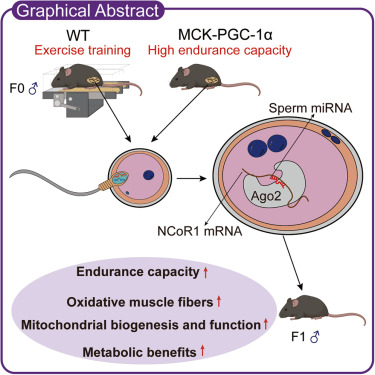
Then what’s so important in the sperm? Sperm contains not just methylated DNA, but also sperm-borne RNA’s, and doing exercise changes what microRNAs are part of the sperm package. MicroRNAs enter the embryo during fertilization and suppress NCoR1, a corepressor that silences the action of PCG- 1α, influencing the embryonic transcriptional focus towards mitochondrial production. The new pup then is born with improved oxidative metabolism and energy usage efficiency (Yin et al. 2025).
Wait, does this mean Lamarck is right? Not quite. The sperm was already inside the training father, so exposure to different microRNAs was an environmental effect on the zygote, and not the inheritance of an acquired trait. These added traits are not heritable, as mammals remove most epigenetic markers from the genome twice, in the germline, and during fertilization (Horsthemke 2018). In an already fertilized sperm cell, adding new RNA molecules dodges both removal processes directly. But results still conflict, with one study showing that paternal exercise pushed offspring toward lower energy expenditure and higher obesity risk (Murashov et al. 2016).
Altogether, paternal exercise can reform what RNA exists in the sperm, and that RNA change, can influence the endurance, and metabolism of mice. The same microRNAs appear in the sperm of well-trained human males. Though these studies were all only conducted in mice, the implications are that the same results could be seen in humans. So if you still can’t beat your dad, here’s a new excuse: he stopped training right before you were born and now you’re destined to lose to him forever :(.
References
Costa-Júnior, J. M., Ferreira, S. M., Kurauti, M. A., Bernstein, D. L., Ruano, E. G., Kameswaran, V., Schug, J., Freitas-Dias, R., Zoppi, C. C., Boschero, A. C., Oliveira, C. A. M. de, Santos, G. J., Carneiro, E. M., & Kaestner, K. H. (2021). Paternal exercise improves the metabolic health of offspring via epigenetic modulation of the germline. International Journal of Molecular Sciences, 23(1), 1. https://doi.org/10.3390/ijms23010001
Horsthemke, B. (2018). A critical view on transgenerational epigenetic inheritance in humans. Nature Communications, 9(1). https://doi.org/10.1038/s41467-018-05445-5
Murashov, A. K., Pak, E. S., Koury, M., Ajmera, A., Maneesh Jeyakumar, Parker, M. O., Williams, O., Ding, J., Walters, D. M., & P. Darrell Neufer. (2016). Paternal long‐term exercise programs offspring for low energy expenditure and increased risk for obesity in mice. 30(2), 775–784. https://doi.org/10.1096/fj.15-274274
Ng, S.-F., Lin, R. C. Y., Laybutt, D. R., Barres, R., Owens, J. A., & Morris, M. J. (2010). Chronic high-fat diet in fathers programs β-cell dysfunction in female rat offspring. Nature, 467(7318), 963–966. https://doi.org/10.1038/nature09491
Yin, X., Anwar, A., Yan, L., Yu, R., Luo, Y., Shi, L., Li, B., Chen, J., Liang, G., Chen, Y., Tang, J., Liang, J., Kan, Y., Zhang, Z., Zhou, X., Ma, J., Ji, C., Wang, Y., Zhang, Q., … Chen, X. (2025). Paternal exercise confers endurance capacity to offspring through sperm microRNAs. Cell Metabolism. https://doi.org/10.1016/j.cmet.2025.09.003
Comments
13 Responses to “Thanks Dad: Parental Epigenetics”
Hello Isci!
This post is inspired by my interest in sports, as well as genetics and epigenetics back from first year!
I look forward to your suggestions!
Hey Nathaniel!
This is an interesting topic to study, and I like your use of humour throughout the blog.
A few things I’d like to point out:
– I believe you are over the world count. Ideally your blog should be around 500 words long, but is currently ~590 words. Cut out some fluff and you should be good.
– I think some of the wording you used in some parts is a bit unclear or could be defined better. An example of this is in “and used glucose better than the offspring of untrained fathers without ever training themselves (Yin et al. 2025).”. I feel as though “using glucose better” is too vague and could be replaced with “using glucose more efficiently” if you don’t have the word count to go into extreme detail.
– I think there are a couple of sentences that could be cut out as they do not contain critical information. An example of this is “This same NCoR1 mechanism was also found to carry a metabolic disorder from father to offspring (Chen et al. 2015).”. This sentence is nice to have, but is slightly redundant as the metabolic connection had already been described earlier.
– Lastly, I think some general polishing would be good to clear up a few grammatical errors or awkward sentences. Read your blog out loud to yourself and edit any parts that are awkward to read out loud.
Overall good start!
Hello Nima,
I have made changes according to all of your suggestions, thank you for the helpful feedback!
Nathaniel Wang
Hi Nathaniel,
I enjoyed the connection you made between historical evolutionary theory, including how you mentioned how physical strength increases from childhood to adulthood, this does not prove Lamarck’s Theory of evolution.
Some suggestions include:
1. Review some run-on sentence for example the following sentence within paragraph one: “The story changed in 2010 when researchers tested the impact of a father’s diet on his daughters in a murine model and found that daughters of a father that was fed a high fat diet developed insulin secretion and glucose tolerance issues (Ng et al. 2010).” This sentence could be broken up into two separate sentences, to better communicate your point in a clearer manner.
2. Include or mention the main topics and points of your blog post within the title, to inform the reader of topic before reading the blog post.
3. I would recommend adding (see Figure 1) to the end of your second paragraph, to make it more clear to the reader, when they should refer to the diagram
Overall, great work!
– Ava
Hello Ava,
Thank you for all of your feedback, I have made edits according to all of your suggestions.
Nathaniel Wang
Hi Nathaniel!
I really enjoyed reading your blog, especially the humour throughout it. The example in the beginning about the arm wrestling was really intriguing and made me want to keep reading.
Here are some suggestions:
1. The use of scientific terms throughout the blog is really confusing. Things like PCG-1a and NCoR1. Maybe introduce them first and explain more so people can understand their importance without needing a PHD.
2. Break down some of your sentences, they have a lot of information packed into them or need more explanation. Putting them into multiple sentences would make your blog post much easier to follow. Some examples of which sentences: “ The offspring of the trained fathers both ran longer, and used glucose better than the offspring of untrained fathers without ever training themselves (Yin et al. 2025).” , “ Second, they took small RNA molecules from the trained father and injected them into regular fertilized eggs and got the same benefits that the father had in the new pups.”
3. I would maybe clarify the part where you connect the study from mice to humans. When you mentioned that the same result could appear in humans, you could word it more cautiously since it has not been confirmed on the effects it has on humans.
Overall, good work!
-Asyah
Hello Asyah,
I define each of the acronyms in the text and do not have word count to further define the terms inside their definitions (i.e. coactivator, corepressor). I have made changes according to the rest of your suggestions. Thanks for the feedback!
Nathaniel Wang
Hi Nathaniel,
This is a really interesting and informative blog post! A couple suggestions to keep in mind while editing:
– Make sure to add a citation within your Figure 1 caption to show what source it is from. Also, ensure to reference your figure within the text before it is shown (i.e. add (Figure 1) somewhere in the paragraph before the figure is shown).
– While I appreciate the humor of your opening paragraph, make sure it is also grammatically correct. Try: Every dedicated gym-goer dreams of beating their Dad in an arm wrestling match. But, here is what he didn’t tell you: he’s been cheating with his genetics.
– P2S1 is a very long sentence and it gets a little confusing as a result. Try splitting it into two sentences to increase clarity.
Happy editing!
Maegan
Hello Maegan,
Thank you for the feedback, I have made changes according to your suggestions!
Nathaniel Wang
Hi Nathaniel,
This is an interesting topic – I didn’t realize the effect that a dad’s fitness training could have on his offspring! Here are a few suggestions for your edits:
P1S5: Consider rephrasing the sentence for clarity. For example, “For most of the past century, it has been assumed that the genome is the father’s sole contribution to his offspring’s physical attributes.”
P1S6: Consider replacing the term “murine” as I don’t think this is common knowledge.
P1S7: Make sure to stick to either singular or plural (ex. “The fathers … their” OR “The father … his”).
P5S2: This sentence seems incomplete because it doesn’t contain a verb.
Great blog post and good luck with your edits!
Kristen
Hi Kristen,
Thank you for your helpful suggestions, I have made changes according to all of your suggestions!
Nathaniel Wang
Hi Nathaniel!
I really enjoyed reading your blog, especially the way you connected paternal exercise to epigenetic changes in sperm. I thought the progression from paternal exercise, to changes in sperm RNA, to effects on the offspring was interesting and easy to follow. Here are a few suggestions:
– In paragraph 2 I think it would be helpful to clarify what you mean when you say that the fathers “passed down their endurance benefits to their pups, though the gene was not inherited.” Since the offspring of the PCG-1α overexpressing fathers did not inherit the genetic change itself, it may be useful to explain more specifically what evidence showed that the phenotype was being transmitted through a non-genetic mechanism.
– In paragraph 2 when you introduce the experiment where small RNA molecules were injected into fertilized eggs, I think it would be useful to briefly explain why this experiment supports the idea that sperm RNA is contributing to the observed phenotype.
– In paragraph 3 the sentence about microRNAs entering the embryo and suppressing NCoR1 introduces several steps in the proposed mechanism at once. It might help to clarify the causal sequence here: exercise changes the sperm microRNA profile, these microRNAs are delivered to the embryo, and they then affect NCoR1 and PCG-1α activity.
– In paragraph 2, I would consider explaining what you mean by “dodges both removal processes directly.” Since this is an important part of your argument for why sperm-delivered RNA could have an effect despite epigenetic reprogramming, a little clarification of what is being “removed” and when could make this section easier to understand.
– In paragraph six, I think the transition from the mouse studies to the statement about human males could use a little more context if you have the word count. You mention that similar microRNAs are found in the sperm of well-trained human males, but it is not immediately clear whether this means the same microRNAs, the same changes in abundance, or simply related patterns have been observed.
Overall, I thought this was a really interesting topic, and I liked how you connected the molecular mechanism to the larger question of whether experiences can influence offspring. A few additional clarifications around the experimental evidence and proposed mechanism would make the scientific argument even stronger!
Happy editing!
Samara
Hello Samara,
Thank you for your helpful suggestions! I added as many as I could but am tight on word count to add more clarifications and mechanism descriptions.
Nathaniel Wang