Radiation therapy is an important component of cancer treatment, with about 50% of all cancer patients requiring it at some point through the course of their illness (Basker et al. 2012). Despite being critical in current cancer treatment schemes, it carries risks due to its tendency to damage nearby cells while destroying cancer cells. This means that the elimination of cancerous tissue is limited by the dose of radiation that the patient can receive without the risk of severe radiation-induced effects (Chow and Ruda 2023). Because of this limitation, a significant proportion of research in radiotherapy is aimed towards minimizing damage to nearby healthy tissue during the targeting of cancer cells (Majeed and Gupta 2023).
Flash Radiotherapy (FLASH-RT) is an emerging technology that could overcome the limitations of conventional radiotherapy by delivering doses of radiation several orders of magnitude higher than that of conventional radiotherapy, at ultrafast speeds typically within a fraction of a second (Chow and Ruda 2023). The term FLASH was coined by a 2014 research paper by Fauvadon et al. that defined FLASH as irradiating dose greater than 40 Gray per second (Gy/s; a unit representing the delivery of one joule of ionizing radiation energy per kilogram of matter per second). In vitro studies suggest that ultrafast pulses of radiation elicit less genomic instability than continuous prolonged radiation with the same total dose, sparing normal tissues from radiation-related side effects like skin toxicity and damage to organs-at-risk (Fauvadon et al. 2014).
The main advantage of FLASH-RT is therefore its ability to selectively damage cancer cells while minimizing damage to surrounding local tissue (Matuszak et al. 2022). Although the precise mechanism responsible for the FLASH effect remains under investigation, one leading explanation involves the rapid production and interaction of reactive oxygen species (ROS). When ionizing radiation passes through cells, it causes the radiolysis of water, producing highly reactive molecules that can damage DNA and other cellular components (Chow and Ruda 2023; Spitz et al. 2024). At the ultrahigh dose rates used in FLASH-RT, these reactive molecules are generated almost simultaneously and at very high concentrations, increasing the likelihood that they will react with one another before causing further damage to cellular structures. FLASH irradiation may also rapidly consume oxygen in the irradiated tissue, creating a brief period of reduced oxygen availability. Oxygen normally reacts with radiation-induced DNA radicals and converts them into more permanent, difficult-to-repair lesions, so reduced oxygen can decrease this process and limit damage to normal cells. This effect may be particularly important because normal tissues are generally more oxygenated than many regions of solid tumours. Therefore, the ultrafast delivery of radiation may reduce the amount of damage produced in healthy tissue while maintaining the direct tumour-killing effects of the radiation.
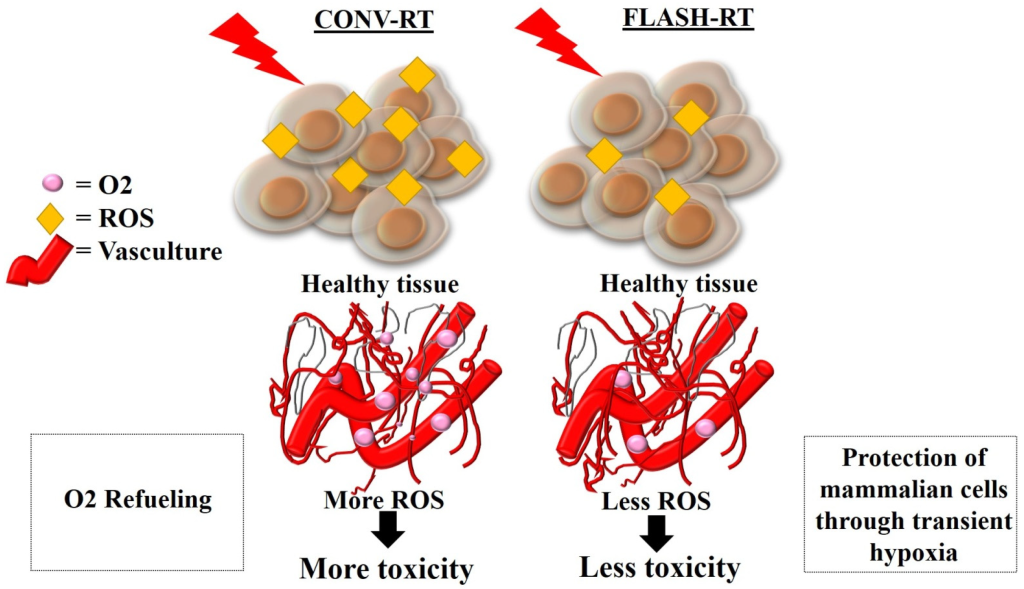
Figure 1: Proposed explanation for how FLASH radiotherapy protects healthy tissue. Conventional radiotherapy produces reactive oxygen species (ROS) and allows oxygen in the tissue to be continuously replenished (Alhaddad et al. 2024). This can lead to greater ROS production and more damage to healthy cells. In contrast, the ultrafast delivery of FLASH-RT rapidly uses up available oxygen, causing a brief period of low oxygen levels (transient hypoxia). This reduces the amount of ROS produced and may therefore decrease damage to surrounding healthy tissue.
FLASH-RT therefore represents a potential shift in how radiation therapy can be used to treat cancer. Rather than simply increasing the amount of radiation delivered to a tumour, its ultrahigh dose rate may alter the chemical and biological response of tissues, allowing cancer cells to be damaged while reducing injury to surrounding healthy cells. This could make it possible to treat tumours that are currently difficult to irradiate because of their proximity to sensitive organs.
Bibliography
Alhaddad, Lina, Andreyan N. Osipov, and Sergey Leonov. 2024. “FLASH Radiotherapy: Benefits, Mechanisms, and Obstacles to Its Clinical Application.” International Journal of Molecular Sciences 25 (23): 12506. https://doi.org/10.3390/ijms252312506.
Baskar, Rajamanickam, Kuo Ann Lee, Richard Yeo, and Kheng-Wei Yeoh. 2012. “Cancer and Radiation Therapy: Current Advances and Future Directions.” International Journal of Medical Sciences 9 (3): 193–99. https://doi.org/10.7150/ijms.3635.
Chow, James C. L., and Harry E. Ruda. 2023. “Flash Radiotherapy: Innovative Cancer Treatment.” Encyclopedia 3 (3): 808–23. https://doi.org/10.3390/encyclopedia3030058.
DEWEY, D. L., and J. W. BOAG. 1959. “Modification of the Oxygen Effect When Bacteria Are Given Large Pulses of Radiation.” Nature 183 (4673): 1450–51. https://doi.org/10.1038/1831450a0.
Favaudon, Vincent, Laura Caplier, Virginie Monceau, et al. 2014. “Ultrahigh Dose-Rate FLASH Irradiation Increases the Differential Response Between Normal and Tumor Tissue in Mice.” Science Translational Medicine 6 (245). https://doi.org/10.1126/scitranslmed.3008973.
Majeed, H, and V Gupta. 2023. “Adverse Effects of Radiation Therapy.” Europepmc.Org, August 14. https://europepmc.org/article/nbk/nbk563259.
Matuszak, Natalia, Wiktoria Maria Suchorska, Piotr Milecki, et al. 2022. “FLASH Radiotherapy: An Emerging Approach in Radiation Therapy.” Reports of Practical Oncology and Radiotherapy 27 (2): 343–51. https://doi.org/10.5603/rpor.a2022.0038.
Spitz, Douglas R., Garry R. Buettner, Michael S. Petronek, et al. 2019. “An Integrated Physico-Chemical Approach for Explaining the Differential Impact of FLASH Versus Conventional Dose Rate Irradiation on Cancer and Normal Tissue Responses.” Radiotherapy and Oncology 139 (October): 23–27. https://doi.org/10.1016/j.radonc.2019.03.028.
Comments
6 Responses to “Eliminating Cancer Like the Flash”
Hi Sara!
What a cool topic. I had never heard of FLASH radiotherapy, and your comparison to the Flash in the title is a great hook! You explained a complicated treatment in a way that was really easy to follow. Here are a couple of things I noticed that you could change:
P2S3: You say “In vitro studies,” but the Favaudon et al. (2014) study was done on mice, so it should be “in vivo.”
Citations: “Basker” should be “Baskar” in P1, “Fauvadon” should be “Favaudon” in P2, and there’s an extra bracket after (Majeed and Gupta 2023)).
Overall, this was a really interesting read, and you did a great job introducing such a new technology!
Happy editing,
Gurdit
Hi Sara,
Really exciting blog post! It’s always nice to see new radiation therapy innovation.
Some suggestions for your edits:
– I would reword your 2PS2 to something along the lines of the effects of ‘The term FLASH was coined by Fauvadon et al. (2014), defining FLASH as an irradiation dose greater than 40 Gray per second (Gy/s; a unit representing the delivery of one joule of ionizing radiation energy per kilogram of matter per second).’ I think it would help streamline the sentence and the flow a bit!
– I would also suggest italicizing ‘in vitro’ in your next sentence- I believe it is a bit more common.
– I think adding a figure of the technology, specifically for the last paragraph, could also be super helpful for understanding.
Overall, amazing work! This was a super engaging and exciting blog post. I’m excited to read your final version.
Happy editing,
Bohmie
Hi Sara,
This is a great topic with an eye-catching title. Don’t forget to make your own comment about your motivations and connections to iSci content. My feedback for you is:
-(Majeed and Gupta 2023) in P1 has an extra parenthesis.
– Be careful with misspelling people’s names; (Fauvadon et al. 2014) in P2 does not match your citation entry (Favaudon et al.).
– Add a figure! I would love to see the explicit process of treatment applied to a patient.
– A stronger conclusion would really elevate this piece, as the ending was a bit abrupt.
– I think you have a great basic explanation of the potential of FLASH radiotherapy. However, if your word count allows, consider speaking more on other aspects associated with this treatment, such as length of treatment and remission rates. Damage from radiation is only one part of the cancer treatment process, and adding these other reference points can help visualize its effectiveness compared to traditional radiotherapy.
This may seem like a lot, but you honestly have a great foundation to work with. I’m really looking forward to the final product!
Happy editing,
Angie
Hi Sara,
I really enjoyed reading this! I had heard of radiation therapy before, but not FLASH-RT, so I thought this was such an interesting topic. You explained a pretty complicated treatment in a way that was really easy to follow 🙂
I had a few suggestions as I was reading:
– In your second paragraph, you say that FLASH-RT delivers “doses of radiation several orders of magnitude higher” than conventional radiotherapy. It might help to clarify that the main difference you describe is the **dose rate**, rather than necessarily the total radiation dose, especially since you later compare ultrafast and prolonged radiation at the same total dose. That might prevent readers from thinking patients are simply receiving much more radiation overall.
– In the third paragraph, I was really curious about the mechanism behind the “FLASH effect.” You explain that tumour cells and normal tissue respond differently to ultrahigh dose rates, but not really why this happens. If you have the space, adding a sentence or two about one of the proposed biological mechanisms could make this section even stronger and help connect the physics of FLASH-RT to the biology.
– I also really liked the 1959 bacteria example, but I think the connection back to cancer treatment could be made a little clearer. Right now the post ends just after describing what Dewey and Boag observed, so maybe you could explain what that observation taught researchers about the FLASH effect or how it eventually helped contribute to the development of FLASH-RT today.
Overall, this was super interesting and I’m excited to read the final version!
Happy editing!
Saniyah
Hi Sara!
This was a really interesting and informative blog post. A couple things to keep in mind while editing:
– In P1S2, consider changing “treatment schemes” to “treatment regime” or simply “cancer regime”. It is more conventional and will likely flow a little better. In the same sentence, it might be more clear to indicate that radiation will often damage nearby healthy cells, specifically!
– It may be informative to elaborate on the impacts of damage to nearby healthy cells, if your word count allows for it. This will further explain the need for advancements in cancer therapy.
– Try and include a conclusion that ties together your whole blog post! It is very strong so far but would benefit greatly from a short conclusion if your word count allows for it.
– Don’t forget to leave a comment on your motivations and the blog post’s connection to iSci!
Happy editing!
Maegan
Hi iSci,
The inspiration behind this post was when my group for wine science considered discussing the health effects of alcohol. One of the effects was a greater risk of cancer and that led me down a rabbit hole on novel cancer treatments.
Thanks for your feedback!
Sara