Have you ever gone to the doctor after experiencing months of stomach pain and gastrointestinal issues, just for them to tell you to adjust your diet to eat “clean,” and to cut your favourite foods? For over 20 years, the low-FODMAP diet has been the number one suggested treatment for irritable bowel syndrome (IBS). IBS is one of the most prevalent functional gastrointestinal disorders, affecting about 9-12% of individuals globally (Peters et al. 2016). It is characterized by the recurrence of abdominal cramping, gas, bloating, and unpredictable bowel habits, including diarrhea, constipation, or a combination of both. IBS is a chronic health disorder, which considerably impacts the quality of patients’ lives (Nathani et al. 2025). However, recent studies suggest a powerful alternative treatment for IBS, called gut-directed hypnotherapy (GDH).
The gut-brain axis is defined as the communication between the central and enteric nervous systems, and is responsible for connecting emotional and cognitive functions of the brain with intestinal functions (Carabotti et al. 2015), represented in Figure 1. IBS occurs when there is a disruption in the gut-brain axis, causing visceral hypersensitivity, gastrointestinal dysmotility, alterations in gut microbiota, and food intolerances. Additionally, psychosocial factors, like stress, can negatively impact intestine sensitivity and microbiota, and will heighten symptoms (Nathani et al. 2025). Disruption in the gut-brain axis occurs from the signalling between the central nervous system and the enteric nervous system. This happens across various signalling pathways, like the neuronal, endocrine, immune, and metabolic signals. Increased signaling from the central nervous system causes visceral hypersensitivity, and signalling to the intestinal track, causing abdominal discomfort, gas, and diarrhea (Nathani et al. 2025).
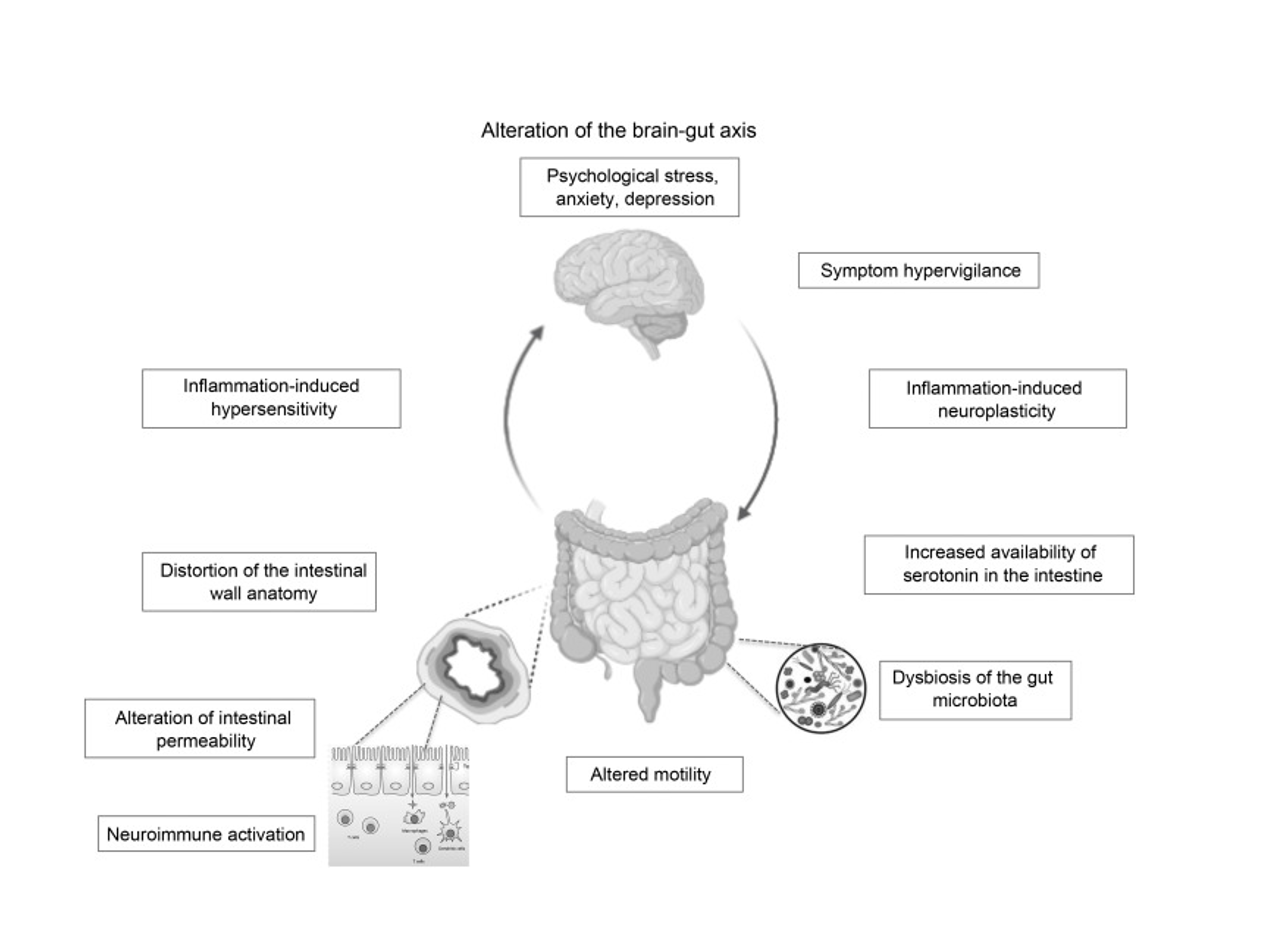
Figure 1. Internal mechanism depicting the gut-brain connection. Alterations in the brain-gut axis can be driven by both psychological factors and diet. These factors can cause a cyclic flow symptom hypervigilance and hypersensitivity down to altered gut motility, which will appear as IBS symptoms (Pérez de Arce et al. 2022).
Altering one’s diet by eliminating known triggers can improve IBS symptoms substantially. Typically fermentable and short-chain carbohydrates like oligosaccharides, disaccharides, monosaccharides, and polyols (FODMAP), do not absorb easily in the small intestine. These short-chain carbohydrates are the main drivers for severe abdominal pain (Bertin et al. 2024). A low-FODMAP diet is the suggested guideline for those struggling with IBS. Common high-FODMAP foods include, lactose, wheat, stone fruit, legumes, root vegetables, soy, nuts and seeds, processed foods, and much more (Figure 2) (Daley et al. 2026). A low-FODMAP diet is very strict, and for many people, unrealistic to follow for the long-term.
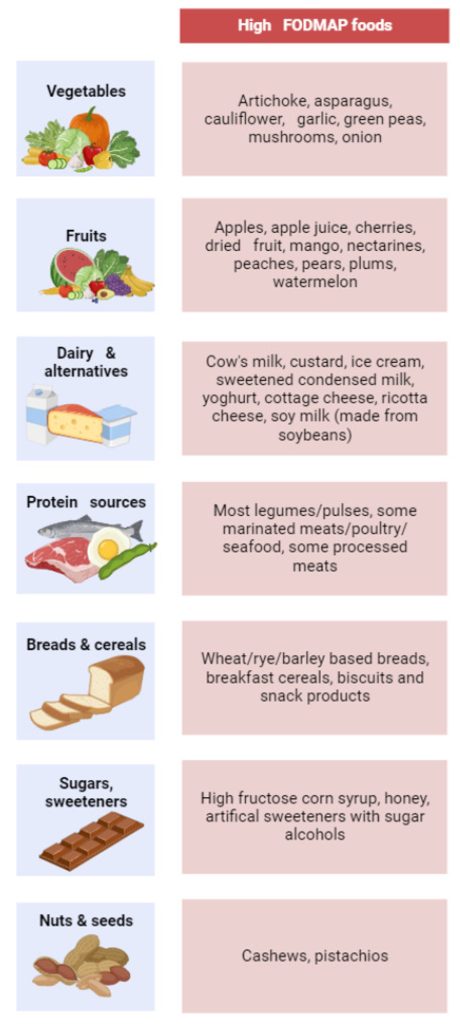
Figure 2. Chart depicting main food groups (left), vegetables, fruits, dairy, protein, breads and cereal, sugars, and nuts/seeds. The right-hand side highlights a selection of high-FODMAP foods within those categories, adapted from (Bertin et al. 2024).
Gut-directed hypnotherapy targets the brain-gut connection to mitigate symptoms, and is delivered by a trained therapist (Vasant and Whorwell 2019). GDH is employed by relaxation techniques with calming music and meditation to “induce” a hypnotic state to restore brain-gut regulation (Adler et al. 2025). During sessions, patients will be taught techniques, enabling them to gain control of their gut (Vasant and Whorwell 2019). Patients remain awake and aware, just in a deeper state of focused concentration during hypnotic sessions. Then, they will be guided through relaxation exercises using imagery. Courses will last from 6 to 12 weeks in length (Bauzá 2018), with up to 76% of patients reporting an improvement of symptoms (Vasant and Whorwell 2019). Additionally, GDH can improve coping strategies, resilience, and self-regulation skills for those with IBS (Vasant and Whorwell 2019). The exact mechanism of GDH is still unclear. However, research suggests that it is possible that GDH can induce changes in neuroplasticity which can act as a “resetting” factor for the communication between the brain-gut axis along with decreasing visceral hypersensitivity (Vasant and Whorwell 2019).
Like all treatment for chronic disorders, GDH will not be a fix for everyone with IBS. However, GDH provides great promise for a more holistic approach to mitigating IBS symptoms without having to cut out your favourite foods.
References
Adler, Elizabeth C., Emma H. Levine, Allison N. Ibarra, et al. 2025. “Gut-Directed Hypnotherapy for Irritable Bowel Syndrome: A Systematic Review and Meta-Analysis.” Neurogastroenterology & Motility 37 (7): e70037. https://doi.org/10.1111/nmo.70037.
Bertin, Luisa, Miriana Zanconato, Martina Crepaldi, et al. 2024. “The Role of the FODMAP Diet in IBS.” Nutrients 16 (3): 370. https://doi.org/10.3390/nu16030370.
Carabotti, Marilia, Annunziata Scirocco, Maria Antonietta Maselli, and Carola Severi. 2015. “The Gut-Brain Axis: Interactions between Enteric Microbiota, Central and Enteric Nervous Systems.” Annals of Gastroenterology : Quarterly Publication of the Hellenic Society of Gastroenterology 28 (2): 203–9. https://pmc.ncbi.nlm.nih.gov/articles/PMC4367209/.
Daley, Sharon F., Kunzah Syed, and Jennifer Goldin. 2026. “The Low-FODMAP Diet in Clinical Practice: Evidence-Based Indications, Implementation, and Interprofessional Care.” In StatPearls. StatPearls Publishing. http://www.ncbi.nlm.nih.gov/books/NBK562224/.
Margarita Bauzá. 2018. June 1. https://www.michiganmedicine.org/health-lab/how-gut-directed-hypnosis-helps-ibs-ibd-and-other-gi-disorders.
Nathani, Rohit R., Shreya Sodhani, and Eric Goosenberg. 2025. “Irritable Bowel Syndrome.” In StatPearls. StatPearls Publishing. http://www.ncbi.nlm.nih.gov/books/NBK534810/.
Pérez de Arce, Edith, Rodrigo Quera, Caroll J. Beltrán, Ana María Madrid, and Pilar Nos. 2022. “Irritable Bowel Syndrome in Inflammatory Bowel Disease. Synergy in Alterations of the Gut-Brain Axis?” Gastroenterología y Hepatología (English Edition) 45 (1): 66–76. https://doi.org/10.1016/j.gastre.2021.02.007.
Peters, S. L., C. K. Yao, H. Philpott, G. W. Yelland, J. G. Muir, and P. R. Gibson. 2016. “Randomised Clinical Trial: The Efficacy of Gut-Directed Hypnotherapy Is Similar to That of the Low FODMAP Diet for the Treatment of Irritable Bowel Syndrome.” Alimentary Pharmacology & Therapeutics 44 (5): 447–59. https://doi.org/10.1111/apt.13706.
Vasant, Dipesh H., and Peter J. Whorwell. 2019. “Gut‐focused Hypnotherapy for Functional Gastrointestinal Disorders: Evidence‐base, Practical Aspects, and the Manchester Protocol.” Neurogastroenterology and Motility 31 (8): e13573. https://doi.org/10.1111/nmo.13573.
Comments
9 Responses to ““Gas”lighting Your Own Gut ”
Hi iSci!
Thanks for reading my post!
With being halfway through neuroscience, I wanted to look into some application of the content we have been learning. This post also integrates some nutrition science and psychology!!
Happy to hear any feedback you have!
Thanks again,
Hava
Hi Hava,
Great work on your blog post! This was a really informative piece. A few suggestions for your final draft:
– Make sure to unlink your sources in your reference list!
– Consider defining the gut-brain axis somewhere in your first few paragraphs, to ensure the reader is clear on this concept.
– In your final paragraph, make sure to remove the hyphen in ‘cut-out’.
Overall awesome job! Looking forward to reading your final draft. Happy editing!
Cheers,
Charlie
Hi Charlie!
Thanks for your suggestions! I have implemented them. I do believe for blog posts the citations should have a hyperlink but I will double check on that!
Thanks again,
Hava
Hi Hava, I really enjoyed reading your blog post, and found it very interesting. Consider making the following changes when editing:
-P1S4: slightly awkward phrasing, try this for better flow: IBS is a chronic health disorder which considerably impacts the quality of patients’ lives
-P4S4: small grammer mistake, it should either be Patients remain awake… OR The patient remains awake…
-P4S5: to avoid repition, you could say “Then, they will…” rather than “Then, the patient will…”
-If word count permits, elaborating on what it means for a food to be high or low ‘FODMAP’ would be helpful
Happy editing,
Hafsah S
Hi Hafsah!
Thank you so much for your edit suggestions, I’ve implanted them now!
Thanks,
Hava
HI Hava! I really liked reading your blog post and I didn’t know much about IBS so I learned so many new things! I have a couple suggestions,
– What is the low-FODMAP? Could you define it?
– Is there a space needed between “Gas” Lighting (Also capitalize ‘lighting”)
– Add in a period between “IBS is one of the most prevalent functional gastrointestinal disorders, affecting about 9-12% of individuals globally (Peters et al. 2016). It is characterized…”
– Maybe add in a figure about the brain/body effects with IBS? or another figure in general
Overall, amazing work! Happy editing 🙂
Emily R
Hi Emily!
Thank you for reading my blog and your helpful suggestions! I’ve implemented your suggestions now where I saw fit 🙂
Thanks again,
Hava
Hi Hava!
What a cool topic to write about! Id be really interested in more research, and I’m wondering if there was any placebo treatment method or if there was any outcome measurement beyond a self reported improvement. Additionally, although i really like the FODMAP diet breakdown, i think another figure that might outline the treatment or a useful figure from the paper that was foundational to this treatment.
I think it would also be really interesting if you went a little more into the neuroplasticity you mentioned.
Overall fascinating and really well written!
Rasmus
Hi Rasmus!
Thanks for your comment! I tried my best to implement all your suggestion, but I have little word count left to add much more about neuroplasticity 🙁
Thanks again,
Hava