So, it is well known that some people tend to smell like they’re allergic to deodorant, *cough* Engineering students *cough*, and these issues are easily solved via spraying yourself with chemicals. My father, a man in his 50s, has begun his journey into becoming the most whimsical fellow in the world by attempting to synthesize and extract essences for his own perfumes. This world of perfuming is a place where B/O goes to die, and it’s a lot more complex than one would think. Inspired by my father’s interest, and his tales of his foraging adventures, I’ll be telling you the science behind getting rid of that backrooms musk and finally touching some grass, starting with how perfume actually works.
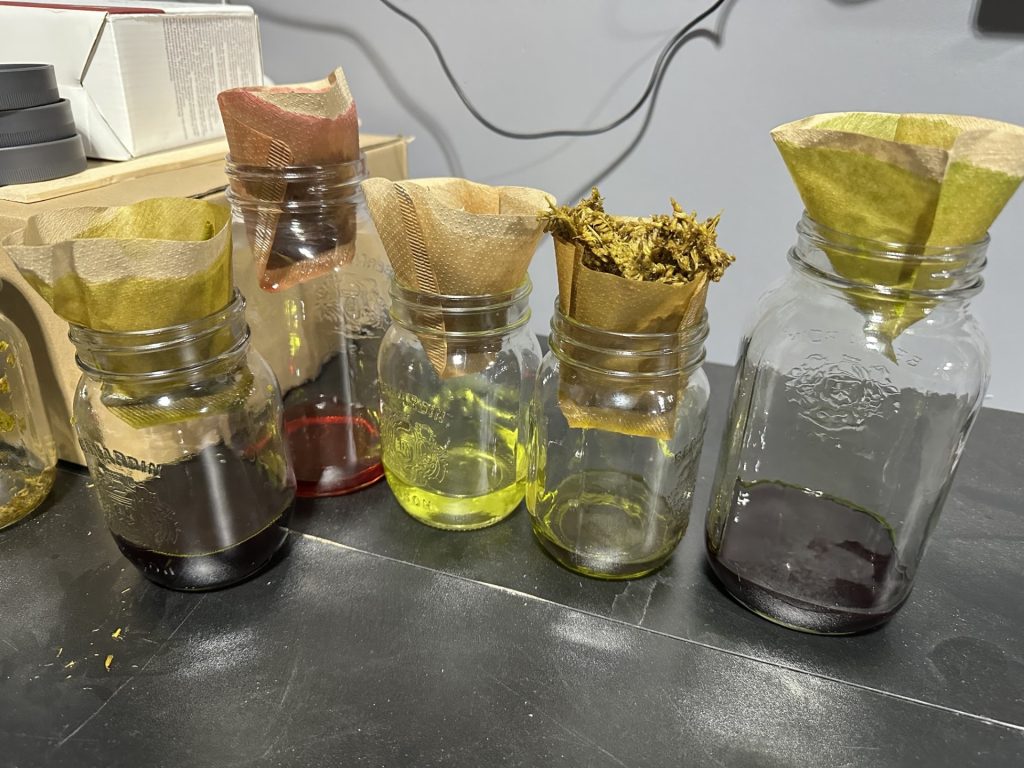
Figure 1: The alcoholic essences derived from foraged materials, filtered and strained into mason jars. As seen in the jars, the alcohol within are no longer clear. This is because the alcohol breaks down the innards of the plant cell, which then begins to seep into the surrounding liquid outside the cells (National Library of Medicine 2013).
A perfume, by definition, is a substance that you wear, and that smells, good or bad. You could have a perfume that smells like flowers… or blue cheese (that’s an actual thing by the way). A perfume is made of multiple different complimentary smells that emerge at different times during the period after applying it. When applying, the different elements extracted stick to the applied area for different periods of time until they evaporate (The Aurel Experience Centre 2021). The smells that result from this evaporation are called notes, with three main notes within each perfume. Top Notes arise around ten to fifteen minutes after applying a perfume, usually a stronger scent to attract customers to buy the product. The Heart Notes are smelled 3-4 hours after, is the main scent that the perfume is known for. Lastly the Base Notes are the scent known for the final stage of the perfume, appearing five to eight hours after applying, known to be more musky (Nasr 2015).
Making perfume, or as I like to call it, alchemy, is more or less based on taking a plant and squeezing the soul out of it. The essence of something, not the spooky soul kind, is captured via trapping it through different mediums, whether it be through water, air, or in our case, alcohol. Within perfumes, alcohol is used for many different reasons, which will be described in further detail later. However, to start off, the alcohol in this case acts as an extremely strong solvent, and is able to remove any oils and essences from within the material, mainly flowers, leaves, bark, and stone. These elements of the materials infuse into the alcohol, creating a baseline for the perfume before any processing (Fenhao Group 2024). However, the actually smelling good part is less just perfume and more how the nose works.
When you smell something, particles enter your nose and interact with the cells that lead to your brain. Millions of these cells gather this information coded to receive a specific set of particles that might enter. Each scent is determined by a series of interactions sensory cells called olfactory neurons. These cells receive different particulates using cilia on their membranes. When introduced to a series of different scents, a more complex system would arise. The cells would change the perception of the scent, even if a specific smell didn’t yield a reaction (National Institutes of Health 2020). Perfumes themselves are synthesized with this concept involved, where the alcohol traps different essences, causing these cells to fire signals similar to an orchestra if I may, harmonizing with the other notes as time goes on.
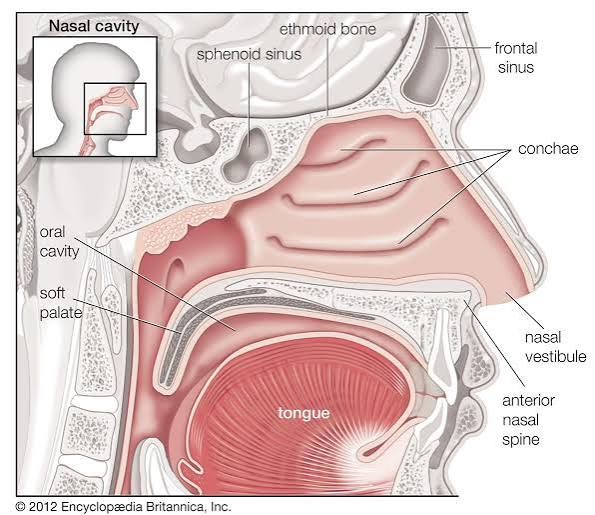
Figure 2: An image of the nasal cavity of a human being. The olfactory neurons are mainly found near the ethmoid bone, protruding though to take any dissolved particles to the brain in order to understand what exactly is making you float through the air when you smell a pie (Brittanica 2019).
Perfuming, as complicated and alchemistic it may be, is essential to not smelling as if you lived in a dumpster. It doesn’t matter whether you’re a person in modern day Hamilton, or someone who lived 500 years ago drinking tea in a castle. If you smell bad, people are gonna notice. And personally, I wouldn’t wish the experience of walking through JHE.
References
The Aurel Experience Centre. 2021. “The Science Behind Perfumed.” https://aurelsg.com/blogs/news/the-science-behind-perfumes.
Brittanica. 2019. “Olfactory system | Parts, Function, & Organs.” Britannica. https://www.britannica.com/science/olfactory-system.
Fenhao Group. 2024. “Exploring Perfume Essences.” https://vi.fenhaogroup.com/info-detail/exploring-perfume-essences.
The London Batch Perfumery. 2026. “What Is Solvent Extraction in Perfumery?” https://www.edpclub.com/blogs/lab-notes/lab-notes004?srsltid=AYCX9vLPLgMEboehgaZLRBI8Umm2HR2Xfu_IqTi0hQaHET5X4Io7MTeH.
Nasr, Susan L. 2015. “How Perfume Works | HowStuffWorks.” Science | HowStuffWorks. https://science.howstuffworks.com/perfume.htm.
National Institutes of Health. 2020. “How the nose decodes complex odors | National Institutes of Health.” NIH. https://www.nih.gov/news-events/nih-research-matters/how-nose-decodes-complex-odors.
National Library of Medicine. 2013. “Alcohol stress, membranes, and chaperones – PMC.” PMC. https://pmc.ncbi.nlm.nih.gov/articles/PMC3982023/.


Leave a Reply
You must be logged in to post a comment.