Smoking cigarettes is a highly addictive habit that is ingrained in many people’s daily routines. As a result, the potential drug interactions of common medications with the compounds in tobacco are often overlooked (Chui et al. 2019). Cigarette smoke contains a class of compounds called polycyclic aromatic hydrocarbons (PAHs), which are major lung carcinogens (Kroon 2007). PAHs can increase the production of certain drug-metabolizing enzymes, potentially causing drug plasma concentrations to decrease at a quicker rate. This is an important factor in deciding medication doses for individuals with regular smoking habits.
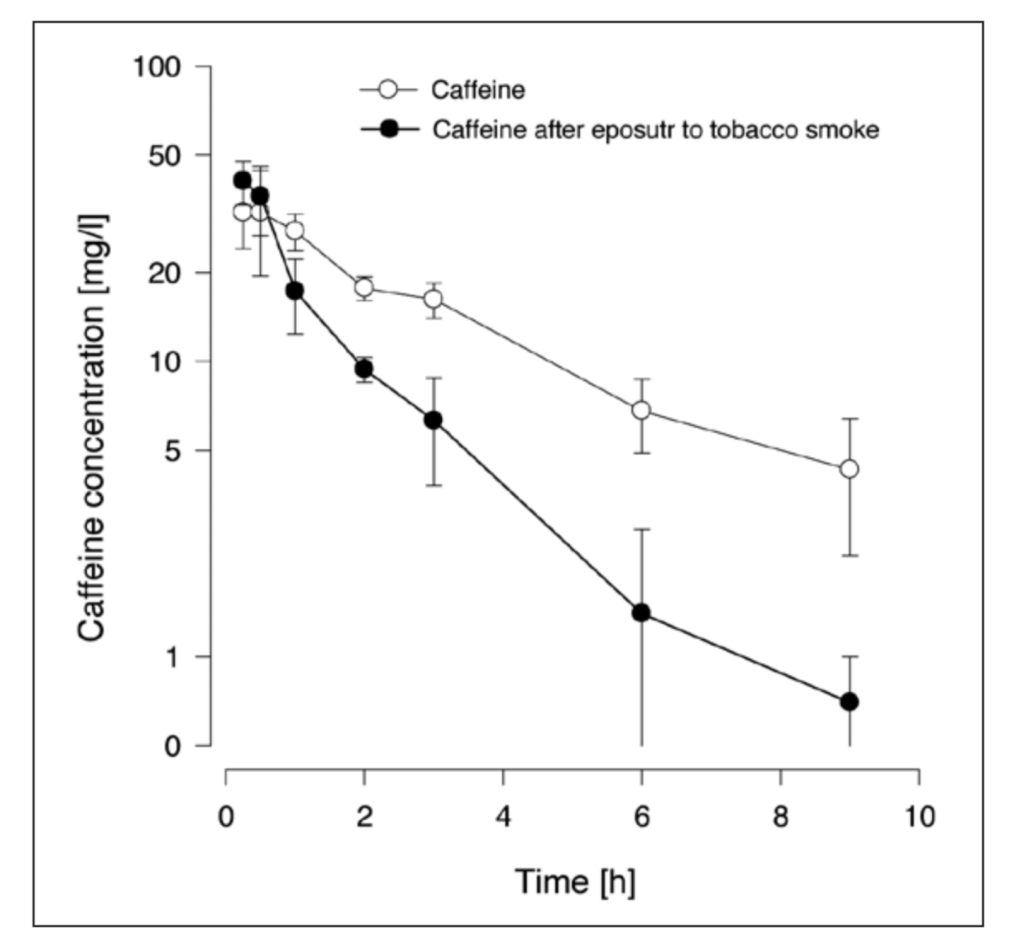
PAHs can induce their own metabolism by activating the aryl hydrocarbon receptor (AhR) in human vertebrate cells. Once the AhR is activated, it moves into the nucleus and forms a complex with the AhR nuclear translocator (ARNT). The AhR/ARNT complex binds to specific DNA sequences called dioxin response elements or xenobiotic response elements that are located in the promoter regions of target genes. This causes the increased expression of enzymes that are involved in PAH metabolism, including cytochrome P450 1A1 (CYP1A1) and 1A2 (CYP1A2) (Goedtke et al. 2020). As a result of this, the metabolism of other drugs that are substrates for CYP1A1 and CYP1A2 will also be increased, such as caffeine, clozapine, fluvoxamine, olanzapine, tacrine, and theophylline (Figure 1) (Kroon 2007). This might suggest that those who are regular smokers taking medications that interact with CYP1A1 and CYP1A2 would need to take higher dosages to reach the needed therapeutic effect. It also means that upon quitting smoking, smokers may require a reduction in the dosage of their medication, or else there could be adverse effects (Kroon 2007).
A study done by Faber and Fuhr looked into the time course of CYP1A2 activity changes in 12 heavy smokers who quit smoking. The participants smoked 20 cigarettes a day and CYP1A2 activity was recorded on days 6, 4, and 1 before sudden smoking cessation and on days 1, 2, 3, 6, 8, 10, and 13 days after. The relative reduction in CYP1A2 activity after smoking cessation was 12.3% on day 1, 20.1% on day 2, 25.0% on day 3, 28.2% on day 4, and 36.1% at a steady state (which was approximately 1 week after smoking cessation). The apparent half-life that they calculated was 38.6 hours. This short half-life suggests that the dose of CYP1A2 substrate medications must be immediately changed after quitting smoking, especially in medications with short therapeutic ranges, to avoid adverse effects (Faber and Fuhr 2004).
The interaction between PAHs and CYP1A1 and CYP1A2 enzymes shows how cigarette smoke can potentially affect the drug plasma concentrations in regular smokers and reduce the therapeutic effect of the medication. However, these effects can rapidly change after smoking cessation, suggesting that medication dosages need to be immediately reassessed to avoid adverse effects. This highlights the importance of considering smoking habits when prescribing or taking certain medications.
References
Chui, Chang Yue, Simone E. Taylor, Dennis Thomas, and Johnson George. 2019. “Prevalence and Recognition of Highly Significant Medication-Smoking Cessation Interactions in a Smoke-Free Hospital.” Drug and Alcohol Dependence 200 (July): 78–81. https://doi.org/10.1016/j.drugalcdep.2019.03.006.
Faber, Mirko S., and Uwe Fuhr. 2004. “Time Response of Cytochrome P450 1A2 Activity on Cessation of Heavy Smoking.” Clinical Pharmacology & Therapeutics 76 (2): 178–84. https://doi.org/10.1016/j.clpt.2004.04.003.
Goedtke, Lisa, Heike Sprenger, Ute Hofmann, et al. 2020. “Polycyclic Aromatic Hydrocarbons Activate the Aryl Hydrocarbon Receptor and the Constitutive Androstane Receptor to Regulate Xenobiotic Metabolism in Human Liver Cells.” International Journal of Molecular Sciences 22 (1): 372. https://doi.org/10.3390/ijms22010372.
Grela, A., M. Kulza, W. Piekoszewski, M. Senczuk-Przybylowska, E. Gomolka, and E. Florek. 2013. “The Effects of Tobacco Smoke Exposure on Caffeine Metabolism.” Italian Journal of Food Science 25 (1): 76-. Gale Academic OneFile.
Kroon, Lisa A. 2007. “Drug Interactions with Smoking.” American Journal of Health-System Pharmacy 64 (18): 1917–21. https://doi.org/10.2146/ajhp060414.
Comments
6 Responses to “How does Cigarette Smoke Affect your Medication?”
Hi Avril! This is a really interesting blog post! I just have some feedback:
– Your title seems to include a grammatical error. Perhaps reword it to “How does Cigarette Smoke Affect Your Medication?” (also removed the “effectiveness” because it’s a bit repetitive)
– consider rewording the beginning of your figure caption to be “a plot of caffeine concentration vs time…” for clarity
– in P2 you include a lot of abbreviations for enxymes etc., consider removing some of these abbreviations of the things that are not referenced again in the text (ex. XREs)
Overall this blog was very well written and extremely interesting! Also dont forget to comment what inspired this post!
Thanks for the feedback Sophie!
Hi Avril,
Interesting post! I hadn’t thought about how quitting smoking could itself become a dosing problem.
Two things:
In P1 you say PAHs cause drug concentrations to drop faster, but later in P2 you say smokers “would need to take higher dosages.” Worth making sure that reads as a suggestion rather than advice, since it could come across as a dosing recommendation.
For the Faber and Fuhr study, adding the number of participants would help readers judge how much weight to put on those percentages.
Happy editing!
Gurdit
Hi Gurdit, thank you for the feedback! I have implemented it in my post.
Hi Avril,
Great job on this blog post! I really liked the topic and thought it was pretty relevant. Please see below some comments/suggestions.
– the title has a typo – effectiveness!
– first paragraph: not sure how to capitalize the PAH – maybe consider capitalizing the full thing, ie: Polycyclic Aromatic Hydrocarbons
– consider finding a diagram that would visually explain the process you talk about in the second paragraph – it seems very complex and you do a good job of explaining, but it can be harder for some people to visualize using just words.
Other than that, great job! Happy editing:)
Janaya
Hi Janaya! Thank you for the feedback; it was very helpful.