Have you ever wondered why some people absolutely adore horror films, while others jump at the sight of their own shadow? By constantly rewatching Nightmare on Elm Street and Halloween, some people seem to be practically fearless from birth, like they have always been so intent on chasing thrills and terror. This question has led to a fascinating debate: does evolution have an effect on a person’s opinion of horror films?
Fear is directly linked to the sympathetic nervous system, which activates when a person experiences fear, anxiety, or arousal. More commonly, this is referred to as the “fight or flight” response (Asma 2014, 942). These processes are a result of hormones such as epinephrine and corticotropin releasing hormone (CRH) which leads to a rush of emotions that can cause a type of “adrenaline rush” that no other kind of media can evoke (Asma 2014, 942). Additionally, the build-up of suspense, followed by a wave of relief at the end of the film, is a reason many individuals enjoy scary movies. As detailed by excitation transfer theory, when there becomes a resolution of tension during the event of a “happy ending”, the once negative emotions transfer to a feeling of euphoria and a rush of dopamine (Martin 2019, 6). This physiological process can be measured through a person’s SCL, which is explained in Figure 1.
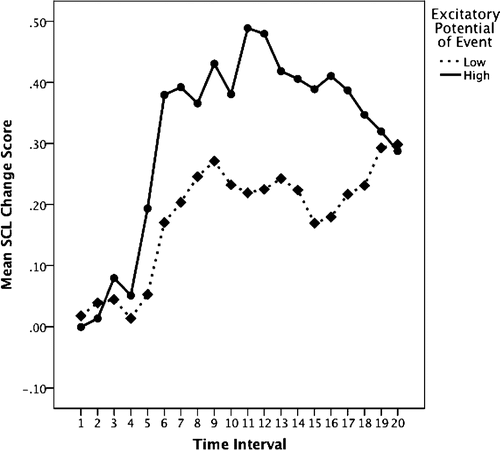
These theories explain why some people enjoy experiencing fear in the form of media but do not cover why there is such a difference in enjoyment throughout individuals. Additionally, some people feel less sense of terror at all, independent of their urge to seek it out. Evolutionarily speaking, this is privy to an individual’s sex and ancestral background.
Firstly, females have been shown to be at a higher risk of anxiety disorders and neuroticism (Mclean & Anderson 2009, 498). There is data showing that the heritability of this anxiety-vulnerability is much more common in women than men, as shown in Figure 2.
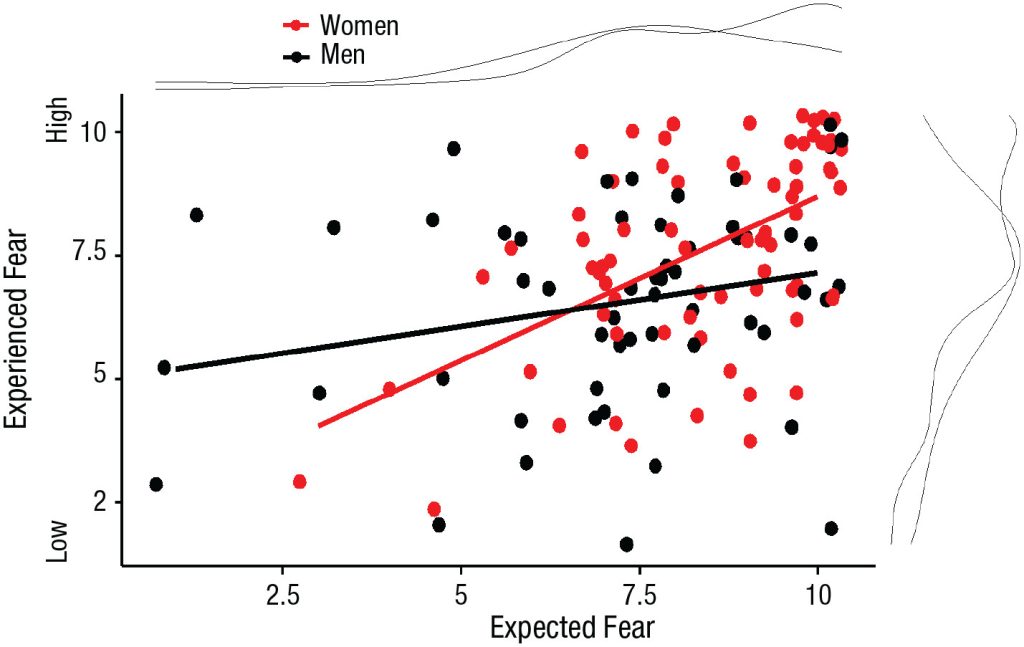
Furthermore, every human is affected by the evolutionary aspect of horror, meaning that ancient fears shape who we are today (Bishop et al. 2024, 6). For instance, theorists believe that, like all traits, fear is subject to evolution, and the personal level of fear between parents is heritable (Bishop et al. 2024, 6; Reale et al. 2007, 305; Asma 2014, 943). If an animal has a common natural predator, they will learn to fear them, causing the more timid animals to survive long enough that the trait will pass onto their offspring (Reale et al. 2007, 305). An example of this is Darwin’s research, in which he investigated multiple chimpanzees’ fear of snakes. By bringing these snakes into the primate zoo in London and recording their reactions, he concluded that the ancestrally rooted fear that the chimpanzees possessed caused this to occur (Asma 2014, 943). He assumed that the morphological traits of the snakes set off the chimpanzee’s recognition and induced this emotional response (Asma 2014, 943). This can be connected back to humans: are we more prone to fear or avoid scary movies if our predecessors did? If an individual despises horror and is easily frightened, this may be a result of their genetic origins.
Yet is evolution actually the result of a person’s love or hatred for horror films? Questions about Darwin’s theory have led to further research, and there is no direct evidence of genes that code a person to fear a specific type of creature, or that fear is heritable (Asma 2014, 943; Ohman 2001, 495). Such leads back to the debate: is an individual’s view on horror films the result of genetics and evolution, or rather their culture and experiences?
Citations
Bishop, M., Servedio, M., and Lerch, B. 2024. “The Evolution of Fear-acquisition Strategies Under Predation.” Journal of Theoretical Biology 595. https://doi.org/10.1016/j.jtbi.2024.111949.
Carmen P. McLean and Emily R. Anderson. 2009. “Brave Men and Timid Women? A Review of the Gender Differences in Fear and Anxiety.” Clinical Psychology Review 29 (6): 496–505. https://doi.org/10.1016/j.cpr.2009.05.003.
Cummins, R. G., Wise, W. T. and Nutting, B. H. 2012. “Excitation Transfer Effects Between Semantically Related and Temporally Adjacent Stimuli.” Media Psychology, 15 (4), 420–42. https://doi.org/10.1080/15213269.2012.723120.
Martin, Neil. 2019. “Why Do You Like Scary Movies? A Review of the Empirical Research on Psychological Responses to Horror Films.” Frontiers in Psychology 2298 (10). https://doi.org/10.3389/fpsyg.2019.02298.
Öhman, Arne and Mineka, Susan. 2001. “Fears, Phobias, and Preparedness: Toward an Evolved Module of Fear and Fear Learning.” Psychological Review 108 (3): 483–522. https://doi.org/10.1037/0033-295X.108.3.483.
Réale, D., Reader, S.M., Sol, D., McDougall, P.T. and Dingemanse, N.J. 2007. “Integrating Animal Temperament Within Ecology and Evolution.” Biological Reviews (82): 291-318. https://doi.org/10.1111/j.1469-185X.2007.00010.x.
Stephen T. Asma. 2014. “Monsters on the Brain: An Evolutionary Epistemology of Horror.” Social Research: An International Quarterly (4): 941-68. https://doi.org/10.1353/sor.2014.0055.
Tashjian, S., Fredrigo, V., Molapour, T., Mobbs, D. and Camerer, C. 2022. “Physiological Responses to a Haunted House Threat Experience: Distinct Tonic and Phasic Effects.” Psychological Science 33 (2): 236-48. https://doi.org/10.1177/09567976211032231.
Comments
11 Responses to “Born to Love Fear: The Science Behind Horror Films”
Hey iSci!
Since its spooky season, and as a massive fan of scary movies, I wanted to choose a topic horror-related. While conducting research on the psychology behind horror films, I found information on its connection to evolution, and was immediately inspired. In this post I connected ideas from psychology, such as the sympathetic nervous system, and evolutionary ideas from biology.
I hope you enjoy,
Lily
Hi Lily,
Fun topic, and perfect timing for the season! The chimpanzee and snake example was a great way to ground the evolutionary side.
Two things:
Figure 2 and its caption appear twice, and there’s no Figure 1. The second placement works better since it directly follows your point about heritability in women.
You cite Cummins et al. in your reference list for excitation transfer theory, but the in-text citation there points to Martin 2019.
Happy editing!
Gurdit
Thank you for catching that! I’ll make sure to correct it.
Hi Lily,
Great blog post! I especially liked the hook as it was engaging. Here are some suggestions I had:
– I think you could rephrase this sentence: “An example of this is with Darwin himself, as he tested multiple chimpanzees’ fear of snakes,” because I don’t think you mean to say that Darwin IS the example. You could say something like, “For example, Darwin researched…finding that…” or something similar.
– Also, in the last paragraph you say “Darwins’ theory” but I think it should be “Darwin’s theory.”
Again, great job 🙂
Sophia
Hi Sophia,
Thank you very much! I did intend to mention Darwin’s research rather than him as a person, so I reworded it to fit the context better. I also fixed the apostrophe error.
Sincerely,
Lily
Hi Lily!
Great post and just in time for Halloween!
Some suggestions I have for you are:
– In your second paragraph, you cite (Aziz and Rashid 2018) but this citation is not included in your reference list so make sure you add it in
– Make sure you reference your figures in text. You do so for figure 2 but not figure 1
– Make sure you are consistent with how you format your figure captions!
-P5 line 13 should use a colon instead of a semi-colon. It should read as “This can be connected back to humans: are we more prone to fear or avoid scary movies if our predecessors did?” since you are presenting a concept
Other than that, amazing post! Happy editing!
Jessica
Hi Jessica!
To address your points:
Aziz and Rashid was an original journal I used to research before I found a better source, so thank you for catching that! I have now replaced it with the correct citation.
I integrated Figure 1 into my text and I believe it connects the text to the figure a lot better. Additionally, it is more consistent with my second figure.
Thank you for the formatting/grammar suggestions, I fixed those.
I appreciate your comment,
Lily
Hi Lily,
This was a great blog post! Your writing style is very captivating, and I was so intrigued by the studies you referenced throughout the text. Well done, this was a great post! Here is some feedback I have for you if you see fit.
– I really like your intro and conclusion! I’m wondering if you may want to consider re-wording the question of someone’s “opinion” of horror movies to an individual’s “experience.” I think that because your blog focuses on this nature vs. nurture concept and the actual biological experience, it may be more correct for your intro to frame this as the “experience” instead. Up to you though, this is a very trivial thing!
– Figure 2 is very interesting! This may be my lack of graph knowledge speaking, but what are the squiggly lines on the vertical and horizontal axes? It may be beneficial to explain those in the caption!
– I’m also wondering if it may be helpful to add a short sentence in the figure caption of Figure 1 draw the connection between SLC and dopamine levels, and how they’re related. This is up to you, but it may make your example clearer because SLC is only referenced in the figure captions.
Overall, this was an excellent blog post! I wish you all the best with edits, and I look forward to reading the final version!
Best,
Leah
Thank you so much! To address your points:
-I personally prefer to use the word opinion, as I first explore the idea of why a person would enjoy a horror film using examples such as excitation transfer theory. I understand that the evolutionary concepts I explained do correlate with an individual’s experience, but I don’t want to take away from my original point where I explored the dopamine and adrenaline rush many people feel, which fits with their opinion of horror films. Despite this, I appreciate your comment on the subject!
-I added both details to my figures, and I agree that this adds more clarity!
Sincerely,
Lily
Hi Lily,
That was a great read! I didn’t know that horror movies were so intricately linked to the sympathetic nervous system.
Some feedback that I think will help:
1. In P3L2, you use the word “don’t”, which isn’t formal language. Perhaps rewording sentences to avoid a contraction trap would help in your writing.
Other than that, this was very well done!
Great job,
Praise
Hi Praise,
Thank you! I changed it to sound more formal.
Sincerely,
Lily