What feelings do you have about spice? Whether you love it or hate it, it’s undeniable that for most people, spicy foods elicit some sort of reaction – usually the burning, painful kind. But as uncomfortable and irritating as it may seem, it is actually a powerful tool when researching pharmaceuticals.
By now, most people know that a primary chemical that causes the “spicy” feeling is capsaicin, found in plants of the Capsicum genus (commonly recognized as chili peppers). Its mode of action is by exciting nociceptors – specialized sensory neurons responsible for detecting heat and pain (Fattori et al. 2016). Notice how these are the primary reactions felt when ingesting chili peppers. To excite these neurons, capsaicin increases the flux of ions – like calcium – across their membranes, creating a larger potential difference until it reaches an action potential. When the action potential is reached, the neuron fires, signaling to the brain; in this case, the nociceptors are specialized to send pain and heat signals, which is what you experience. As with regular neuron signaling, these ion fluxes (and subsequent action potentials) are controlled by ion channels, as the membrane is selectively permeable and non-polar, preventing ions from naturally flowing across it. Thus, the capsaicin must somehow interact with ion channels within the nociceptors to activate the painful sensation.
Normally, ion channels within neurons are not open or closed all the time – there are often conditions that need to be reached. These channels are said to be “gated”. Some are dependent on the change in membrane potential (voltage-gated), others require specific molecules to be bound to them first (ligand-gated), and others still are stretch-gated and thermo-gated (physical deformation and temperature respectively). In this case, the ion channel TRPV1 is the one affected by capsaicin (Yang and Zheng 2017). This channel is actually multiply gated, affected by both temperature and the presence of capsaicin – it is both thermo-regulated and ligand-regulated. An example of how TRPV1 is ligand gated is provided in Figure 1.
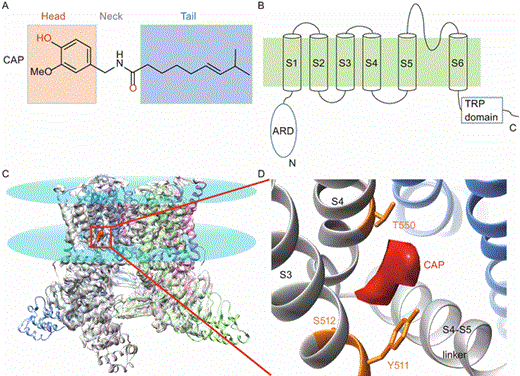
Now that we know how capsaicin and its receptor TRPV1 work, we can examine how it helps when researching medication. As established, TRPV1 is also a pain receptor. Knowing that capsaicin is able to excite this channel in nociceptors means that it can be used to locate where these channels are present (González-Ramírez et al. 2017). For example, it has helped with the understanding of abdominal pain (particularly useful for helping people suffering from IBS) by highlighting potential targets for pain within the colon via capsaicin injections to deliberately induce pain (Fattori et al. 2016). Having the ability to induce pain “on-demand” is what makes capsaicin very valuable, especially in the development of pain medication. It also allows for further study on the TRPV1 receptor and how other agonists may potentially interact. Agonists like capsaicin change the pore size of the channel (capsaicin expands the size, allowing more ion flux). Due to how different agonists like N-arachidonoyldopamine, piperine and resiniferatoxin provide distinct patterns of ion selectivity and discrimination to TRPV1, it’s possible to alter the ion channel such that it affects different ions (Fattori et al. 2016), potentially allowing ways to prevent the activation of the nociceptor and allowing for pain relief. The large role of TRPV1 in pain and pain medicine research allows one of its most well-known agonists, capsaicin, to be an extremely helpful tool.
Now, the next time you feel the heat and pain from a spicy food, you know which ion channel it is triggering, and maybe recall how useful the same chemical causing you that pain is at developing and researching pain prevention and mitigation.
References:
Fattori, Victor, Miriam S. N. Hohmann, Ana C. Rossaneis, Felipe A. Pinho-Ribeiro, and Waldiceu A. Verri. “Capsaicin: Current Understanding of Its Mechanisms and Therapy of Pain and Other Pre-Clinical and Clinical Uses.” Molecules 21, no. 7 (2016): 844. https://doi.org/10.3390/molecules21070844.
González-Ramírez, Ricardo, Yong Chen, Wolfgang B. Liedtke, and Sara L. Morales-Lázaro. “TRP Channels and Pain.” In Neurobiology of TRP Channels, edited by Tamara Luti Rosenbaum Emir. Frontiers in Neuroscience. CRC Press/Taylor & Francis, 2017. http://www.ncbi.nlm.nih.gov/books/NBK476120/.
Yang, Fan, and Jie Zheng. “Understand Spiciness: Mechanism of TRPV1 Channel Activation by Capsaicin.” Protein & Cell 8, no. 3 (2017): 169–77. https://doi.org/10.1007/s13238-016-0353-7.
Comments
13 Responses to “Capsaicin and spice, are they secretly nice?”
Hello Daniel,
I really loved your post! I thought your topic was really interesting, and I loved learning how spice is actually helping us research pain prevention and medicine!
Awesome job!
Anchan
Thank you for your kind words Anchan.
I’m glad you enjoyed the post, I was very intrigued by how surprisingly useful spice really is!
Hi Daniel,
What a “fire” blog post! (haha, get it?) I’m a huge spicy food fan so thanks for the interesting read. I have just a few suggestions:
– P4S7: You abbreviate resiniferatoxin to RTX, but only use it once. As such, the abbreviation is not needed here.
– Make sure to reference Figure 1 somewhere within your text before introducing it!
– This may just be on my end, but Figure 1 is showing as an error for me. If it’s alright on your end then ignore this 🙂
Overall, great job again! Next time I eat something particularly spicy, I’ll keep your blog post in mind.
– Gohar
Hi Gohar,
Haha, I get it. I have implemented some of these corrections – removed the abbreviations for the long agonists I mention just once at the end, and also gave an indicator for Figure 1 in the actual body text. As for the figure, I hope its back now, maybe it had something to do with uploading so soon after synopsis went down.
Daniel
Hi Daniel,
Amazing job! This is such a good idea for a blog post, and I really enjoyed reading it. A few suggestions I have for you are:
– There appears to be a missing space between the page numbers and the URLs in your references.
– P2S5: The phrase “the neuron is fired” sounds a little awkward. I would suggest changing it to “the neuron fires” for better sentence flow.
– P5S1: In the sentence “you know which ion channel its triggering,” “its” should be changed to “it’s”.
– Also don’t forget to add a comment saying why you picked this topic.
Overall, this is super well written and is a very well-done blog. Can’t wait to read the final version!
– Claire
Hi Claire,
Thank you so much for the feedback and compliments! I’m glad you enjoyed reading it. I have corrected the spacing and sentence flow (in P2S5), as well as “its” to “it is” to better clarify what I wish to say. Can’t believe the comment didn’t show up, must’ve failed to post just like the figure did…
Daniel
Hi Daniel,
This was a really interesting post,I really liked learning about the receptors responsible for the feelings of spice we feel!! A couple minor suggestions you could consider while editing include:
– The capitalization of your title currently is a bit inconsistent. If you’d want, you can use standard title case rules and put it as “It’s Gonna Be Hot! Capsaicin and Spice”. If not, I would suggest everything being lowercase including capsaicin since it’s a common noun.
– Make sure you write your little comment explaining the inspiration/thought process behind your blog post before the due date!
– Consider italicizing the figure 1 caption and writing the caption with the actual tool for captions in synopsis that makes it smaller underneath your figure instead of the size of the regular text!
Happy Editing!!
– Emma
Hi Emma,
Thank you for reminding me, I was wondering why the title looked so off…
Also added the comment, it is very important for context. Also used the caption tool, forgot that existed!
Daniel
Hi Daniel,
I really enjoyed your post! The way you connected something as everyday as eating spicy food to real pain research was very engaging.
One suggestion, in P3S1, you write “ion receptors within neurons,” but everywhere else you call them “ion channels.” Switching this to “ion channels” would keep your terminology consistent.
Great work overall!
– Kayo
Hi Kayo,
Glad you enjoyed! Fixed the mistake, must’ve been thinking of capsaicin receptors by accident, haha.
Daniel
Hi Daniel!
What a great blog post!! I really enjoyed learning about capsaicin and its receptor TRPV1! That being said, here are a few comments that might help you out:
1) Don’t forget to write your comment under your post!
2) It seems as if your Figure 1 isn’t loading. I’m not sure if that’s just on my side, but do double check.
3) In your in-text citations, don’t forget the period after “et al.”
Great work!
– Sanay 🙂
Hi Sanay,
Good to hear that you liked reading about capsaicin! I have added the comment and figure, not sure what happened there. Also corrected all the “et al.”s. Thank you!
Daniel
Hello Isci!
When we covered ion channels in neuroscience, the multiply-gated channels stood out to me. Especially since we were also covering some plant defence, the first chemical that popped into my head was capsaicin. Upon doing some research, I was also surprised to see its involvement within drug research as well. I hope you all enjoy reading through my post, and maybe gain a newfound appreciation for spiciness as I have.
Daniel