Imagine for a second you are standing in front of a classroom for a presentation. Your heart is racing, your stomach feels strange, a feeling that you have learned to equate to nervousness. You’re probably thinking about what your peers are thinking, how you’re being evaluated, and maybe how you shouldn’t have had that second cup of coffee this morning. But why is that? Why does an emotional experience have such a physical effect on your body?
The vagus nerve is a cranial nerve that predominantly supplies the thoracic and abdominal cavities (Berthoud and Neuhuber 2000). It has sensory fibres that connect with many internal organs, which detect mechanical, chemical and other changes within the body. The signals contribute to central nervous system responses, including emotional and behavioural responses (Berthoud and Neuhuber 2000). In addition to carrying sensory information toward the brain, the vagus nerve carries signals that help to regulate the functioning of internal organs (Kenny and Bordoni 2020) . The vagus nerve is a key player in the parasympathetic nervous system, and contributes to regulating involuntary processes such as heart rate and digestion. This bi-lateral communication allows the brain to monitor the body’s internal state while also influencing organ activity, demonstrating how closely interconnected the nervous system and the body’s organs are (Kenny and Bordoni 2020) .
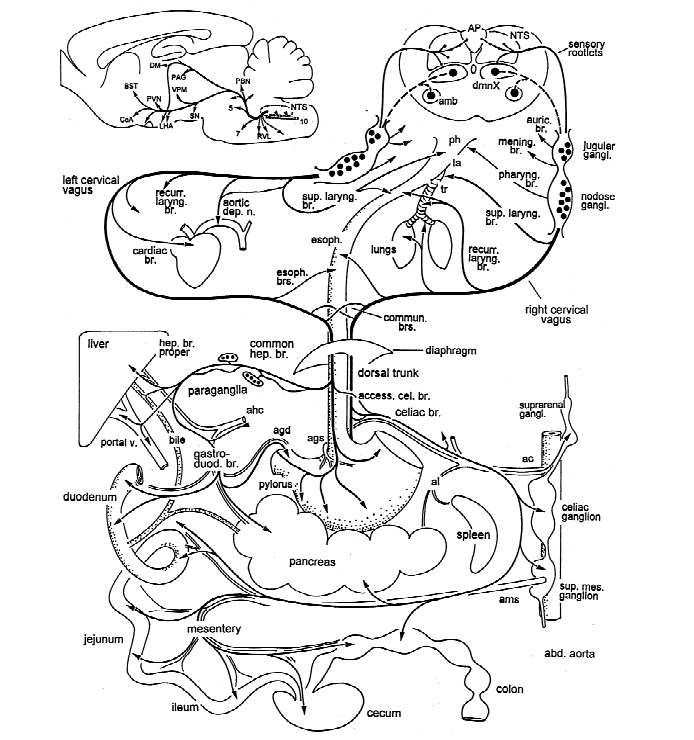
The communication between the brain and the body is a two-way street. Through sensory pathways like the vagus nerve, the brain is able to receive information of the body’s internal landscape on both conscious and unconscious levels, a process known as interoception (Khalsa et al. 2018). Interoception allows the nervous system to sense and integrate signals originating within the body. For example, when a person is dealing with stress, an elevated heart rate and digestive function can provide signals to the brain, which it will process along with information about the surrounding environment. These signals contribute to how we perceive and experience our emotions (Critchley and Garfinkel 2017) and to bodily regulation, highlighting the close relationship between physiological processes and how we feel (Khalsa et al. 2018).
So what happens once you have finished giving your presentation? Your heart rate may decrease, the queasy feeling that you felt in your stomach subsides, and you start to feel a little better. This is because as the stress response subsides, the vagus nerve plays a key role by modulating sinoatrial node activity, slowing the heart rate and facilitating the return to parasympathetic regulation (Roddick et al. 2025). Through knowing this, we can stimulate the vagus nerve to help us calm down. Through slow deep breaths, splashing your face with cold water, or even having a good laugh (Marshall 2025) .
This helps to show how closely our physical and emotional states are connected. Our brain and body are continuously exchanging information, influencing how we respond, and recover from our experiences. The vagus nerve is one part of the complex relationship that allows us to move through the world in the way that we do. So the next time you’re about to lead a presentation, maybe take some deep breaths, and help your vagus nerve to keep you calm.
Bibliography
Berthoud, Hans-Rudolf, and Winfried L Neuhuber. 2000. “Functional and Chemical Anatomy of the Afferent Vagal System.” Autonomic Neuroscience 85 (1–3): 1–17. https://doi.org/10.1016/s1566-0702(00)00215-0.
Critchley, Hugo D, and Sarah N Garfinkel. 2017. “Interoception and Emotion.” Current Opinion in Psychology 17 (October): 7–14. https://doi.org/10.1016/j.copsyc.2017.04.020.
Kenny, Brian J., and Bruno Bordoni. 2020. “Neuroanatomy, Cranial Nerve 10 (Vagus Nerve).” PubMed, StatPearls Publishing, November 7. https://www.ncbi.nlm.nih.gov/books/NBK537171/.
Khalsa, Sahib S, Ralph Adolphs, Oliver G Cameron, et al. 2018. “Interoception and Mental Health: A Roadmap.” Biological Psychiatry. Cognitive Neuroscience and Neuroimaging 3 (6): 501–13. https://doi.org/10.1016/j.bpsc.2017.12.004.
Marshall, Amy-Sarah. 2025. “5 Vagus Nerve Exercises to Try When You Need to Calm Down, Stat!” 5 Vagus Nerve Exercises to Calm You Down Now, March 18. https://www.uvahealth.com/healthy-balance/5-vagus-nerve-exercises.
Roddick, Charlotte M., Seo Yeon Soo, Shan-Li Barkovich, Luke Forrester, and Frances S. Chen. 2025. “Cardiac Vagal Recovery Following Acute Psychological Stress in Human Adults: A Scoping Review.” Neuroscience & Biobehavioral Reviews 176 (September): 106268. https://doi.org/10.1016/j.neubiorev.2025.106268.


Leave a Reply
You must be logged in to post a comment.