The typical spiders wait in webs, but jumping spiders hunt on foot (Garrison et al. 2016). One tempting explanation is that webs are costly, so shedding them must be an upgrade (Schmitz 2004, 2005). But a plausible story remains only a hypothesis; science consists of constant questioning and testing. Upon a closer look, abandoning web foraging looks less like an upgrade than a trade-off, and the evidence becomes far messier while trying to retrace historical evolution.
If webs are energetically costly, hunters should theoretically thrive ahead. In reality, the picture is a lot more balanced. Web-building spiders may raise their metabolic rate as much as 10-20 times above resting levels while spinning, but building is often brief, and in certain species, recycling web protein can substantially reduce the cost of making silk (Wilder 2011). Jumping spiders expend their energy differently: the jumping spider Marpissa muscosa had a cost of transport nearly double that of a wolf spider at top sustainable running speed, despite a lower resting metabolic rate (Schmitz 2004, 2005).
Testing the theory from a historical perspective, if abandoning webs was indeed a major advantage, webless lineages should have produced far more species than their web-spinning counterparts. Fernandez et al. (2018) analyzed about 2500 genes from 159 spider species and found no significant association between losing foraging webs and faster diversification, suggesting that habitat variety or biotic interactions may play a bigger influence. However, Garrison et al. (2016) found that the mostly ground-dwelling, webless Retrolateral Tibial Apophysis clade diversified faster than orb weavers, possibly because a rise in Cretaceous non-flying insects favored spiders feeding on ground-dwelling prey. Together they suggest that new food or habitats, not web loss itself, may have mattered, but historical tests as such can only show associations.
The factor that drove web loss is compensated in jumping spiders with superior senses. Jumping spiders hunt by sight, and their eyes solve a design trade-off by dividing the labour: wide-angle side eyes that are sensitive to motion, and principal eyes with the sharpest spatial acuity known among terrestrial invertebrates (Jakob et al. 2018). If the side eyes guide the principal eyes toward movement, masking them should stop the principal eyes from tracking moving targets. Jakob et al. (2018) tested this with a specialized eye-tracker: with the side eyes masked, the principal eyes generally stayed and relaxed instead of following moving disks. The web’s replacement comes with trade-offs of its own.
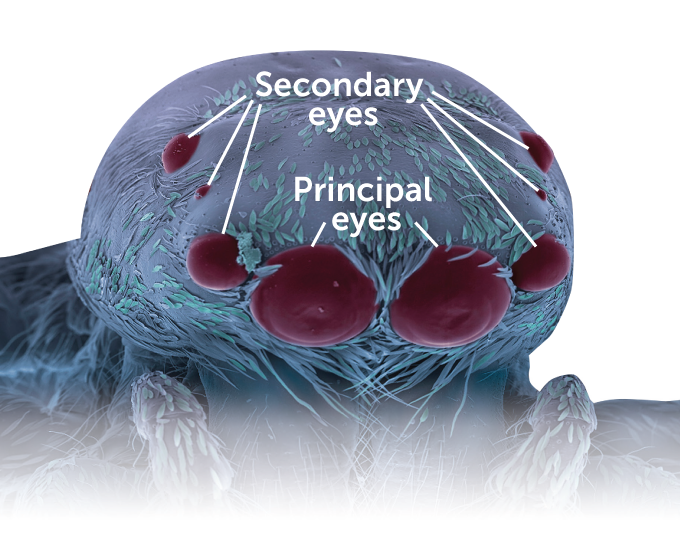
The assumption “leaving the web was an upgrade” thus functions better as a starting point than a conclusion. Broken into testable hypotheses, it yields an energy budget with costs on both sides, a contested historical record, and a hunting toolkit built on its own trade-off between acuity and motion detection. The studies present the evolution branching of jumping spiders as not simply progressively better, but instead a specialized lineage that traded one set of costs and benefits for another.
References
Fernández, Rosa, Robert J. Kallal, Dimitar Dimitrov, et al. 2018. “Phylogenomics, Diversification Dynamics, and Comparative Transcriptomics across the Spider Tree of Life.” Current Biology 28 (9): 1489–97.e5. https://doi.org/10.1016/j.cub.2018.03.064.
Garrison, Nicole L., Juanita Rodriguez, Ingi Agnarsson, et al. 2016. “Spider Phylogenomics: Untangling the Spider Tree of Life.” PeerJ 4: e1719. https://doi.org/10.7717/peerj.1719.
Jakob, Elizabeth M., Skye M. Long, Duane P. Harland, et al. 2018. “Lateral Eyes Direct Principal Eyes as Jumping Spiders Track Objects.” Current Biology 28 (18): R1092–93. https://doi.org/10.1016/j.cub.2018.07.065.
Mason, Betsy. 2022. “See the World through a Jumping Spider’s Eyes—and Other Senses.” Science News Explores, February 17, 2022. https://www.snexplores.org/article/jumping-spider-vision-eyes-color-senses-hearing-mating-courtship
Schmitz, Anke. 2004. “Metabolic Rates during Rest and Activity in Differently Tracheated Spiders (Arachnida, Araneae): Pardosa lugubris (Lycosidae) and Marpissa muscosa (Salticidae).” Journal of Comparative Physiology B 174 (7): 519–26. https://doi.org/10.1007/s00360-004-0440-6.
Schmitz, Anke. 2005. “Spiders on a Treadmill: Influence of Running Activity on Metabolic Rates in Pardosa lugubris (Araneae, Lycosidae) and Marpissa muscosa (Araneae, Salticidae).” Journal of Experimental Biology 208 (7): 1401–11. https://doi.org/10.1242/jeb.01497.
Wilder, Shawn M. 2011. “Spider Nutrition: An Integrative Perspective.” Advances in Insect Physiology 40: 87–136. https://doi.org/10.1016/B978-0-12-387668-3.00002-7.
Comments
7 Responses to “Leaving the Web: Upgrade or Trade-off?”
In life science, we learned that not every evolution by natural selection is progressive and that every adaption is constrained by trade-offs and tailored towards a specialisation for better survival. The concept of studying organisms from different perspectives has also inspired me to discuss the jumping spider from various scopes. The absolute dating module in Earth science has taught me that the deep past cannot be observed directly. Evolutionary history has the same limitation, which also helped me settle on this topic.
Hi Brand! I enjoyed reading your blog about spiders, it was a very interesting read. Your blog is overall very well written, and has a nice flow.
Here is some feedback you may consider implementing:
– P2S2: there is a small typo, there is an s after web-building. I believe it should be “Web-building spiders…”
– P2S3: small grammar mistake, it should be either “A jumping spider expends its energy differently” or “Jumping spiders expend their energy differently”
– Not sure if it is possible to italicize text on here, but if it is, “Maripissa muscosa” should be italicized, because in formal scientific writing, the species name is italicized.
– Not sure if this is possible, but if you could find a table with data comparing your point about wolf spiders and jumping spiders in P2, it would strengthen your blog
– P3S1: small grammar mistake, the word “if” is capitalized in “… perspective, If abandoning…”
– P3S3 what does “RTA” stand for? I think it is important to state the acronym as a whole word then say (RTA) afterwards.
Overall, nice work!
Happy editing 🙂
– Hafsah S
Hello Hafsah,
Thank you for your feedback! I am glad you enjoyed the blog. I have applied all suggestions for grammar and corrected all of the errors. Thank you for pointing out the ambiguity with RTA, It was meant to stand for Retrolateral Tibial Apophysis which is a specific group of araneomorph spiders. I have replaced it with its full name for clarity.
While I do agree adding a table comparing the cost of transport of wolf spiders and jumping spiders in paragraph 2 would help support the point, I am not going to as I want to avoid putting a lot emphasis on one point with an elaborated data table. Also for the sake of word count and flow, I am going to keep that part as is to serve more as a quick fact.
Thank you,
Brand
Hi Brand!
I love the topic of your blog post; it is so fascinating to question spider webs in the context of jumping spiders!
Some suggestions:
-in P1, I think you are missing in-text citations. Remember to always cite your source in the first and last sentences where you are referencing it!
-Your conclusion paragraph appears to not have a line separating it from the second last paragraph; if you added it it might be easier to read and follow the flow of the paragraphs.
-Remember to change your “References” title to a bold blue heading
Overall, awesome blog post and happy editing!
-Heer
Hello Heer,
Thank you for reading! I am glad you pointed these out. I have added in-text citations on the introductory paragraph and also fixed the formatting of the paragraphs. I had it together by mistake and it was definitely meant to be two separate paragraphs, thank you so much! I also changed the reference title formatting as you suggested.
Best,
Brand
Hi Brand,
This is a really interesting topic! I never knew how much energy goes into being an active hunter. Here are a few suggestions:
-If word count permits, I think having a figure/visual explaining the jumping spider’s visual system and functional division of labor would be really beneficial for the reader.
-Whenever you use the scientific name of a species, it should be italicized!
-P2: Make sure that you are writing “Marpissa” and not “Maripissa”
-P3: In your first sentence, the “if” after the comma is capitalized
Overall, you did an amazing job, and I cannot wait to read your final copy!
Happy editing,
Via
Hi Via,
Thank you for reading! I appreciate your feedback. I have fixed all the grammatical errors as you have suggested. I also added a visual to help elaborate on the jumping spider’s visual system as I have realised trying to digest the information as a reader might be slightly challenging on a first-time basis. Thank you for pointing that out!
Regards,
Brand