Though the earliest relatives of the seaweed plant date back to more than 1.6 billion years ago, it remains one of the most versatile plants of the modern world (Osterloff 2017). “Seaweed” is the common name used to classify large, multicellular algae. Among the years, its applications have evolved—from being known as a gastronomical treasure back in ancient times, to modern plastic alternatives. Yet, there exists another important hallmark in the creation of sustainable alternatives—seaweed fertilizer.
A fertilizer can be classified as a natural/synthetic material used to supply essential nutrients for plant growth (Macmillan et al. 2025). The Haber-Bosch process, invented in 1909, allowed for the production of ammonia from nitrogen and hydrogen and catapulted the production of nitrogen fertilizers (Smith et al. 2020). These are a type of Chemical Fertilizer (CF), which are manufactured fertilizers that generally contain higher concentrations of macronutrients essential for plant growth, such as nitrogen, potassium and phosphorus. Seaweed fertilizers function similarly by providing plants with these macronutrients, in addition to rare elements such as zinc, bromine, and iodine, which are unique to marine organisms (Meng et al. 2022). Their administration differs from CFs, as they do not directly supply nutrients to crops, instead promoting cultures of probiotic bacterias and fungi which integrate them into the soil (MR Wahane et al. 2020).
In terms of efficacy, the organic extract promotes growth through an improvement in soil quality and moisture retention. The probiotics contained in the soil possess enzymes such as sucrase and cellulase (involved in polysaccharide degradation), as well as nitrogen-fixing capabilities. Long-term application has been shown to decrease the content of pathogenic bacteria within soil (Qiqin et al. 2023).
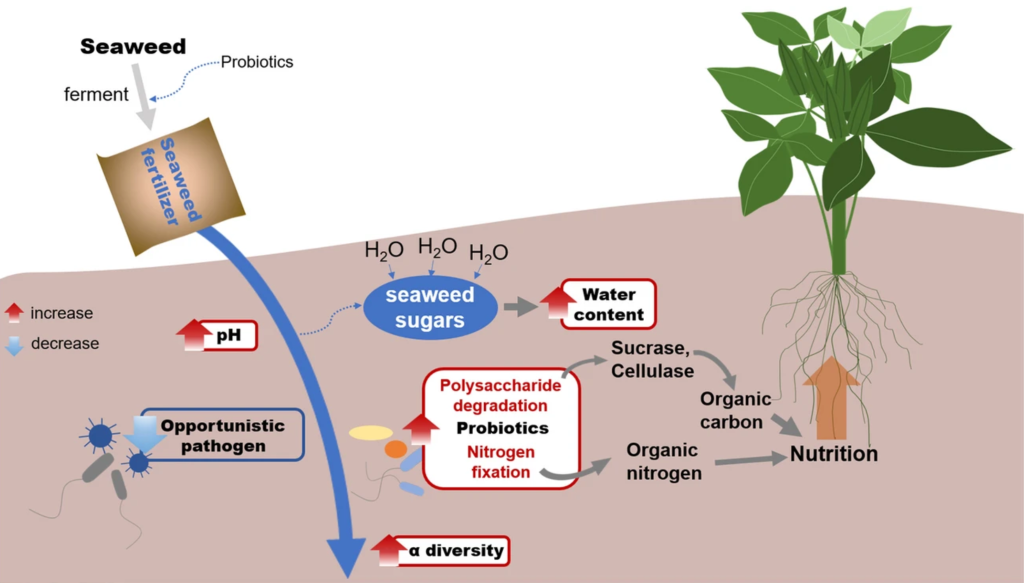
Figure 1: An illustration of the effects of applying the fertilizer into surrounding plant soil, leading to increased nutritional uptake, decreased pathogen content and other effects mentioned above (Qiqin et al. 2023)
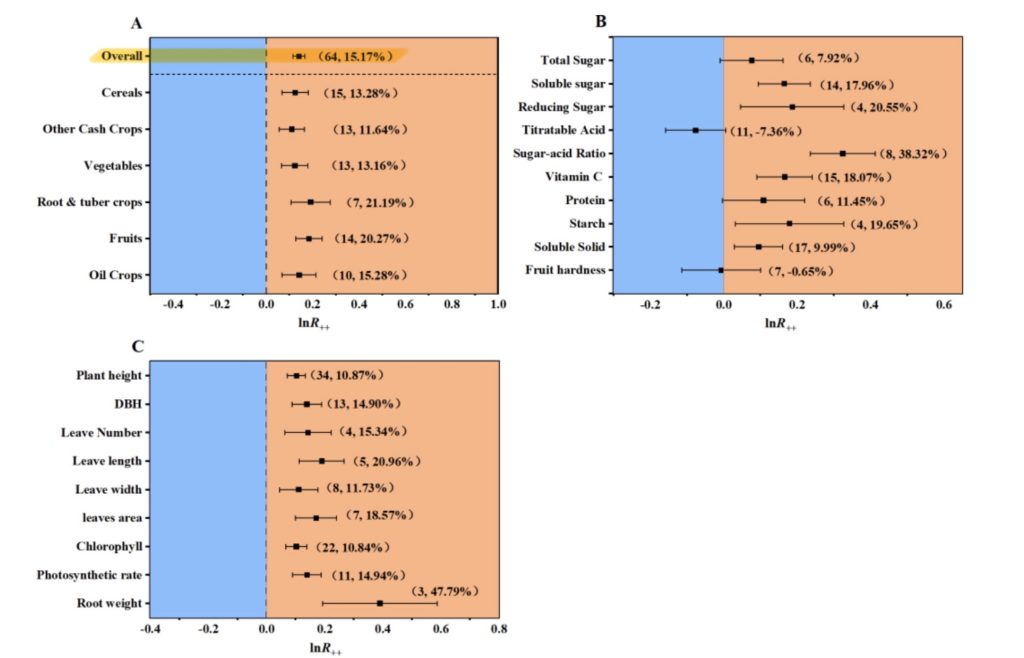
Figure 2: Graphs of the results of (Pei et al. 2024) which show that the application of a seaweed fertilizer exhibited an average increased crop yield of 15.17% compared to a non-fertilizer control group. The different tables represent quantifiable characteristics to measure the fertilizer’s efficacy. Section A represents the effects of the fertilizer on different types of crops while B is the effect on quality and C is the effect on plant growth.
In comparison to CFs, seaweed fertilizers have a slower effect on the soil. However, why are so many green farmers opting towards using them?
The overuse of CFs can result in unseen and undesirable effects on soil health. Many CFs contain traces of heavy metals, which can enter the food chain to cause low birth rate, congenital disabilities, and cancers in humans (T. and M.a. 2023). Another common phenomenon associated with the overuse of chemical fertilizers is known as Nitrogen Leaching. This is the process where nitrate (NO3−) anion[s] are carried by groundwater moving downwards through the soil (Padilla et al. 2018). In turn, excessive use of CFs can contaminate the groundwater and harm animal populations, leading to more costly consequences in the long run when the soil becomes no longer viable for use.
New innovations in green technology are popping up every day, allowing us to conserve resources for future generations to come. Despite our reliance on chemical fertilizers for centuries, there is still time to pivot to more sustainable alternatives. After all, seaweed is (quite literally) greener!
References
Macmillan, S. R., R. A. Hedlin, Tom Jensen, and Cynthia Grant. 2025. “Fertilizer.” Thecanadianencyclopedia.Ca. https://thecanadianencyclopedia.ca/en/article/fertilizer.
Meng, Cuiping, Gu Xue, Haiyan Liang, et al. 2022. “Optimized Preparation and High-Efficient Application of Seaweed Fertilizer on Peanut.” Journal of Agriculture and Food Research 7 (March): 100275. https://doi.org/10.1016/j.jafr.2022.100275.
MR Wahane, NA Meshram, SS More, and NH Khobragade. 2020. “Biofertilizer and Their Role in Sustainable Agriculture-A Review.” The Pharma Innovation Journal 9 (7): 127–30. https://www.thepharmajournal.com/archives/?year=2020&vol=9&issue=7&ArticleId=4846.
Osterloff, Emily. 2017. “Seaweeds: A Hidden Habitat Under Threat.” Nhm.Ac.Uk. https://www.nhm.ac.uk/discover/seaweeds-a-hidden-habitat-under-threat.html.
Padilla, Francisco M., Marisa Gallardo, and Francisco Manzano-Agugliaro. 2018. “Global Trends in Nitrate Leaching Research in the 1960–2017 Period.” Science of The Total Environment 643 (December): 400–413. https://doi.org/10.1016/j.scitotenv.2018.06.215.
Pei, Baolei, Yunpeng Zhang, Ting Liu, et al. 2024. “Effects of Seaweed Fertilizer Application on Crops’ Yield and Quality in Field Conditions in China-A Meta-Analysis.” PLOS ONE 19 (7): e0307517. https://doi.org/10.1371/journal.pone.0307517.
Qiqin, Liu, Zhou Huaguang, Sun Minxiu, et al. 2023. “Improvement of Soil Structure and Bacterial Composition by Long-Term Application of Seaweed Fertilizer.” Journal of Soil Science and Plant Nutrition 23 (4): 5122–32. https://doi.org/10.1007/s42729-023-01341-0.
Smith, Collin, Alfred K. Hill, and Laura Torrente-Murciano. 2020. “Current and Future Role of Haber–Bosch Ammonia in a Carbon-Free Energy Landscape.” Energy Environ. Sci. 13 (2): 331–44. https://doi.org/10.1039/c9ee02873k.
T., Karthik, and Jayasri M.a. 2023. “Systematic Study on the Effect of Seaweed Fertilizer on the Growth and Yield of Vigna Radiata (L.) R. Wilczek (Mung Bean).” Journal of Agriculture and Food Research 14 (December): 100748. https://doi.org/10.1016/j.jafr.2023.100748.
Comments
7 Responses to “Gee, I love Algae! — An Exploration of Seaweed Fertilizers”
Hey iSci! This blog post was inspired by Unit 1: Sustainable Chemistry, particularly the concept of green chemistry and the search for more sustainable/safer alternatives to existing processes (Ibuprofen synthesis). I wanted to combine this with the material in earth science, and hence decided to focus on soil health and crop yield (from the introductory lecture about climate change decreasing potato crop yield). Though climate change was one aspect that could lead to adverse conditions in soil, I thought about other potential aspects that could affect the soil and stumbled across my current topic— fertilizers!
Hi Cynthia,
This was an interesting topic! This was my first time hearing that seaweeds could be used as fertilizers as well! I enjoyed learning about it.
As an overall suggestion, I noticed you had several direct quotes in your article. While it is proper to use them for exact definitions, I think it might be better to reword some of them into your own sentences so they integrate more smoothly. A few examples where I think this would work well:
– P3S4 “rare elements (such as zinc, bromine, and iodine) which are unique to marine organisms.”
– P6S4 “nitrate (NO3−) anion[s] moves downwards in the soil profile with soil water.”
A few other minor issues:
– P1S1: Subject-verb agreement. Since “relatives” is plural, it should be “date back” instead of “dates back.”
– P1S3 & P1S4: I believe the Chicago Manual of Style (2024) omits spaces both before and after an em dash. Here is the link: https://www.chicagomanualofstyle.org/qanda/data/faq/topics/HyphensEnDashesEmDashes/faq0108.html.
– P6S2: “Many CFs contain traces of heavy metals” is a complete sentence on its own, so I believe there should be a comma before the word “which”.
– P6S4: I believe “groundwater” is one word.
– P6S7: I believe “long run” is not connected by a hyphen in this case, as it is not a compound adjective.
– I believe it is best to hyperlink the sources.
Best,
Jerry Wu
Hello Jerry,
Thank you for the feedback, I am glad you enjoyed reading my post! I’ve implemented your suggestions and fixed the citations/grammar.
Hi Cynthia!
I found your blog post very interesting and all of the new technologies around sustainable chemistry are very cool.
I have a couple suggestions:
– P2S1: you don’t need to put quotation marks around what fertilizer can be classified as
– P1S4: you don’t have to include what the subject of the paper is
– What is the Haber-Bosch process?
– You seemed to have the same paragraph twice, P2 and P3 are the same
– P2S2 the citation can go at the end of the sentence even though it might not apply to the whole paragraph
– P2S4 the quotation marks are unnecessary
– P2S5 I would have thought adding in bacteria to crops would be a bad thing? Is there an example of good bacteria cultures in seaweed fertilizer?
– Make sure to introduce your figures/give context!
– Figure 2, you mention the increased crop yield compared to the control, would you be able to highlight these numbers so it is easier for the audience to read?
– The last sentence in P5 seems very similar to the first sentence, maybe merge the two?
– P5 no need for quotations and the word ‘moves’ I think you can remove the ‘s’
Overall amazing job, happy editing!
– Emily
Hello Emily,
Thank you for your kind words and feedback! I’ve implemented the suggestions you mentioned, and removed the duplicate paragraph (I thought I removed it before I posted it, but maybe it didn’t save!). I also clarified the sentence on good bacterial cultures as well as editing figure 2.
Hi Cynthia,
I really enjoyed how you connected green chemistry with agriculture and the flow of the blog is great.
Quick suggestions for your figures,
1. For Figure 2’s caption, I would deeply recommend describing where to look and focus our attention on. At first glance, the graphic itself looked a bit heavy on statistics that take quite a bit of time to understand and track down where to actually find the info we’d like to see (this being the overall growth statistic). If you’d like to streamline the reader’s attention, perhaps mentioning what each of the graphs represent other than using only a small statistic in a very large graph would work great.
2. Also, just to go a bit further and beyond, one small thing I noticed is that Figure 1 seems to sum up several points that are already explained directly above it. You could potentially let the figure visualize more information you explain above to save words so that the surrounding paragraphs can have room for any additional things you’d like to add.
Overall very nice job writing this,
Teddy
Hello Teddy,
Thank you for the suggestions and kind feedback! I’ve implemented the edit for figure 2’s caption, however have chosen to keep the surrounding paragraphs as it would unfortunately put me under word count 🙁 Nonetheless, thank you!