How did the universe form? This is one of the most pressing questions in the scientific community. Despite technological advances, the nature of our existence remains a mystery.
Researchers are now saying that normal matter makes up only 4% of the universe, whereas the other 96% may be dark matter and dark energy(Agency 2022). Dark matter is widely regarded as a “cosmic glue” that holds the universe together. This can be attributed to the fact that dark matter does not interact with light, but its gravity can bend light(Betz 2020). Though dark matter particles cannot be physically seen, its gravitational effect can be observed. After the Big Bang, the same amounts of hydrogen, photons and dark matter were present(Rubinobservatory.Org, n.d.). However, small clumps of matter existed and began to grow in size. They gained new effects, such as being able to turn gas into stars and form new galaxies. These can be referred to as “halos”(Rubinobservatory.Org, n.d.). The gravity of dark matter then began to pull in normal matter, allowing galaxies and stars to form (ScienceDaily 2026). Thus, dark matter played a foundational role in shaping structures that allowed for planetary systems to form.
One galaxy cluster that provides strong evidence for the existence of Dark matter is the Bullet Cluster(Figure 1). This cluster is composed of two clusters that collided previously in an energetic manner(NASA 2006). An X-Ray showed that hot gas from one cluster passed through the hot gas of the other cluster during their collision. Further imaging showed that most of the mass is separated from normal matter, shown in pink(NASA 2006). The concentration of mass determined is a result of gravitational lensing(NASA 2006). Scientists believe that during the collision of the two clumps, dark matter strayed away from the hot gas, causing the separation between normal and dark matter(NASA 2006).
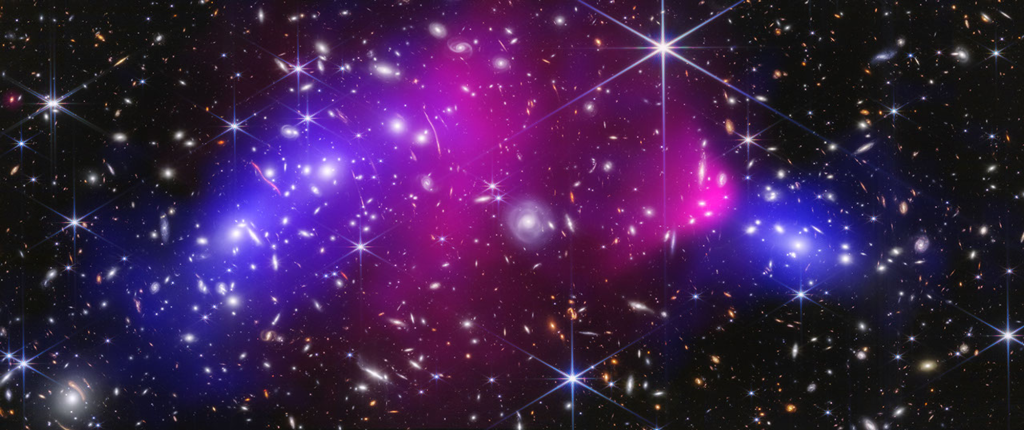
Figure 1: Bullet Cluster(NASA 2006)
While dark matter can help explain galaxy formation, dark energy remains more mysterious. The definition of dark energy is still unclear, but scientists label it as something that causes the universe to expand at a faster rate(Kazmierczak 2025). It does this by exerting negative pressure and pushing space outwards. One possible explanation for dark energy is vacuum energy, which is said to exist throughout space(Kazmierczak 2025). According to quantum field theory, space is not exactly devoid of energy and that there exist virtual particles, which consist of pairs of particles and antiparticles(Kazmierczak 2025). These particles are said to pop in and out of existence, an attribute deemed to be possible by dark energy(Kazmierczak 2025). However, there is a discrepancy in the calculation of the amount of vacuum energy, illustrating that there is a crucial piece missing in this puzzle.
Ultimately, the 96% of “invisible” matter that shapes our universe dictates everything we see and experience. As astronomical technology advances, scientists will gain tools to better understand these invisible components and, in turn, reveal how the universe came to be.
References
Agency, Canadian Space. 2022. “The Mysteries of Dark Matter and Dark Energy.” Canadian Space Agency, September 28. https://www.asc-csa.gc.ca/eng/astronomy/beyond-our-solar-system/dark-matter-and-dark-energy.asp.
Betz, Eric. 2020. “What’s the Difference Between Dark Matter and Dark Energy?” Astronomy Magazine, March 3. https://www.astronomy.com/science/whats-the-difference-between-dark-matter-and-dark-energy/.
Kazmierczak, Jeanette. 2025. “What Is Dark Energy? Inside Our Accelerating, Expanding Universe.” NASA Science, NASA, March 7. https://science.nasa.gov/dark-energy/.
NASA. 2006. Bullet Cluster: Direct Proof of Dark Matter. https://chandra.harvard.edu/graphics/resources/handouts/lithos/bullet_lithos.pdf.
Rubinobservatory.Org. n.d. “How Does Dark Matter Affect the Evolution of the Universe?” Accessed September 20, 2026. https://rubinobservatory.org/explore/science-goals/dark-matter.
ScienceDaily. 2026. “Scientists Just Mapped the Hidden Structure Holding the Universe Together.” https://www.sciencedaily.com/releases/2026/02/260203020205.htm.


Leave a Reply
You must be logged in to post a comment.