Heavy metals, in small concentrations, are essential for many biological processes. However, they can pose serious health risks if they accumulate in the body (Kim et al. 2019). Heavy metals can enter our surroundings through a number of natural processes including erosion and weathering of the earth’s crust, mining, runoff, and even through insecticides applied to crops. The most common heavy metals are arsenic, cadmium, chromium, copper, lead, nickel, and zinc which can all pose risks to human health and have unique mechanisms of toxicity. Heavy metal toxicity can cause damage to a number of organs including the brain, kidney, liver, and lungs. Long term exposure has even more concerning effects including neurological degeneration, and can imitate the symptoms of Parkinson’s and Alzheimer’s disease. Additionally, arsenic, chromium, lead, and cadmium are carcinogenic (Jaishankar et al. 2014). The main treatment used for metal toxicity is chelation therapy (Kim et al. 2019).
Chelating therapy is based on interactions between a metal centre and a chelating ligand. It works because the chelating agent binds with the toxic metal centre to form a stable complex that can be safely eliminated by the kidney. A ligand is defined as a molecule or ion that binds to a metal center to form a coordination complex. Chelating or polydentate ligands are ligands capable of bonding to a metal centre by more than one point of attachment (Figure 1) (Lundgren and Stradiotto 2016).
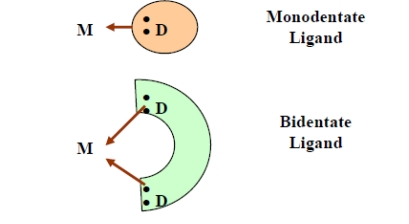
Chelating ligands form more stable complexes and have greater formation constants than those formed with the same number of monodentate ligands (Lundgren and Stradiotto 2016). This effect can be explained by differences in reaction entropy. Consider a metal in solution bound to two water molecules (Figure 2).
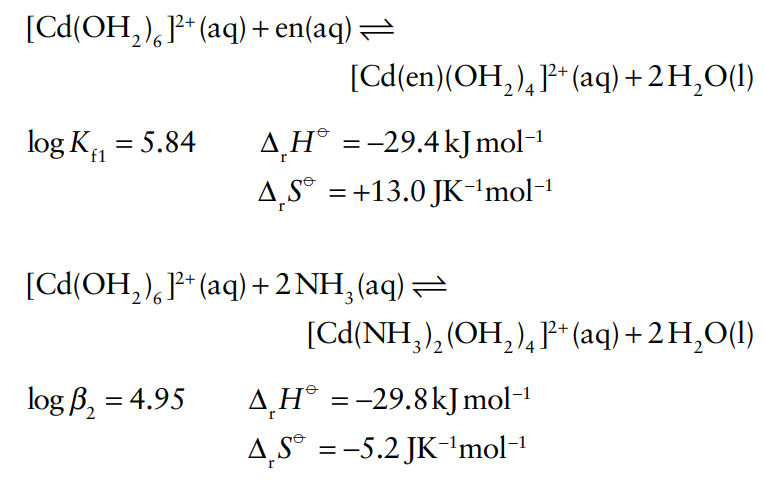
These water molecules can be displaced by ligands introduced to the system. A greater formation constant can be seen in the reaction with the bidentate ligand (en) than with the monodentate ligand (NH3). This means the reaction with the bidentate ligand proceeds more favourably, and the product has a higher stability. These reactions have almost identical changes in enthalpy, but the reaction with en has a greater increase in entropy, because there are more free molecules in the products than in the reactants (Weller et al. 2025). The affinity of chelating ligands to bind to metal centers is essential in the effectiveness of chelation therapy.
Ideal chelating agents to use as treatments for heavy metal toxicity must be: highly soluble in water, resistant to biotransformation, able to reach sites of metal storage, and retain their chelating ability at body pH (Flora and Pachauri 2010). They also should have a higher affinity for binding with toxic metals than other metals present in the body (Kim et al. 2019). The most commonly used chelating agent is Calcium disodium ethylenediamine tetraacetic acid (CaNa2EDTA), which is primarily used for lead poisoning but is also used to treat poisoning of any metal with a higher affinity for binding than Ca²⁺ (Flora and Pachauri 2010).
Heavy metal toxicity poses a health risk, and people can be exposed to these metals by a number of natural processes. The most common and effective treatment for heavy metal poisoning is chelation therapy. Chelation therapy can be simply explained by the behaviour of metal coordination complexes, and can allow for these metals to be safely eliminated by the body.
References
Flora, Swaran J. S., and Vidhu Pachauri. 2010. “Chelation in Metal Intoxication.” International Journal of Environmental Research and Public Health 7 (7): 2745–88. https://doi.org/10.3390/ijerph7072745.
Jaishankar, Monisha, Tenzin Tseten, Naresh Anbalagan, Blessy B. Mathew, and Krishnamurthy N. Beeregowda. 2014. “Toxicity, Mechanism and Health Effects of Some Heavy Metals.” Interdisciplinary Toxicology 7 (2): 60–72. https://doi.org/10.2478/intox-2014-0009.
Kim, Jong-Joo, You-Sam Kim, and Vijay Kumar. 2019. “Heavy Metal Toxicity: An Update of Chelating Therapeutic Strategies.” Journal of Trace Elements in Medicine and Biology 54 (July): 226–31. https://doi.org/10.1016/j.jtemb.2019.05.003.
Lundgren, Rylan J., and Mark Stradiotto. 2016. Key Concepts in Ligand Design. September 2, 1–14. https://doi.org/10.1002/9781118839621.ch1.
Weller, Mark, Jonathan Rourke, Fraser Armstrong, Simon Lancaster, and Dr Tina Overton. 2025. Inorganic Chemistry. Eighth Edition, New to this Edition: Oxford University Press.


Leave a Reply
You must be logged in to post a comment.