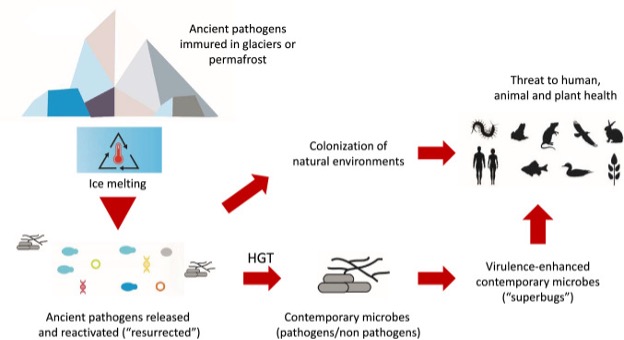
For about 34 million years, the cryosphere has been home to ancient pathogens—a pristine environment that remained untouched —but now, with climate change, that ice is melting, leaving us with the question: what happens when those pathogens escape the ice? (Yarzábal et al. 2021; Defebaugh 2021)
Outbreaks from emerging pathogens mostly come from humans invading virgin territory or from close contact between people and wildlife removed from their habitats (Yarzábal et al. 2021). Scientists warn that climate change can release old viruses that may create new infectious disease outbreaks; these pathogens are called “zombie viruses” because they remain preserved in ice and may become infectious when thawed. In a study led by Jean-Michel Claverie, researchers recovered infectious viruses from Siberian permafrost, some of which had been frozen for thousands of years. The revived viruses infected amoebae, showing that frozen viruses were able to remain infectious even after long periods of being frozen, a terrifying discovery for humans (McKie 2024). Normally, viruses die when exposed to heat or other environmental conditions, but freezing slows processes that can help viruses remain infectious (Smith et al. 2004).
Scientists are trying to determine which viruses may survive ice, for example, Influenza A viruses, which spread through migratory birds and marine mammals. Enteroviruses, including polioviruses, can spread through contaminated water and remain viable. Finally, Caliciviruses, which infect marine mammals such as seals and whales, can also infect humans and terrestrial mammals; caliciviruses are the most abundant (Smith et al. 2004).
Some of these frozen pathogens can infect both humans and animals; after thawing, some eradicated viruses may return, such as smallpox and the Spanish flu. If these diseases are reintroduced, people will have never been exposed to them, so we will have no protection. However, studies on these pathogens are scarce and inconsistent, so we remain unsure of the possible dangers (Caruso and Rizzo 2025).
Knowing these frozen pathogens could escape raises the question: should we be worried? Scientists suggest that the risk is small, but can’t be completely ignored. So far, no overwhelming evidence shows that zombie pathogens pose a major threat to human health. We should worry more about the risk human activity poses to the environment than the risk these viruses pose to us (Harvey 2020).
References
Caruso, Gabriella, and Carmen Rizzo. 2025. “Cryosphere Microbial Communities as a Reservoir of Hidden Risks to Human and Ecosystem’s Health.” Microbiological Research 299 (October): 128261. https://doi.org/10.1016/j.micres.2025.128261.
Defebaugh, Willow. 2021. Frozen in Time. December 2. https://atmos.earth/ecological-wisdom/cryosphere-ice-age-glacial-loss-history/.
Harvey, Chelsea. 2020. ‘Zombie’ Viruses: Can They Escape the Thawing Arctic? April 14. https://www.eenews.net/articles/zombie-viruses-can-they-escape-the-thawing-arctic/.
McKie, Robin. 2024. Arctic Zombie Viruses in Siberia Could Spark Terrifying New Pandemic, Scientists Warn. January 21. https://www.theguardian.com/society/2024/jan/21/arctic-zombie-viruses-in-siberia-could-spark-terrifying-new-pandemic-scientists-warn.
Smith, Alvin W., Douglas E. Skilling, John D. Castello, and Scott O. Rogers. 2004. “Ice as a Reservoir for Pathogenic Human Viruses: Specifically, Caliciviruses, Influenza Viruses, and Enteroviruses.” Medical Hypotheses 63 (4): 560–66. https://doi.org/10.1016/j.mehy.2004.05.011.
Yarzábal, Luis Andrés, Lenys M. Buela Salazar, and Ramón Alberto Batista-García. 2021. “Climate Change, Melting Cryosphere and Frozen Pathogens: Should We Worry…?” Environmental Sustainability 4 (3): 489–501. https://doi.org/10.1007/s42398-021-00184-8.


Leave a Reply
You must be logged in to post a comment.