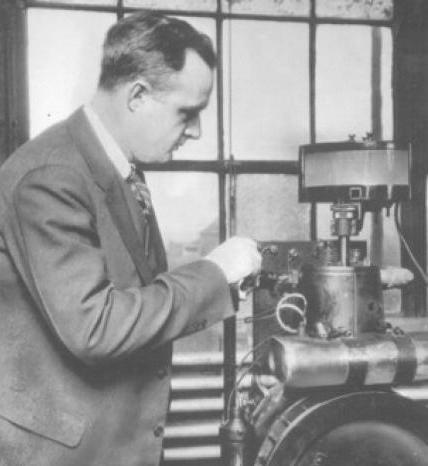
The story of Thomas Midgley Jr. is a cautionary tale of the power of scientific research, and its consequent potential dangers. As an engineer with over 100 patents by the end of his career, Midgley (Figure 1) could always be expected to be working on the next big breakthrough (National Inventors Hall of Fame, 2003). The fact that his discoveries would come to threaten all life on Earth was not expected.

During his time working at General Motors (GM), Midgley was tasked to develop a type of gasoline that eliminated “knocking” in the combustion engines of cars (Edelmann, 2016). Knocking was the sharp sounds produced by the new car engines of the early 1900s. Air-fuel mixture in the combustion chamber was compressed more than before, and this caused extra combustion when certain fuels were used (Figure 2). This produced pressure waves that caused vibrations heard as an audible knock (Britannica, 2015).

In 1921, Midgley discovered that adding tetraethyl lead to gasoline was a cheap way to reduce this noisy knock by raising the temperature and pressure at which auto-ignition occurs. As a result, GM began marketing leaded gasoline and the public treated it as a breakthrough (Kovarik, 2005). At one point, Midgley inhaled leaded gas at a public conference to show its safety, but fell ill a couple days later due to lead-poisoning (Edelmann, 2016). Lead is highly toxic, and this was well known at the time, but the effects of its addition to gasoline was undermined by the companies that sold leaded gas.
Tetraethyl lead is hydrophobic in order for it to be compatible with gasoline, meaning it is not easily broken down by water and it bioaccumulates in living tissue (Edelmann, 2016). Lead impacts nearly all human organ systems, notably causing neuropsychiatric effects such as delayed reaction times, irritability, and difficulty in concentrating. Lead is also known to cause developmental issues in children (Wani, Ara, and Usmani, 2015). Interestingly, some suggest that the addition of lead to gas in the mid-1900s led to the later uptick in crime in the late 1900s due to the neurological issues it caused in children as they grew up (Beckley, et al., 2017).
Leaded gasoline was not Midgley’s only harmful invention. He also invented the first of chlorofluorocarbons (CFCs) used as a replacement for toxic refrigerants at the time. This time when he inhaled the gas in public to show its safety, the CFCs were actually nontoxic. However, decades later, it would be shown that CFCs were the driving force behind the depletion of the Earth’s ozone layer. Midgley died before the effects of CFCs on the ozone layer were known. He was strangled by yet another one of his inventions: a system of pulleys and strings designed to lift himself out of bed when he contracted polio (Edelmann, 2016).
Scientists have the potential to change the world, but it is this very fact that makes it crucial to be a responsible scientist. Thomas Midgley’s story shows that dismissing known risks and potential future harms could have catastrophic implications.
References
Arduino, D., 2020. Experimental study of gasoline direct injection under spray collapse conditions. [image online] MSc. Politecnico Di Torino. http://dx.doi.org/10.13140/RG.2.2.32511.56481 [Accessed 22 October 2022].
Beckley A.L., Caspi A., Broadbent J., et al, 2018. Association of Childhood Blood Lead Levels With Criminal Offending. JAMA Pediatrics. 172(2), pp. 166-173. https://doi.org/10.1001%2Fjamapediatrics.2017.4005
Britannica, T. Editors of Encyclopaedia, 2015. knocking. Encyclopedia Britannica. Available at https://www.britannica.com/technology/knocking-internal-combustion-engine [Accessed 22 October 2022].
Edelmann, F.T., 2016. The life and legacy of Thomas Midgley Jr. Papers and Proceedings of the Royal Society of Tasmania. 150(1), pp.45-49. https://doi.org/10.26749/rstpp.150.1.45
Kovarik, W., 2005. Ethyl-leaded gasoline: How a classic occupational disease became an international public health disaster. International Journal of Occupational and Environmental Health. 11(4), pp. 384-397. https://doi.org/10.1179/oeh.2005.11.4.384
National Inventors Hall of Fame, 2003. Thomas Midgley, Jr [image online] Available at https://www.invent.org/inductees/thomas-midgley-jr [Accessed 22 October 2022].
Wani, A., Ara, A., and Usmani, J.A., 2015. Lead toxicity: a review. Interdisciplinary Toxicology. 8(2), pp. 55-64. https://doi.org/10.1515%2Fintox-2015-0009
Comments
9 Responses to “The One-Man Environmental Disaster”
Hi iSci!
I was intrigued when I learned about lead contamination during a chemistry lecture and was reminded about how lead was used in gasoline. After looking into it, I discovered Thomas Midgely Jr., and his bizarre life and inventions inspired me to write my blog post about him! I hope you also enjoy this tragic tale of innovation and the rippling effects of his work from the perspective of chemistry and biology.
Happy reading, and I look forward to seeing your feedback and comments!
Hi Arnica!
Your post was incredibly well written, and I found the way you described foreign concepts (I.e., “knocking”) very easy to understand.
I knew as soon as I saw the title of your post on the Synopsis dashboard, I wanted to read your post, and as expected your topic was extremely interesting! (I kind of feel bad for Midgley, oh my goodness he just could not catch a break.)
A few suggestions I have are the following:
-It is not necessary at all, but when referring to figures you could also write “(Figure 1)”. Using brackets rather than incorporating it into the sentence would prevent needing to deter from the point being made.
-When referring to General Motors, make sure to introduce the acronym when the company is first mentioned. This way, when the reader sees “GM” in the following paragraph they are certain of what it stands for.
-In paragraph four, I am not sure the word “Specifically” fits with the rest of the sentence. The introduction would work fine without it or perhaps a different word (ex: Furthermore, Moreover, Additionally, etc. could be used in its place).
-Most likely this is just a typo but there is an extra space at the beginning of paragraph four’s second sentence.
-In paragraph four, at the end of the phrase: “Lead is also known to cause developmental issues in children,” be sure the in-text citation is before the period, it seems there is an extra period that was not deleted after “children”.
-In paragraph four we are given the time frame, “early mid-1900s” perhaps be more specific with the wording, it is a bit contradictive as it is currently phrased. A possible alternative would be saying, “early to mid-1900s”.
Again, amazing job, I thoroughly enjoyed reading your article!
-Rakel
Hi Rakel!
You made some great points, and I have applied your suggestions to my blog post. Thank you so much for your feedback!
Hey Arnica,
I really enjoyed reading your blog post! I thought you did a great job of taking an interesting topic and simplifying it so it could be easily understood. A few comments:
In your second paragraph, I found the sentence “Knocking” was the sharp sounds produced by a car engine in newer models of cars of the early 1900s” to be a little wordy. Maybe condensing it to “Knocking” was the sharp sounds produced by the new car engines of the early 1900s” would help it flow.
I am not sure if you have the space for it but I am curious why adding tetraethyl lead to gasoline eliminated the knocking sound. I think it could be beneficial to add a sentence or two briefly explaining the science behind this.
In paragraph four, you have an extra space after your first citation and before the word “lead.”
Great work on your blog post, I am looking forward to reading your final copy!
All the best,
Hi Isaac!
I fixed a couple of the typos and tried to improve sentence clarity. I also added a bit on why tetraethyl lead eliminated the knocking sound. Thank you for your feedback!
Hi Arnica!
Your post was very interesting and well-written. I really enjoyed learning about Thomas Midgley Jr.’s unfortunately harmful inventions. I think you did a really good job at explaining concepts very concisely and with enough detail, such as knocking and tetraethyl lead.
A few comments and suggestions I have:
-I agree with Rakel and think you should introduce the acronym for General Motors in the second paragraph. (For example, “During his time working at General Motors (GM), Midgley…”)
-In the first paragraph, I believe you should refer to the figures as (Figure #), so the sentence flows a little bit better. (For example, “Midgley (Figure 1) could always be…”)
-In paragraph 4, you have a few minor typos. There is an Extra space after the first sentence. In the third sentence, you have an extra period before the citation.
-In the last sentence of the fourth paragraph, I believe the citation should be (Beckley, et al., 2017), with a comma after Beckley. I found this website to ensure the citing is correct (https://library.aru.ac.uk/referencing/harvard.htm ). Also in the references, when you cite this source, you only cite one author, but when I checked the journal, there seemed to be multiple. I would check this.
Once again, great job! I can not wait to read your final draft.
– Prapti
Hi Prapti!
You are totally right about that citation, I’ve updated it in the post. Thanks for your feedback!
Hi Arnica,
Wow, this was such an interesting blog post! I had never heard of Thomas Midgley, but your title sums him up perfectly! I really enjoyed how you integrated chemistry, life science, scientific ethics, and a smidge of earth science – it made for a very engaging and well-rounded post. I just have a couple of suggestions:
1. Your use of the word “consequently” is a bit confusing in “The story of Thomas Midgley Jr. is a cautionary tale of the power of scientific research, and consequently, its potential dangers.” It is correct, it just interrupts the flow a bit. Maybe consider something like: “Thomas Midgley Jr. is a cautionary tale of the power of scientific research to harm as well as help.”
2. I don’t think that the quotes around “knocking” in the second sentence of the second paragraph are necessary. Generally, these are used to introduce unfamiliar terms, as you did when you used it in the first sentence, but can be omitted with subsequent mentions.
3. In the fifth paragraph, you have two “however”s a bit too close together. Maybe consider leaving out the one in the fifth sentence.
4. I think the second last sentence could be tweaked a bit for clarity. Particularly, it might be more accurate to say that scientists have the potential to change the world rather than science itself. For example: Scientists have the potential to change the world, which makes it crucial that science be wielded responsibly.
5. I don’t think that “undermining” is quite the right word in the last sentence. Maybe trivializing or dismissing would work a bit better?
6. This isn’t really a big deal, but you don’t need to include [online] or [e-journal] in your references where you have a DOI.
Overall, amazing work! I really enjoyed reading your blog post!
– Molly
Hi Molly!
I’ve edited all the parts where you suggested some wording changes or clarity, thank you for pointing them all out! I’ve also removed the media type from the references. Thanks so much for your feedback!