Tuesday has no colour. At least, it shouldn’t. It’s just a day of the week, nothing more. You can’t point to Tuesday, hold it in your hands, or shine light through it. There is simply nothing there to see, and yet, the question doesn’t really feel meaningless.
Give it a moment, what colour is Tuesday?
For some, Tuesday might be yellow; the number 7 might be orange, a name might feel sharp while others feel strangely round. These seemingly arbitrary connections represent something interesting about the way we experience ideas. This is where ideasthesia begins.
Ideasthesia, meaning “sensing concepts,” describes the idea that meaning itself can trigger a sensory experience (Nikolić 2014). Rather than colour belonging to the word Tuesday or the shape of the number 7, it may be our understanding of what these concepts represent that gives them sensory qualities. (Mroczko-Wąsowicz and Nikolić 2014). The idea grew from research into synesthesia, a phenomenon in which certain stimuli involuntarily evoke additional sensory experiences, such as colours. Researchers began to question whether these experiences were really caused by a crossing of the senses, or whether it was something deeper.
To test whether meaning could actually influence synesthetic experiences, Jürgens and Nikolić (2012) taught people with grapheme-colour synesthesia, in which letters or numbers elicit colour experiences, 24 unfamiliar symbols from an invented writing system (Figure 1).
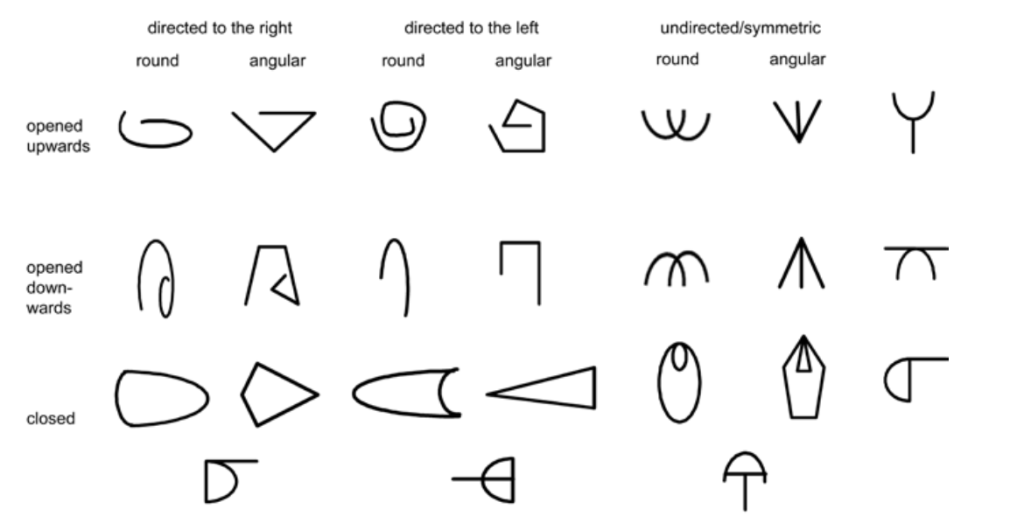
Participants learned the symbols by repeatedly writing them and using them to translate sentences, a process that only took 10-15 minutes. Afterward, 20 participants associated colours with at least half of the newly learned symbols, while six associated colours with all 24 symbols (Jürgens and Nikolić 2012). The researchers argued that these associations formed too quickly to result from new cross-wiring between sensory areas of the brain, instead suggesting a more flexible conceptual process. This suggests that what we perceive could depend on more than what physically reaches our senses.
In other studies, the same colour could be triggered by physically different representations of a number, including Arabic and Roman numerals, dots, dice patterns, finger counting, and number names. These representations triggered the same colour when they represented the same quantity (Mroczko-Wąsowicz and Nikolić 2014). In these cases, what remained constant wasn’t necessarily the appearance of whatever stimulus was used, but rather its meaning. Ideasthesia therefore suggests that conceptual understanding could affect perceptual experiences.
So, what colour is Tuesday? Scientifically, the answer is still none, but maybe the more interesting question is why our minds give it one at all. Ideasthesia suggests that the boundary between understanding something and experiencing it may not be as clear as we think. Tuesday may not have a colour of its own, but the colour we assign it shows how meaning can become part of the way we experience the world.
References
Jürgens, Uta, and Danko Nikolić. 2012. “ideasthesia: Conceptual Processes Assign Similar Colours to Similar Shapes.” Translational Neuroscience 3 (1): 22-27. https://doi.org/10.2478/s13380-012-0010-4
Mroczko-Wąsowicz, Aleksandra, and Danko Nikolić. 2014. “Semantic Mechanisms May Be Responsible for Developing Synesthesia.” Frontiers in Human Neuroscience 8: 509. https://pmc.ncbi.nlm.nih.gov/articles/PMC4137691/
Nikolić, Danko. 2014. “Ideasthesia: How do ideas feel?” TED-Ed, November 6, 2014. https://ed.ted.com/lessons/ideasthesia-how-do-ideas-feel-danko-nikolic
Comments
9 Responses to “What Colour is Tuesday?”
Hello!
Thank you for reading my blog post! What first sparked my interest in this topic was seeing it on social media all the time! In comment sections or posts, people often associate things like the number 7, autumn, and Thursday as giving off the same “vibe”. Until now I had wondered why and it fascinated me.
I thought this topic was relevant to what we do in iSci because we are often asked to approach questions from multiple scientific perspectives and use experimental evidence to evaluate different explanations. The Qsonz experiment does pretty much exactly that by taking something seemingly subjective, like colour associations, and finding a way to investigate it experimentally.
I’d love to hear any suggestions on things I can improve!
Also, what colour is Tuesday to you, if it has one at all?
Thanks!
Hi Jahaan,
I really enjoyed reading your first blog post! It reminded me of the ‘what colour are certain subjects?’ debate on social media.
I also noticed that you often cited the study by Jürgens et al., out of curiosity, have similar experiments been done elsewhere that describe a similar process occurring?
Minor suggestions:
In P3: I recommend defining what grapheme-colour synesthesia is.
Figure 1: centre-align the figure and the caption
In P7S2: You have a typo, “sane” should be “same”.
Overall, amazing job! Really clear, succinct, and interesting read.
Best,
Vani
Hi Vani!
Thank you for your feedback! I found it very helpful. To respond to your question, yes there are multiple studies exploring the same concept, however, both involve the same researcher, which is why their name appears frequently throughout my post.
Thank you.
Jahaan
Hello Jahaan!
I found your blog post very interesting and it made me reflect on what colours I associate different days of the week with (Tuesday for me is blue).
I have a couple suggestions:
– In your references the top link seems to have pasted weird, it is much further off the page than the others
– When you are referencing figure 1 in an in-text citation you can do (Figure 1) instead of (see figure 1)
– In the second last paragraph I’d suggest moving the first sentence to the paragraph above because it seems to fit more with that then the one it is currently in. “….. instead suggesting a more flexible conceptual process. Meaning, what we perceive could depend on more than what physically reaches our senses.
In other studies….”
Overall great work and I can’t wait to read the final draft!
– Emily
Hi Emily!
Thank you for the feedback! I fixed the formatting of the reference by changing it to the DOI, and adjusted my Figure 1 citation. I also agreed with your suggestion about moving the first sentence of the second last paragraph, so I moved it to the end of the preceding one. I do think it makes the transition between the ideas much clearer.
Thanks again for your suggestions!
Jahaan
Hi Jahaan! I love your choice of topic! Ideasthesia is a concept I have heard a bit about before and it was fascinating to learn more about it. For me, Tuesday is blue.
I just have a couple of suggestions:
When you write “additional experiences” in P2, I would add “sensory” or another descriptive word before “experiences” to make it clearer what kind of experiences the stimuli evoke.
It might also help to rephrase “these experiences” in the first sentence of P3 to clarify exactly which experiences you are referring to.
I liked your conclusion and think it synthesizes the point you are trying to make very well! Overall, great job!
Happy editing,
Sofia
Hi Sofia.
Thank you for the feedback. I applied both of your suggestions which I think have definitely improved the clarity and made some of my sentences more specific.
Jahaan
Hi Jahaan!
I loved this blog post! It really caught my interest from the first paragraph onwards. You had a great hook and concept, I feel like it’s something everyone has thought about. I would say Tuesday is the colour blue.
Some feedback I have for you:
– P4: you cite “Mroczko-wąsowicz and Nikolić 2014,” however, Wąsowicz isn’t capitalized.
– P7: the sentence where you list the different colour triggers seems a little long. You could try ending the sentence after your list and starting a fresh sentence. For example, “These representations triggered the same colour when showcasing the same quantity.”
Great blog post! I absolutely loved reading it.
– Zahra
Hi Zahra!
I really appreciate you reading my post and providing feedback. I corrected the capitalization of my in text citation and split that long sentence in two so it isn’t a run-on sentence.
Thanks again!
Jahaan