Biomimicry is an interdisciplinary field that combines engineering and biology to design machines and tools based on plant traits (Hayakawa et al. 2024). Scientists were interested in creating an extremely water-repellent material that would prevent liquids from adhering to surfaces, thus superhydrophobic surfaces were made(Xue et al. 2010). Superhydrophobic surfaces which are areas with small bumps and ridges designed to capture air under water droplets, minimizing the physical contact between the liquid and solid (Ma and Hill 2006). Although water repels well from superhydrophobic surfaces, external factors could easily damage them or cause them to lose their abilities over time (Wan et al. 2022). The search for a more effective slippery surface led research towards an unexpected biological model: the pitcher plant (Li et al. 2024).
The carnivorous pitcher plant possesses highly specialized modified leaves that trap insects (Scholz et al. 2010). They have a rounded rim surrounding the opening of the pitcher, called the peristome. One of its primary functions is to attract insects, with its bright leaves, odours, and moisture absorbing nectar (Scholz et al. 2010; Li et al. 2024). When wet, the peristomes get extremely slippery, causing the insects to lose their footing and fall into the pitcher (Figure 1) (Li et al. 2024). Below the peristome is the conductive zone. The inner walls of the conductive zone feature downward-facing lunate cells coated with a thick layer of tiny epicuticular wax crystals. The feet of insects feature an adhesive pad to boost contact with the surface and an adhesive secretion that releases a thin fluid, improving the pad’s adhesion to the surface (Drechsler and Federle 2006). The crystals form a rough structure on the pitcher walls, reducing the adhesive on the insect’s feet, making climbing back out difficult (Li et al. 2024). The fluid in the pitcher then digests the insects, and special glands on the inner surface of the pitcher absorb the released nutrients (Mithöfer 2011).
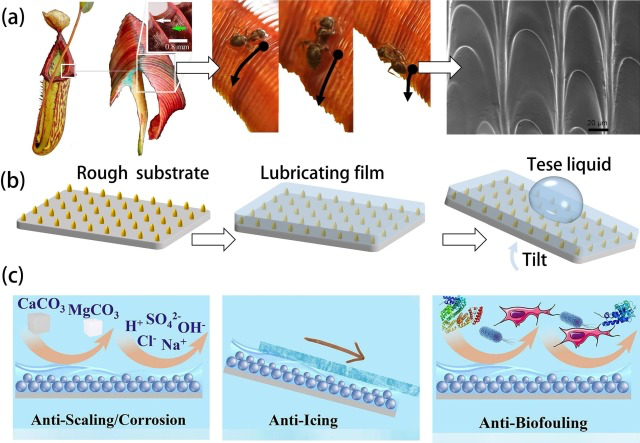
In 2011, taking inspiration from the trapping mechanism of pitcher plants, the Aizenberg research group created a novel method to substitute superhydrophobic surfaces, called slippery liquid infused porous surfaces (SLIPS) (Li et al. 2024). Instead of using trapped air, SLIPS replaced it with a thin layer of lubricating fluid that was held in place using capillary and van der Waal forces. This created a very smooth and continuous liquid composite lubrication layer that lowered friction resistance between the solid substrate and the external liquid. Additionally, unlike superhydrophobic surfaces, if mechanical damage occurs to the lubricant layer on SLIPS, the lubricant redistributes across the surface and restores the slippery properties, demonstrating excellent repairability (Li et al. 2024)
The distinctive characteristics of SLIPS have enabled its use in various applications, including self-cleaning surfaces and anti-icing materials, which maintain surfaces clean and functional without frequent upkeep (Scholz et al. 2010; Zhang et al. 2019). SLIPS and the pitcher plant demonstrates how studying biological adaptations can lead to innovative technological solutions.
Bibliography
Drechsler, Patrick, and Walter Federle. 2006. “Biomechanics of Smooth Adhesive Pads in Insects: Influence of Tarsal Secretion on Attachment Performance.” Journal of Comparative Physiology. A, Neuroethology, Sensory, Neural, and Behavioral Physiology 192 (11): 1213–22. https://doi.org/10.1007/s00359-006-0150-5.
Hayakawa, Takahiko, Hayato Suzuki, Hiroshi Yamamoto, and Nobutaka Mitsuda. 2024. “Synthetic Biology in Plants.” Plant Biotechnology 41 (3): 173–93. https://doi.org/10.5511/plantbiotechnology.24.0630b.
Li, Junwei, Bin Lu, Zhengbai Cheng, Haibing Cao, and Xingye An. 2024. “Designs and Recent Progress of ‘Pitcher Plant Effect’ Inspired Ultra-Slippery Surfaces: A Review.” Progress in Organic Coatings 191 (June): 108460. https://doi.org/10.1016/j.porgcoat.2024.108460.
Ma, Minglin, and Randal M. Hill. 2006. “Superhydrophobic Surfaces.” Current Opinion in Colloid & Interface Science 11 (4): 193–202. https://doi.org/10.1016/j.cocis.2006.06.002.
Mithöfer, Axel. 2011. “Carnivorous Pitcher Plants: Insights in an Old Topic.” Phytochemistry, Plant-Insect Interactions, vol. 72 (13): 1678–82. https://doi.org/10.1016/j.phytochem.2010.11.024.
Scholz, I., M. Bückins, L. Dolge, et al. 2010. “Slippery Surfaces of Pitcher Plants: Nepenthes Wax Crystals Minimize Insect Attachment via Microscopic Surface Roughness.” The Journal of Experimental Biology 213 (Pt 7): 1115–25. https://doi.org/10.1242/jeb.035618.
Wan, Tao, Bo Wang, Qing Han, Jianshe Chen, Binchuan Li, and Shicheng Wei. 2022. “A Review of Superhydrophobic Shape-Memory Polymers: Preparation, Activation, and Applications.” Applied Materials Today 29 (December): 101665. https://doi.org/10.1016/j.apmt.2022.101665.
Xue, Chao-Hua, Shun-Tian Jia, Jing Zhang, and Jian-Zhong Ma. 2010. “Large-Area Fabrication of Superhydrophobic Surfaces for Practical Applications: An Overview.” Science and Technology of Advanced Materials 11 (3): 033002. https://doi.org/10.1088/1468-6996/11/3/033002.
Zhang, Dong, Yuzheng Xia, Xiaonong Chen, Shuxian Shi, and Lei Lei. 2019. “PDMS-Infused Poly(High Internal Phase Emulsion) Templates for the Construction of Slippery Liquid-Infused Porous Surfaces with Self-Cleaning and Self-Repairing Properties.” Langmuir 35 (25): 8276–84. https://doi.org/10.1021/acs.langmuir.9b01115.
Comments
7 Responses to “Be careful not to SLIP”
Hey iSci!
I got the idea to write my blog post about the biomimicry of pitcher plants because I have been recently working in the greenhouse and had stumbled upon the pitcher plant. I was curious and wanted to know more about it and found out that scientists have developed an application based on the mechanism of the pitcher plant!
Thanks for reading
Hi Brianna,
I really enjoyed reading your blog post! I learned a lot about the pitcher plant and I find it really interesting that humans have leveraged the same concepts for some pretty cool applications.
Overall it was really well done and engaging! I wanted to offer the following feedback which you may want to consider while editing:
– In your figure caption be sure to include the source of the figure
– You have a good selection of sources, but in Chicago 18 DOIs can be hyperlinked which you can add in so readers can quickly go directly to the articles to read more!
– P1S2: when you say “One of the major challenges for scientists” you could specify what the purpose of the initial research was, like “One of the major challenges for scientists when _____ was creating…”
– P2S3: you could be more concise and replace “specifically because of” with “with”.
Happy editing!
Amanda
Hi Amanda, thank you for the suggestions. I have read them over and made the corrections to my post!
Hi Brianna! I loved your blog post. This is my first introduction to biomimicry, and I found it very interesting. I also found the figure you chose visually appealing and helpful to understanding the concepts you were explaining!
Here is some feedback I would consider implementing:
P1: you repeat the word surface five times in back to back sentences. to better the flow, you could try layers, coats, exteriors, areas.
Figure caption: the acronym SLIPS is used before its introduced. I would introduce it in the caption as well as again in the text.
P3S1: rather than saying “… surafeces, or SLIPS” you can say “… surfaces (SLIPS).” to maintain a formal tone.
P4S2: you said “SLIP” rather than “SLIPS” was this intentional?
P4: It appears like there is a missing period after your citation
Happy editing!
– Hafsah S
Hi Hafsah, thank you for the edits! I have made the corrections you suggested.
Hi Brianna,
This was very interesting as I’ve never heard of the applications for the pitcher plant! Here are a few suggestions:
– Paragraph 1: Consider adding another sentence before your current sentence 2. You can add a short phrase on the purpose of creating water-repellent materials.
– Paragraph 2, first sentence: you can add the genus and species name of the pitcher plant
– Paragraph 2, second last sentence: you mention that the rough structure on the pitcher walls reduces the adhesive on the insect’s feet. If word count allows, perhaps you could elaborate on the mechanism of this.
Overall, your piece was well-organized and I like how you transitioned from the biology of the plant to the design of SLIPS and their applications!
Best of luck with editing,
Ria
Hi Ria, Thank you for the edits! I have read them over and made the necessary corrections.