Press two neighbouring piano keys together, and the combination may sound unpleasant. Does that make it noise rather than music? To understand this distinction, we need to look at how sound is structured, how the brain processes it, and how our experiences shape what we hear.
While the physical properties of sound alone cannot define the boundary between music and noise, they help explain how frequency relationships give a sound a clear pitch. Sound can contain several frequencies, measured in hertz (Hz), which describe how many cycles a wave completes per second. Harmonics are whole-number multiples of a fundamental frequency. They follow the relationship fₙ = n·f₀, where f₀ is the fundamental and n identifies the harmonic. For a fundamental of 200 Hz, the second harmonic is 400 Hz and the third is 600 Hz. Because these frequencies fit into a shared repeating pattern, they can produce a clear pitch. The fundamental generally determines how high or low that pitch sounds, while the strengths of its harmonics help give the sound its particular tone.
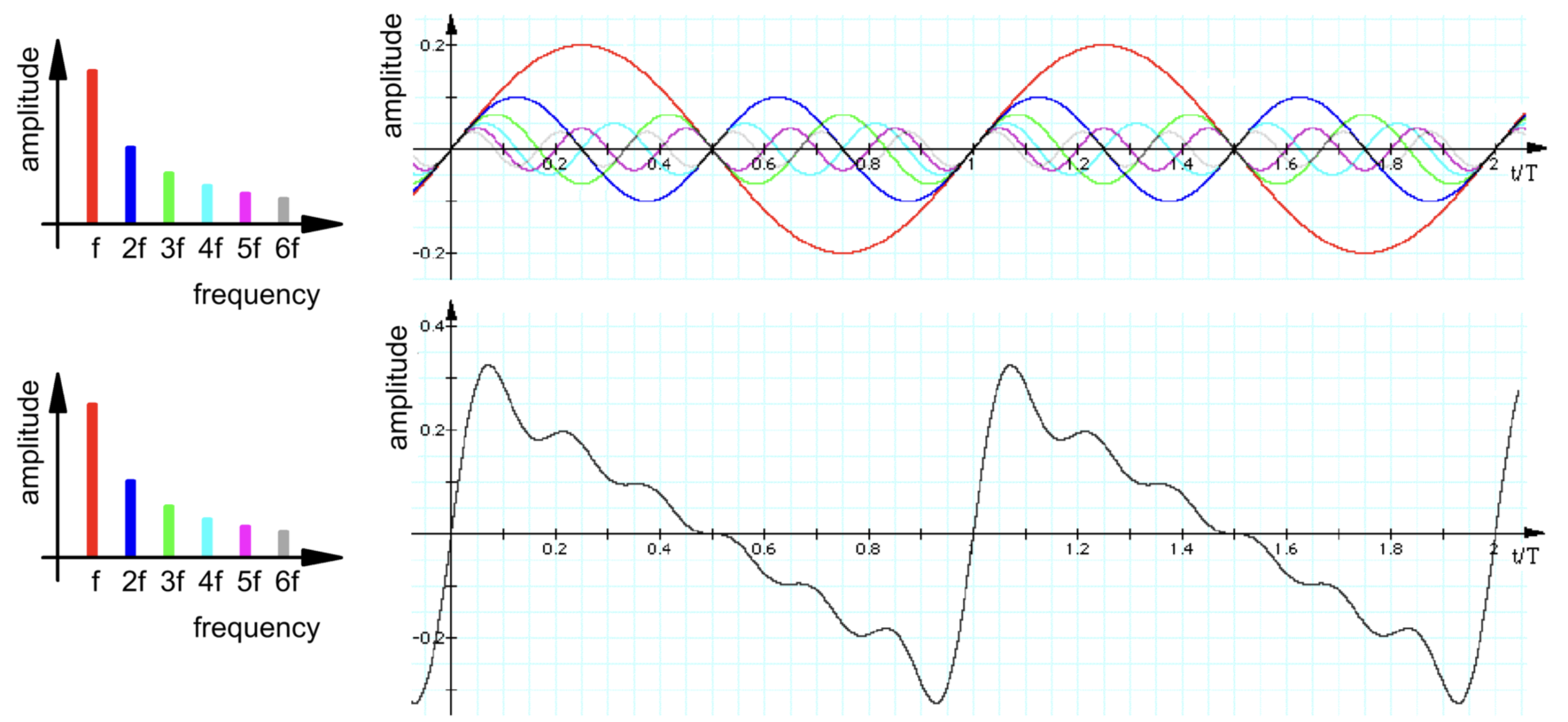
Figure 1: Harmonic components and their combined waveform. The left panels show the relative amplitudes of f, 2f, 3f, and 6f. Their individual waves appear at the upper right. Adding them produces the lower-right waveform, which repeats every fundamental period, T. The axis t/T shows time in fundamental periods (Wolfe 2012, fig. 4).
Frequencies that do not follow this whole-number relationship are inharmonic and may produce a less clear pitch. However, bells show that inharmonic sounds can still be musical. Harmonics help explain how sound is structured, but cannot tell us whether it is music or noise.
The brain’s response, however, adds to this picture. Researchers used functional magnetic resonance imaging (fMRI), which measures blood oxygenation changes associated with neural activity, to record responses to 165 everyday sounds. By separating overlapping responses, they identified a response pattern in non-primary auditory cortex that was stronger for music than for speech and other sounds. The acoustic measurements tested did not explain this difference (Norman-Haignere, Kanwisher, and McDermott 2015). This suggests that the brain’s response to music involves more than these basic sound properties. It does not, however, explain why we enjoy certain sounds.
Psychology helps explain how experience shapes which sounds we enjoy. McDermott et al. (2016) found that Tsimane’ participants from the Bolivian Amazon, with minimal exposure to Western music, rated consonant (typically stable-sounding) and dissonant (typically tense-sounding) chords as equally pleasant. US participants preferred consonance. The Tsimane’ could still distinguish harmonic from inharmonic tones in a separate task, showing that hearing a difference does not necessarily mean preferring one sound. These findings suggest that cultural experience helps shape musical preferences.
Returning to the neighbouring piano keys, their unpleasantness alone does not make them noise. The same combination could create tension within a piece. Whether we recognize it as music depends partly on its context and the patterns we have learned. Even music can be called noise when it is unwanted. There is therefore no single frequency relationship that separates the two: understanding the sound also means understanding the listener.
References
McDermott, Josh H., Alan F. Schultz, Eduardo A. Undurraga, and Ricardo A. Godoy. 2016. “Indifference to Dissonance in Native Amazonians Reveals Cultural Variation in Music Perception.” Nature 535 (7613): 547–50. https://doi.org/10.1038/nature18635.
Norman-Haignere, Sam, Nancy G. Kanwisher, and Josh H. McDermott. 2015. “Distinct Cortical Pathways for Music and Speech Revealed by Hypothesis-Free Voxel Decomposition.” Neuron 88 (6): 1281–96. https://doi.org/10.1016/j.neuron.2015.11.035.
Wolfe, Joe. 2012. “Musical Sounds and Musical Signals.” In Sound Musicianship: Understanding the Crafts of Music, edited by Andrew Brown, 14–27. Newcastle upon Tyne: Cambridge Scholars Publishing. https://www.phys.unsw.edu.au/jw/reprints/Musical-Sounds-and-Musical-Signals.pdf.
Comments
11 Responses to “When Does Sound Become Music, and When Does It Become Noise? The Science of Harmonics and Perception.”
While I was playing the piano recently, I accidentally hit a neighbouring key that completely threw the tone off and sounded super harsh. That misclick made me wonder: would someone else be just as thrown off by that sudden dissonance, and consequently, does a harsh sound like that turn something from music into noise?
To answer that, I decided to take that experience as an excuse to dive into the science behind it! This post explores the boundary between music and noise across a few different science disciplines, from the physics of harmonic frequency structures, to how the brain processes sound in neuroscience, and how our cultural background shapes the psychology of what we actually enjoy.
I hope you enjoy reading this and thank you so much for any feedback!
Hey Riyal,
Great job on your first blog post! It was really enjoyable to read, and I especially found your paragraph on the Tsimane’ peoples response to western music very interesting.
I have a few small suggestions that may help improve this blog post,
1. Make the capitalization in the title consistent.
2. Your definition of noise is somewhat unclear since you sometimes use it to describe irregular sound frequencies and other times to mean an unwanted sound. If you distinguished between the scientific and everyday meanings of noise would make the central argument clearer.
Overall, you did a really good job!
Happy editing!
Kayo
Hey Kayo! The title has been fixed, and the argument should be far clearer now. Thank you for your comment, and enjoy the reread! 🙂
Hi Riyal,
The writing flows, elaborating on top of the engaging opening with clear logic. I understand that the boundaries between music and noise remain as an ambiguous grey area. However, to not let the audience be lost in your writing, I do agree with Kayo, to define the two types of noise you mentioned.
Harmony is also not limited to frequency of waves. The amplitudes and the color of the tone, timbre are significant layers within a harmonic arrangement. One can play the same note with the exact frequency across instruments, while it remains deviated in human ears. This is because of the timber of the note. I think this part remains absent in your analysis.
Best Regards,
Edgar,
Hello Edgar,
I have filled in definitions for consonants within the writing to make it a little less confusing! Good catch, and thank you so much.
Hi Riyal!
What a fun way to open a blog post. Starting with the piano keys made the topic instantly relatable! I really liked how you went from the physics of harmonics to the brain and then to culture. The Tsimane’ study was a great example of how what sounds “pleasant” isn’t universal. Here are a couple of things I noticed that you could change:
Figure 1: The caption cites (Wolfe 2012, fig. 4), but Wolfe isn’t in your reference list. Make sure to add it!
P4–P5: The fMRI study is described across two paragraphs, but it isn’t cited until the second one, so at first it’s unclear who “researchers” are. You could name them at the start (“Norman-Haignere, Kanwisher, and McDermott (2015) used fMRI…”). Another option is to merge the first sentence of P5 into P4, so the study and its citation stay together.
Overall, this was a really thoughtful post, and you did a great job connecting so many different areas of science!
Happy editing,
Gurdit
Hey Gurdit!
I appreciate the kind words about the post, I have touched up the reference list, alongside clearing up authors. Enjoy the reread 🙂
Hi Riyal,
This was a great blog post and I greatly enjoyed reading it. I really liked how you smoothly incorporated and flowed between different scientific disciplines. Here are some things you could improve on.
– You should try to incorporate figure 1 into the argument rather than leaving it as a standalone caption. The text should point back to it when making specific claims.
– Try to support the closing claim “…a familiar song can become unwanted noise in the wrong setting.”. There isn’t really anything in the text prior to that adding context in that direction.
– Explaining math in simpler terms would help retain the readers attention. For example, the equation in p2 or whole number multiples could use a quick explanation for better reader comprehension.
Otherwise, this was a great post, and I look forward to reading the final product.
-Vaughn
Hey Vaughn, thank you so much for the detailed comments. I have implemented your suggestion about relating the figure to the point of the blogs, it now demonstrates a visual for different harmonics. There is also more support to individual statements, and the math was also made simpler. I hope you enjoy the reread if you choose to! 🙂
Great job on your blog post, it’s very well written and an extremely interesting read! It’s such an interesting topic, especially with how you connected the physical properties of sound with how we actually perceive it.
I have a few suggestions:
– In the fMRI paragraph (P4), you could explain a little more about what the finding that the brain responded more strongly to music actually tells us about how we process music.
– You could try to tie your introduction back into your conclusion to show us how the different studies changed the way we perceive the original harsh sound.
– At times, it was a little hard to follow, so you could cut out certain parts that make it wordy without adding much to your main point. For example, the frequency math was hard to follow without much explanation beforehand, and could be explained more concisely to make the point more effective without going too in-depth.
– I agree with the previous comments about differentiating more clearly between what “noise” means in different contexts.
Overall, this was an amazing blog post and an extremely insightful perspective, I can’t wait to see the final version!
– Hala
Hey Hala! Thank you so much for your feedback. I have implemented a clearer explanation alongside a deeper foundation on fMRI. I hope you enjoy the rewritten version 🙂