When Physics and Perception Collide: Why Your Brain Has the Final Say 

Ever wondered how two people can look at the same set of objects and perceive it totally differently? The answer partly relies on the physics lens; we can see that light behaves as an electromagnetic wave, where an object’s color is perceived from a combination of specific wavelengths that are reflected or absorbed, with the visible wave bands occupying a spectrum between 380 and 700 nanometers (NASA 2010). The physical light that hits your eyes at any given moment depends on two variables, the inherent properties of the object itself and the nature of the ambient lighting shining upon it. Our eyes receive this information, but it’s totally ambiguous, and our brain’s job is to perceive this data and connect the dots, creating a world that is coherent. It does so using three photoreceptor cones, designated as S, M, and L within our retinas that detect these wavelengths. The letters are representative of the length of the wavelengths; S cones respond to short waves, most strongly around 420nm, M cones respond to medium wavelengths, most strongly around 530nm, and L cones respond to long wavelengths, most strongly at 560nm (Bowmaker and Dartnall 1980). These signals get sent to the visual cortex within the occipital lobe of your brain. Your brain then uses them to create color (Spielman, Jenkins, and Lovett 2020).
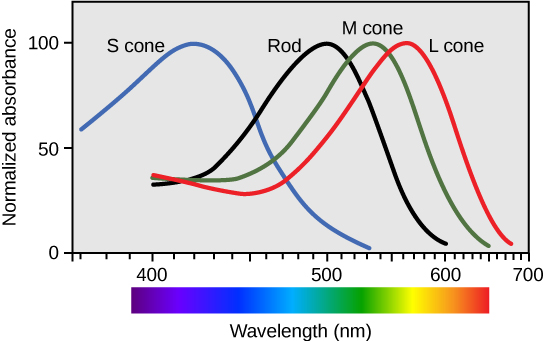
Figure 1. Graph comparing the absorbance of the three different cones and rods across visible wavelengths. Lined with the perceived color of each wavelength. Source: Source: Hutchins 2024.

But what stops your brain from getting confused by the given changes in color caused by lighting changes? It’s a perceptual mechanism called color constancy, which lets you recognize the true color of an object no matter if it’s basking in sun or sitting in a dimly lit room (Foster 2011). It explains the viral phenomenon of “the dress”, a photo that went global, sparking a debate of whether or not it is blue and black, or white and gold. A survey was then conducted by Lafer-Sousa and her colleagues and of the over 1400 people they asked, 57% of them saw blue/black, 30% of them saw white/gold, 11% of them saw blue/brown and 2% of them saw something else. The ambiguous lighting in the photo forced viewers to interpret cool shade (making it appear white/gold) vs warm lighting (making it appear blue/black) and is a perfect example of the same physics yielding completely different perceptions in the brain (Lafer-Sousa, Hermann, and Conway 2015).

Ultimately, this disconnect between raw data and interpretation is what matters significantly for scientists. It’s a reminder that there is no purely passive interpretation of images, charts and empirical data when it’s perceived visually and that it’s important to recognize internal biases and minimize them in the pursuit of scientific research. 

References

Bowmaker, J. K., and H. J. A. Dartnall. 1980. “Visual Pigments of Rods and Cones in a Human Retina.” Journal of Physiology 298: 501–11. https://doi.org/10.1113/jphysiol.1980.sp013097.

Foster, David H. 2011. “Color Constancy.” Vision Research 51: 674–700. https://doi.org/10.1016/j.visres.2010.09.006.

Hutchins, Jim. 2024. “Color Processing in the Retina.” In Introduction to Neuroscience. Pressbooks. https://uen.pressbooks.pub/introneuro/chapter/color-processing-in-the-retina/.

Lafer-Sousa, Rosa, Katherine L. Hermann, and Bevil R. Conway. 2015. “Striking Individual Differences in Color Perception Uncovered by ‘the Dress’ Photograph.” Current Biology 25 (13): R545–46. https://doi.org/10.1016/j.cub.2015.04.053.

NASA. 2010. “Visible Light.” NASA Science. https://science.nasa.gov/ems/09_visiblelight/.

Spielman, Rose M., William J. Jenkins, and Marilyn D. Lovett. 2020. Psychology 2e. Houston: OpenStax. https://openstax.org/books/psychology-2e/pages/5-2-waves-and-wavelengths.

Comments

4 Responses to “When Physics and Perception Collide: Why Your Brain Has the Final Say ”

  1. Farida Shaban Avatar
    Farida Shaban

    Hey Isci! I thought about this after my friends and I were debating the dress again (ironically) and I was curious about what part of the brain perceives color and why its so subjective since thats what we talked about in psychology. hope you enjoy!

  2. Cassidy Barbour Avatar
    Cassidy Barbour

    Hello Farida,

    Interesting blog post. Light is a fascinating topic to learn about. I have a few notes:

    – P1, S5: This sentence is long, and might work better if you split it up. As an example: “Our eyes receive this information, but it is ambiguous. The brain’s function is to perceive this data and connect the dots, creating a coherent world.”

    – P1, S7: When referring to the different types of cones, you may want to write them with a dash (eg M-cone). Writing it like this seems to vary from source to source, but it’s easier to read.

    – Figure 1 Caption: “Source” is written twice.

    – P2, S3: Consider including a picture of the dress. It would be a good illustration of the phenomenon.

    – Chicago-style citations should be (First Author et al. Date) if including more than 2 authors.

    – You should include the full title of any organizations you cite (NASA should be National Aeronautics and Space Administration)

    I look forwards to reading the final post!

    Cassidy Barbour

  3. Maegan Bell Avatar
    Maegan Bell

    Hi Farida,

    This is a really interesting and informative blog post! A couple things to keep in mind while editing:

    – Your figure includes absorbance of S, M, and L cones, as well as “Rod”. While you explained the various cones in your text very well, “rod” was not mentioned. I suggest including a brief explanation in your figure caption!

    – P1S2: this sentence is quite long. Consider splitting it up for better clarity. For example: “The answer partly relies on the physics lens, which explains that light behaves as an electromagnetic wave. An object’s perceived colour depends on the combination of specific wavelengths of light that it reflects or absorbs, with visible light occupying a spectrum ranging from approximately 380 to 700 nanometers (NASA 2010).”

    – I’m a little confused by your explanation of ‘color constancy’ in paragraph 3. You explain that this concept keeps your brain from getting confused when lighting changes, but then say it explains the dress dilemma. I thought the dress demonstrated how different interpretations of lighting can actually lead to different perceptions of an object’s colour, rather than how the brain maintains colour constancy. Could you clarify how the two concepts are connected? I think explaining how the brain’s assumptions about illumination influence colour perception would help make the connection clearer.

    Happy editing!

    Best,
    Maegan

  4. Brooklyn Decou Avatar
    Brooklyn Decou

    Hi Farida
    I loved your topic choice and think you did a great job of explaining it concisely!

    I have some suggestions for you:
    -In your figure caption you could add some more detail to explain the scales and lines in figure (even if this was already stated in the text). Your figure caption should be able to stand alone from your text and should fully explain the figure!
    -Your concluding statements feel somewhat out of place. I think, if word count allows, adding a brief transition sentence about how “interpretation of the light spectrum causes differences in collected data” and then go into the sentence about raw vs. interpreted data would help with flow.

    Again, I think you did a great job explaining this topic!
    Can’t wait for the final edit,
    Brooklyn

Leave a Reply