In the musical Next to Normal by Tom Kitt and Brian Yorkey, the main character Diana, after years of taking medications, is pushed to undergo electroconvulsive therapy (ECT) to manage her symptoms, resulting in severe memory loss. She struggles to regain her memories, highlighted by the line, “You wonder which is worse, the symptom or the cure” (Tveit 2009). Though an extreme example, it still raises an important question: where is the line between treating symptoms and preserving identity?
To understand this question, we can look at selective serotonin reuptake inhibitors (SSRIs). SSRIs work by blocking neurotransmitters from being reabsorbed, leaving increased amounts of serotonin in the synaptic cleft for a longer time (Figure 1; Chu and Wadhwa 2023). This allows serotonin to continuously stimulate postsynaptic receptors, correcting chemical imbalances. Though effective, it can take 6 weeks for the medication to work, and patients may experience enhanced symptoms during initial phases of treatment (Chu and Wadhwa 2023). One study even found a statistically significant decline in patients’ MMSE (Mini-Mental State Examination) scores over an 8-week period. They concluded that starting SSRIs can be associated with acute cognitive dysfunction or memory complications during the early phases of treatment (Sayyah et al. 2016).
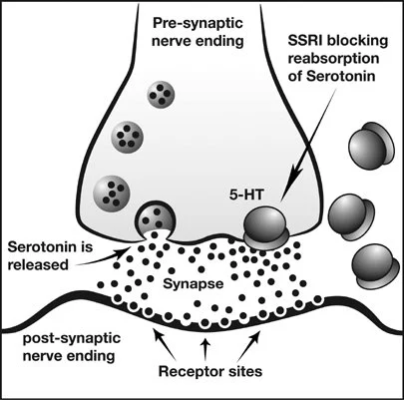
SSRIs are typically understood to work under the disease-centred model, where they are viewed as correcting an abnormal brain state, treating any resulting side effects as entirely separate (Chu and Wadhwa 2023). In contrast, some propose a drug-centred model, which views drugs as psychoactive substances that create a deliberate, altered physical and mental state. From this model, the cognitive changes that occur are the mechanisms that suppress symptoms (Moncrieff and Cohen 2009). This brings us back to our original question: where is the line between treating symptoms and preserving identity?
This question is emphasized when considering electroconvulsive therapy (ECT), a medical procedure where electric currents are delivered to the brain to induce small, controlled seizures. It acts much faster than standard medications, showing a 50% reduction in depressive symptoms within a 2-to-3-week period (Kritzer et al. 2023). However, some argue ECT causes amnesia and apathy in nearly everyone who receives it, and as illustrated by Diana’s experience in Next to Normal, patients are often unaware of the full scope of potential side effects, which makes true, uncoerced consent difficult to obtain (Mosher and Cohen 2003)
When evaluating treatments, there is a tension between beneficence, the medical duty to relieve suffering, and patient autonomy, the effort to preserve an individual’s identity (Varkey 2021). While treatments can alleviate symptoms, their side effects ask whether suppressing symptoms is truly a “cure” if a patient’s personality is altered. Viewing SSRIs through a drug-centred model can address this dilemma by empowering patients to weigh the real advantages and disadvantages of treatment, supporting true informed consent and patient autonomy (Moncrieff and Cohen 2009). In the end, patients must choose: is getting relief worth potentially losing a piece of who you are?
References
Chu, Andrew, and Roopma Wadhwa. 2023. “Selective Serotonin Reuptake Inhibitors.” In StatPearls. StatPearls Publishing. http://www.ncbi.nlm.nih.gov/books/NBK554406/.
Kritzer, Michael D., Angel V. Peterchev, and Joan A. Camprodon. 2023. “Electroconvulsive Therapy: Mechanisms of Action, Clinical Considerations, and Future Directions.” Harvard Review of Psychiatry 31 (3): 101–13. https://doi.org/10.1097/HRP.0000000000000365.
Lattimore, Keri, Steven Donn, Niko Kaciroti, Alex Kemper, Charles Neal, and Delia Vázquez. 2005. “Selective Serotonin Reuptake Inhibitor (SSRI) Use during Pregnancy and Effects on the Fetus and Newborn: A Meta-Analysis.” Journal of Perinatology : Official Journal of the California Perinatal Association 25 (October): 595–604. https://doi.org/10.1038/sj.jp.7211352.
Moncrieff, Joanna, and David Cohen. 2009. “How Do Psychiatric Drugs Work?” The BMJ 338 (May): b1963. https://doi.org/10.1136/bmj.b1963.
Mosher, Loren, and David Cohen. 2003. “The Ethics of Electroconvulsive Therapy.” AMA Journal of Ethics 5 (10): 463–66. https://doi.org/10.1001/virtualmentor.2003.5.10.oped1-0310.
Sayyah, Mehdi, Kaveh Eslami, Shabnam AlaiShehni, and Leila Kouti. 2016. “Cognitive Function before and during Treatment with Selective Serotonin Reuptake Inhibitors in Patients with Depression or Obsessive-Compulsive Disorder.” Psychiatry Journal 2016: 5480391. https://doi.org/10.1155/2016/5480391.
Tveit, Aaron. 2009. Aftershocks. Next To Normal. Ghostlight Records, May 5. Recording, 2:10.
Varkey, Basil. 2021. “Principles of Clinical Ethics and Their Application to Practice.” Medical Principles and Practice 30 (1): 17–28. https://doi.org/10.1159/000509119.
Comments
15 Responses to ““You wonder which is worse, the symptom or the cure”: A Look Into The Ethics of Mental Health Treatments”
Hi Ayn,
Super interesting blog post! I liked that you chose a topic that raises a good question about medication uses.
Here were some things I noticed while reading:
– In P2, sentences 2-4 are missing a citation
– Consider adding an image or visual of some kind to break up the text
– P5S3 is a little bit long, maybe consider separating it into two sentences
Overall great blog post. I look forward to reading the final version!
Best,
Tsippora
Hi Tsippora!
Thank you so much for your comment! I totally didn’t notice the missing citation in the second paragraph; I’ll be sure to keep that in mind when editing. I’ll be sure to add a figure for clarity in my final post. I understand what you mean about P5S3 being quite long, but I like the flow of the sentence. I’ll definitely take a close look, though!
Again, thank you for your feedback.
Ayn
Hi Ayn,
I really enjoyed reading your blog post, and I found your topic really interesting! Your writing style is very clear and it was easy for me to understand your main points, even having no prior knowledge of this topic. Here are some suggestions you might want to use while editing:
– A figure might help explain your topic a bit clearer and provide some visual support to your blog post.
– In the beginning of P3, maybe change “Contrast” to “Contrasting.”
– It might be interesting to connect different points of your blog to the original “Next to Normal” example.
Good luck editing!
Best,
Isabel
Hi Isabel!
Thank you so much for your comment! I’ll add a figure for clarity in my final post. I totally missed the typo at the beginning of P3. Thank you for telling me; I’ll be sure to fix that in my final post. I understand that connecting some of my other points to the musical would help tie my blog together, but to stay under the word count, I don’t think it’ll be possible. I’ll definitely take another look!
Again, thank you for your feedback!
Ayn
Hi Ayn,
This is a really interesting blog post! I liked how you connected ‘Next to Normal’ to the ethical dilemma of balancing symptom relief with preserving a patient’s sense of identity and autonomy.
A few suggestions to help you in your editing process:
– You’re missing citations in P3S1 and P4S1.
– P3, it’s slightly difficult to visualize the drug-centred model; perhaps you can consider adding a figure that describes the model, making it easier for the readers to follow along.
– Don’t forget to add a comment below your post to mention why you chose this topic!
Overall great work, can’t wait to read your final post!
– Harshita
Hi Harshita!
Thank you for your comment! For the citations, I’ll take another look at the guidelines to see where I can improve. I’ll look into finding a figure that helps readers understand the difference between the two models. Thank you for reminding me about the comment; I totally forgot!
Again, thank you for your feedback.
Ayn
Hi Ayn!
This was a very interesting post! I loved how you brought up important ethical questions when looking at treatment options for patients.
A couple of suggestions:
– P1S1, when you’re stating that Diana uses ECT and medications to “manage her hallucinations and bipolar”, it might make more sense grammatically if you said “bipolar disorder”, since bipolar is an adjective rather than a noun
-P3, you might want to say “In contrast with” at the beginning of the paragraph rather than just “contrast…”
Overall, great blog post! I look forward to reading the final version!
Happy editing!
-Anchan
Hi Anchan!
Thank you for your comment! I totally missed that bipolar is an adjective; thank you for your sharp eye! I also missed that typo at P3, I’ll be sure to fix that in the final edit.
Again, thank you for your comment!
Ayn
Hi Ayn,
Great job on your blog post! This is actually a pretty interesting medical ethical dilemma you’ve explored.
I have a couple of suggestions,
– In terms of formatting, I would recommend breaking up the second paragraph, which has quite a bit of ideas about SSRIs, their mechanism of action, and their potential cognitive effects. Perhaps separating the explanations of how SSRIs work from the discussion of the study’s findings would make the information easier to follow and let the reader digest the large amount of new information easier.
– Also, if you add a figure, I would recommend placing it in between the SSRI descriptions and your introduction of the new treatment of ECT for a bit of clarity.
Otherwise, this topic is very interesting and I hope to see the final product!
Teddy
Hi Teddy!
Thank you for your comment! I will take another look at my second paragraph to see if I can split it up. I understand what you mean by it being quite long. Thank you for your recommendation of what kind of figure I should add; I’ll definitely add a figure in my final post for clarity.
Again, thank you for your feedback.
Ayn
Hi Ayn, this was a great blog post. Here are some suggestions:
-P1S1: I recommend splitting up this sentence into two, as it is long
-P3S1: the start of this sentence is slightly, I recommend changing it to “In contrast…”
-I would make the title of your references larger to differentiate it from the regular text
Overall, great job!
Celine
Hi Celine!
Thank you for your comment! I understand what you mean by my introductory sentence being quite long; I’ll take another look when editing. Thank you for noticing that typo at the beginning of paragraph three, I’ll change that in my final edit. For the citations, I’ll take another look at the guidelines for font size.
Again, thank you for your comment.
Ayn
Hi Ayn!
This was a great blog post. I really liked the fringe example ECT. A few pointers:
– In P5S1, you put tidbits of information I think should be free from their brackets.
– in P2, you mention MMSE. Could you potentially identify what that is?
Otherwise, the blog post looks great. Happy editing!
Josh
Hi Joshua!
Thank you for your comment! I’ll take another look at P5S3 to see if I can reword the sentence at all. I’ll try my best to identify what MMSE is in my final post.
Again, thank you for your feedback.
Ayn
Hi isci!
I rewatched this musical over reading week, and that’s what inspired me to write this blog! I’ve always been interested in mental health and how treatments for it are monitored and administered.
Hope you enjoy!
Ayn