It has become common to refer to scams as ‘snake oil’, a term originating from the original snake oil scam back in the 19th century. Clark Stanley, the fraudulent salesman, took the idea of using snake oil from Chinese practices and sold a product known as Clark Stanley’s Snake Oil Liniment (Weill Cornell Medicine, n.d.-b; Graber 2007). While this may appear to be a fun historical tale, there remains true benefit in original Chinese snake oil. This case serves as an example of how psychological scams persist, and most notably, it was involved in the development of public health regulations.
The original snake oil comes from the Erabu sea snake found along the coast of the South China Sea, and this folk medicine in China likely made its way to the United States with the arrival of Chinese laborers in the mid 1800s (Graber 2007; Higuchi et al. 2008). People believed it could treat joint pain, particularly inflammation, and fellow workers may have offered it to each other as relief during their long days building the Transcontinental Railroad. Interestingly, the Erabu sea snake has a fat sack that contains large amounts of polyunsaturated fatty acids, notably eicosapentaenoic acid (EPA) (Higuchi et al. 2008). EPA plays a role in reducing pro-inflammatory cytokines and it is proposed to do so through influencing the transcription factor nuclear factor-kappa B (NF-κB) (Calder 2013).
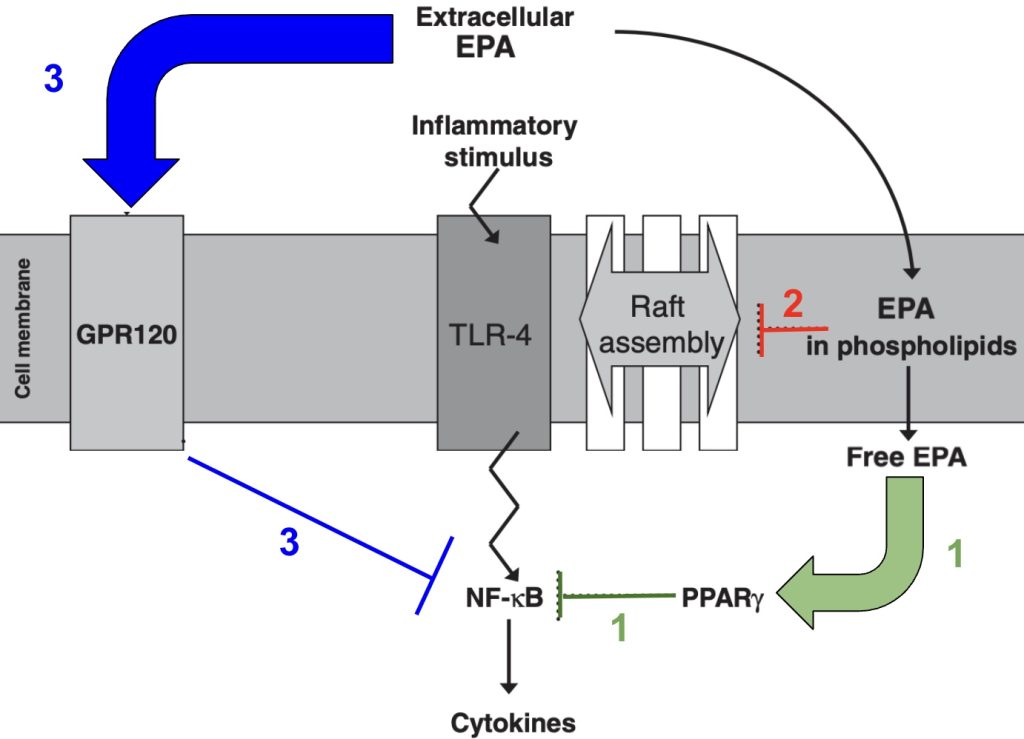
There are three proposed mechanisms by which EPA inhibits NF-κB (Figure 1). First, EPA is proposed to activate PPARγ, a transcription factor, which inhibits NF-κB activation, preventing it from transcribing cytokines in the nucleus. Without cytokines causing an inflammatory response, inflammation is reduced. Alternatively, it inhibits the recruitment of Toll-like receptor 4 (TLR-4) in the cell membrane, which is needed to induce a signalling cascade that activates NF-κB. Lastly, a cell surface G-protein coupled receptor called GPR120, may be activated by EPA disrupting the phosphorylation of the inhibitor preventing NF-κB translocation. Without phosphorylation, the inhibitor is not degraded and NF-κB remains in its cytosolic form, preventing it from transcribing cytokines that induce inflammation (Calder 2013). Stanley’s snake oil contained mostly mineral oil, and therefore those buying his product did not receive this anti-inflammatory benefit.
It is not surprising that people are receptive to scams when we consider the psychology behind scam compliance. While susceptible populations like the elderly, less well educated, and socially isolated are particularly vulnerable to scams, technically anyone can be a victim (Fischer et al. 2013). The first psychological aspect of scams is appealing to strong motivators like miracle cures, as was the case with snake oil. These create a strong emotional incentive and in the presence of high motivation, a person’s ability to make decisions is deteriorated. Scammers exploit strong emotions like greed, guilt and lust. The second psychological driver of scams is trust, where scammers induce trust through fake testimonials to build credibility, and try to find commonalities with the victim to create personal connection and trust. Pair that with people’s natural inclination to trust those with authority, and it’s reasonable to see where trust makes a scam appear legitimate to a person (Fischer et al. 2013). The combination of these techniques may explain Stanley’s success with Snake Oil Liniment.
Stanley’s snake oil scam was one of the many contributors to the changes made in public health. In 1916, the United States Bureau of Chemistry, now the Food and Drug Administration (FDA), found it to be mostly mineral oil alongside some other compounds like capsaicin (Weill Cornell Medicine, n.d.-b; Graber 2007). Stanley was ultimately fined a lofty sum of $20 for his misbranding (Incze and Katz 2018). It was obvious that scams like this were not tolerated, however there were minimal repercussions. Following this, there were other products that were not regulated well, most notably Elixir of Sulfanilamide (Weill Cornell Medicine, n.d.-a). In 1937, this improperly tested medicine killed 107 persons since it contained the poisonous solvent diethylene glycol. This, and snake oil, and many other products, highlighted how drug testing needed to be established prior to marketing. In 1938, the Federal Food, Drug, and Cosmetic Act was passed to give the FDA more authority to prosecute manufactures and mandated that new drugs must be shown safe before selling and advertising (Weill Cornell Medicine, n.d.-a).
Snake oil is one of many scams, but is a great case to study to understand the importance of health regulations and the psychology behind scam compliance. Ultimately, it also highlights the potential for anti-inflammatory benefits that could come from the original snake oil that was used in Chinese medicine. Cases like this served as a foundation for modern health regulations, ensuring trust is not met with deception.
References
Calder, Philip C. 2013. “N -3 Fatty Acids, Inflammation and Immunity: New Mechanisms to Explain Old Actions.” Proceedings of the Nutrition Society 72 (3): 326–36. https://doi.org/10.1017/S0029665113001031.
Fischer, Peter, Stephen E. G. Lea, and Kath M. Evans. 2013. “Why Do Individuals Respond to Fraudulent Scam Communications and Lose Money? The Psychological Determinants of Scam Compliance.” Journal of Applied Social Psychology 43 (10): 2060–72. https://doi.org/10.1111/jasp.12158.
Graber, Cynthia. 2007. “Snake Oil Salesmen Were on to Something.” Scientific American. https://www.scientificamerican.com/article/snake-oil-salesmen-knew-something/.
Higuchi, Tomoyuki, Nobuya Shirai, Hiramitsu Suzuki, and Eiji Shimizu. 2008. “CHANGES IN LEVELS OF PLASMA TOTAL CHOLESTEROL, TRIACYLGLYCEROL AND PHOSPHOLIPID IN MICE FED ERABU SEA SNAKE ( LATICAUDA SEMIFASCIATA ) LIPIDS DIET.” Journal of Food Lipids 15 (4): 453–69. https://doi.org/10.1111/j.1745-4522.2008.00133.x.
Incze, Michael, and Mitchell H. Katz. 2018. “Regulating the Dietary Supplement Industry: The Taming of the Slew.” JAMA Internal Medicine 178 (12): 1723. https://doi.org/10.1001/jamainternmed.2018.5097.
Weill Cornell Medicine. n.d.-a. “The Food and Drug Administration: The Continued History of Drug Advertising.” Weill Cornell Medicine. Accessed November 11, 2025. https://library.weill.cornell.edu/about-us/snake%C2%A0oil%C2%A0-social%C2%A0media-drug-advertising-your-health/food-and-drug-administration-continued.
Weill Cornell Medicine. n.d.-b. “The History of Drug Advertising.” Weill Cornell Medicine. Accessed November 11, 2025. https://library.weill.cornell.edu/about-us/snake%C2%A0oil%C2%A0-social%C2%A0media-drug-advertising-your-health/history-drug-advertising.