You have consistently been exercising and tracking your macronutrients, but you can’t seem to increase your muscle mass at the same pace as the fitness influencers that you follow online. Often what is not seen is the pharmacological “advantage” they have over you, accelerating physical results that go beyond training and diet. This “advantage” is delivered through the use of an anabolic steroid known as trenbolone, which increases their muscle mass and strength at an exponential rate compared to yours (Yarrow et al. 2010). Although trenbolone may seem like a favourable method to gain muscle, its risks strongly outweigh the benefits.
17β-hydroxyestra-4,9,11-trien-3-one, also known as trenbolone, is known to be a modified version of testosterone, as it has two additional double bonds in its steroid ring system (located between C9-C10, and C11-C12) and lacks a C-19 methyl (Figure 1) (Yarrow et al. 2012). The molecule also has the exact same 3-keto/17β-hydroxyl effect that testosterone produces which enhances the binding of androgens to the androgen receptor. However, the C9-C10 and C11-C12 modification orchestrates the molecule to be non-aromatizable to estrogen specifically, and results in stronger muscular tone with less water retention (McCoy et al. 2012).
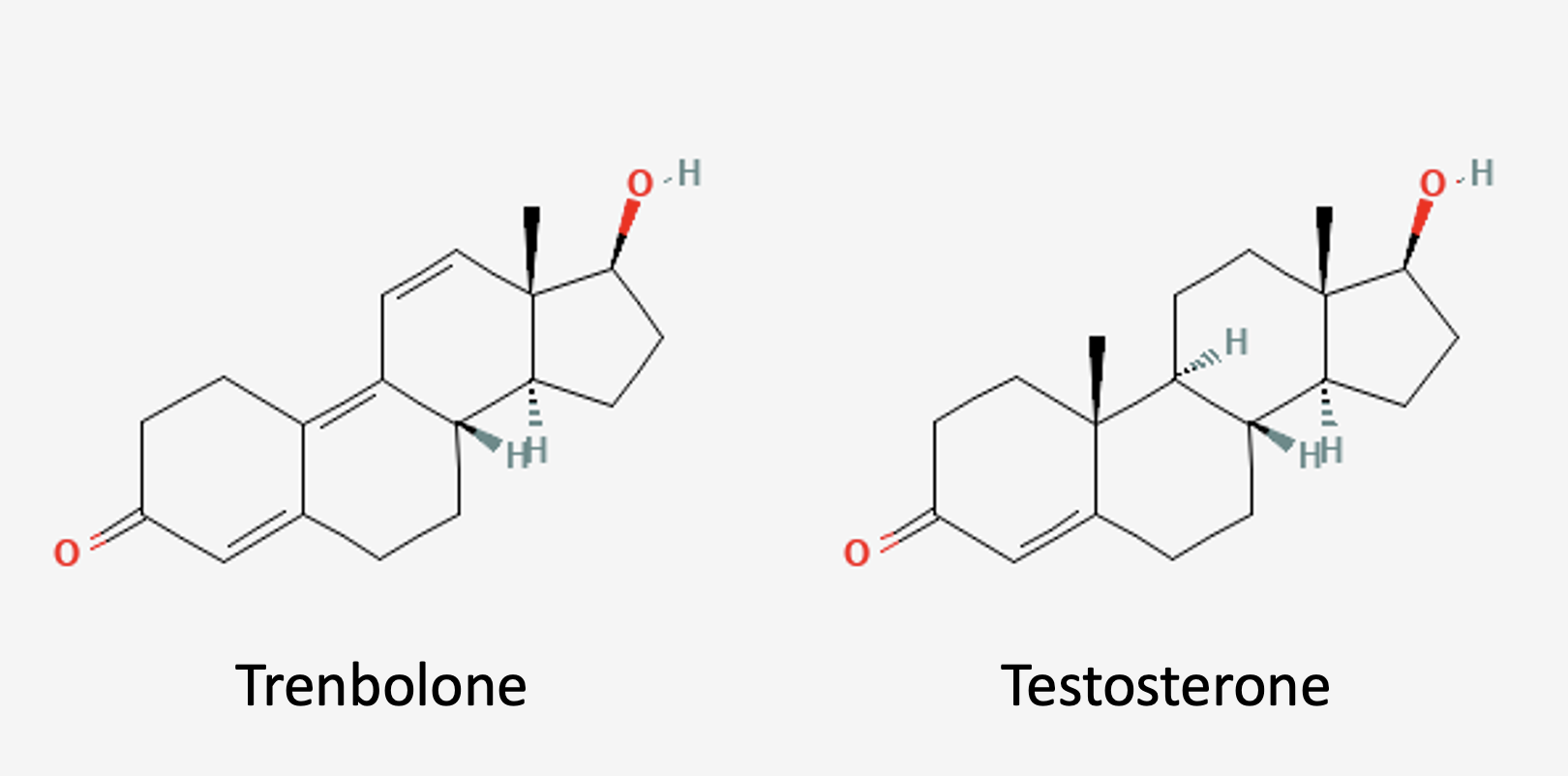
Trenbolone is highly lipophilic (highly fat-soluble) and is formed through an oil-based ester. When the oil is stored in the body, normal enzymes in the body clip the ester and lead to small amounts of trenbolone to enter the bloodstream in small increments instead of simultaneously, which is a process known as de-esterification (Rabhi El Osta et al. 2016). Trenbolone then diffuses into muscle fibers once it is de-esterified, and binds strongly with the androgen receptor, creating an androgen-receptor-trenbolone complex. This complex is transferred to the nucleus and functions as a catalyst for increasing gene expression for myofibrillar proteins, while decreasing the expression for the breakdown of cells (Chen et al. 2005). Androgen signalling also signals muscle stem cells that merge with existing fibers, which provides additional nuclei so that each fiber can manufacture a larger amount of protein. In parallel to this mechanism, there is also a boost of the IGF-1-Akt-mTOR pathway that decreases signals of cortisol breakdown, which helps the muscles retain protein (Rossetti et al. 2017).
This mechanism may seem like an aimless process, but the downstream effect of the increased affinity of the androgen receptor plays a major role in strengthening the growth signal throughout the body, and is eventually translated into fitness progress. Due to this effect, lifters often have the ability to increase their volume when trenbolone is consumed and their muscles appear to be further defined. This is due to the increased levels of intracellular glycogen and water with anabolism, as well as the lack of aromatization that produces less estrogen-related fluid retention under the skin (Bond et al. 2022).
Although the accelerated rate of visible change would be nearly impossible to achieve without the use of an anabolic steroid like trenbolone, it has extreme risks if consumed. Cardiovascular risks (hypertension and cardiomyopathy) and endocrine risks (testicular atrophy and infertility risks) have been most commonly linked to this drug (Liu and Wu 2019; Rabhi El Osta et al. 2016). If one wants to succeed in the gym, instead of taking these risks, they should try pairing a progressive overload workout routine with a diet that has an adequate amount of protein.
References
Bond, Peter, Diederik L. Smit, and Willem de Ronde. 2022. “Anabolic-Androgenic Steroids: How Do They Work and What Are the Risks?” Frontiers in Endocrinology 13: 1059473. https://doi.org/10.3389/fendo.2022.1059473.
Chen, Yue, Jeffrey D. Zajac, and Helen E. MacLean. 2005. “Androgen Regulation of Satellite Cell Function.” The Journal of Endocrinology 186 (1): 21–31. https://doi.org/10.1677/joe.1.05976.
Liu, Jian-Di, and Yan-Qing Wu. 2019. “Anabolic-Androgenic Steroids and Cardiovascular Risk.” Chinese Medical Journal 132 (18): 2229–36. https://doi.org/10.1097/CM9.0000000000000407.
McCoy, Sean C., Joshua F. Yarrow, Christine F. Conover, et al. 2012. “17β-Hydroxyestra-4,9,11-Trien-3-One (Trenbolone) Preserves Bone Mineral Density in Skeletally Mature Orchiectomized Rats without Prostate Enlargement.” Bone 51 (4): 667–73. https://doi.org/10.1016/j.bone.2012.07.008.
PubChem. 2025. “Testosterone.” https://pubchem.ncbi.nlm.nih.gov/compound/6013.
PubChem. 2025. “Trenbolone.” https://pubchem.ncbi.nlm.nih.gov/compound/25015.
Rabhi El Osta, Catherine Diligent, Thierry E Almont, and Nicolas Hubert. 2016. “Anabolic Steroids Abuse and Male Infertility.” ResearchGate, ahead of print, February. https://doi.org/10.1186/s12610-016-0029-4.
Rossetti, Michael L., Jennifer L. Steiner, and Bradley S. Gordon. 2017. “Androgen-Mediated Regulation of Skeletal Muscle Protein Balance.” Molecular and Cellular Endocrinology 447 (May): 35–44. https://doi.org/10.1016/j.mce.2017.02.031.
Yarrow, Joshua F., Luke A. Beggs, Christine F. Conover, Sean C. McCoy, Darren T. Beck, and Stephen E. Borst. 2012. “Influence of Androgens on Circulating Adiponectin in Male and Female Rodents.” PLOS ONE 7 (10): e47315. https://doi.org/10.1371/journal.pone.0047315.
Yarrow, Joshua F., Sean C. McCoy, and Stephen E. Borst. 2010. “Tissue Selectivity and Potential Clinical Applications of Trenbolone (17β-Hydroxyestra-4,9,11-Trien-3-One): A Potent Anabolic Steroid with Reduced Androgenic and Estrogenic Activity.” Steroids 75 (6): 377–89. https://doi.org/10.1016/j.steroids.2010.01.019.
Comments
7 Responses to “A Breakdown of Trenbolone: Why Doping is not Dope!”
Hey iSci,
I hope you enjoyed reading my blog post. I decided to write about a topic that is very prevalent in society, as many fitness influencers supplement their workouts with anabolic steroids. I integrated concepts of the chemistry of trenbolone’s structure with the effect it has on our body, specifically our anatomy. I found this topic very interesting, but feel free to leave any feedback.
Thanks,
Arjun
Hello Arjun,
This is such an interesting topic that you bring awareness to, more specifically, with emerging (and dangerous) social media trends in recent years.
I have a few suggestions that could help improve your post:
– In P1S1, though it might be general knowledge, it would be helpful to expand on what macronutrients are in the context of that sentence.
– Great use of the figure
– In P3S1, I would recommend taking out “always” from the sentence, it still sounds nice without.
– In your third paragraph, you talk about ” IGF-1-Akt-mTOR pathway,” could you please expand on that a bit more in the context of how trenbolone functions cellularly.
– Very informative conclusion as well.
Overall, this is a very nice blog post.
Happy editing!
– Tinu 🙂
Hey Tinu,
Thanks for taking time to read my post. I do agree to remove the “always in p3s1 and I will do that. Unfortunately, I am already slightly above the word count so I can’t expand on the pathway. I will edit it to make it more clear though. Thanks!
Arjun
Hi Arjun,
I think that you chose an incredible topic and certainly an engaging one. I just have a couple of suggestions so that you can potentially improve your final draft.
– I would suggest changing the second sentence in the first paragraph for better readability. Instead of writing “What is often invisible…” I would suggest changing this to “Often what is not seen…”
– My second suggestion would be changing the second sentence in the second paragraph. Instead of “…testosterone produces since it helps androgens tightly bind to the androgen receptor” I would recommend changing this to “…testosterone produces which enhances the binding of androgens to the androgen receptor”; for better flow
– As for my last suggestion you may want to slightly decrease the size of your for better legibility
Great work with your post, it was really interesting to read!
Sayana 🙂
Hey Sayana,
Thanks for providing some great feedback! I have changed the two sentences to what you suggested, as it flows much better now. I also decreased my the font size.
Thanks,
Arjun
Hey Arjun!
Great Job on your blog post. It was a super interesting read, and it was interesting to see the physiology behind the damaging effects of anabolic steroids.
– I did a quick search and saw that Trenbolone is actually a veterinary medication, and not even approved for human use. Including a sentence or two about this might help emphasize your points regarding its harmful effects on the body since it isn’t even meant for human consumption.
– I would consider making your figure caption, a caption of the figure/image itself. You just need to select the figure and click the 3 dots to access this option.
– In paragraph 4, it may be helpful to clarify what you mean by “volume” by specifying “training volume,” since readers who aren’t familiar with fitness terminology might not immediately understand that you mean sets, reps, or weight.
– Also, just a reminder to cite the figure in your figure caption!
Overall, this was very well written and super engaging. Great work!
Happy editing 🙂
Ann
Hey Ann,
Thanks for reading my post! I really value this feedback and it helped a lot. Unfortunately, I don’t have the word count to focus on how trenbolone is a medicine used for animals, especially since I focus on the chem/bio effects of it. If I had more words to work with, then I would definitely include this. I also fixed my figure and figure caption, so thank you for that.
Arjun