Deep in the dark waters of Earth’s oceans and seas are bubbling chimneys and cauldrons of energy that support diverse ecosystems unlike anything we see at the surface of our home planet
Stated by Nasa Researcher Aaron Gronstal, the quote gives insight on the unique ecosystem of hydrothermal vents. While most of us have heard about the theory of life starting at these exact locations, how many of us know the extent of how life not only evolved there, but thrived?
Hydrothermal Vents
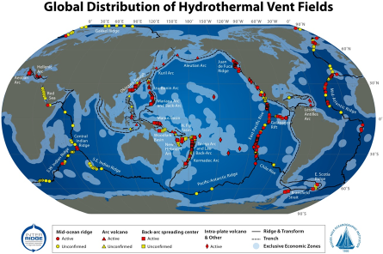
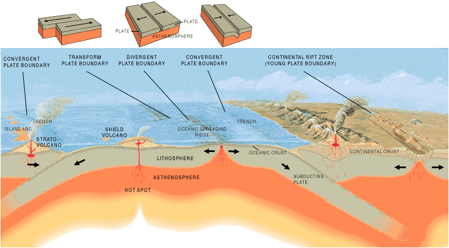
Figure 1: Map of Hydrothermal Vents
Figure 2: Types of Tectonic Plate Interactions
Hydrothermal vents are fissures commonly found at the bottom of the sea floor, spewing super-heated water filled with a wide range of chemicals from the earth’s crust. Located at convergent plate boundaries, where continental plates collide, scrape, or rip apart from each other, with magma found in the asthenosphere swelling into the lithosphere in a verity of ways (See figure 1). In divergent plate boundaries, magma rises to fill the cracks of the separating plates, creating new crust. In convergent plates, the subducting plate forms a mantle wedge in the subduction zone, causing volatiles, such as water and gas to rise into the upper mantle rock, lowering its melting point causing magma to form (See figure 2).
Cold sea water filles the newly formed fissures, flowing towards the magma in the oceans crust. As it approaches, it gets super-heated up, some reaching temps of 400°C or higher, not boiling due to ocean pressures. It absorbs chemicals such as sulfur, copper, zinc, gold, iron, and helium as it rises to the ocean floor. These chemicals are the backbone to life and the formation of hydrothermal vents, with them providing the necessary chemicals for life and by allowing for the rapid generation of precipitates from super-heated fluids mixing with near freezing water, which allows for the formation of chimney like structures.
Some types of Hydrothermal vents!
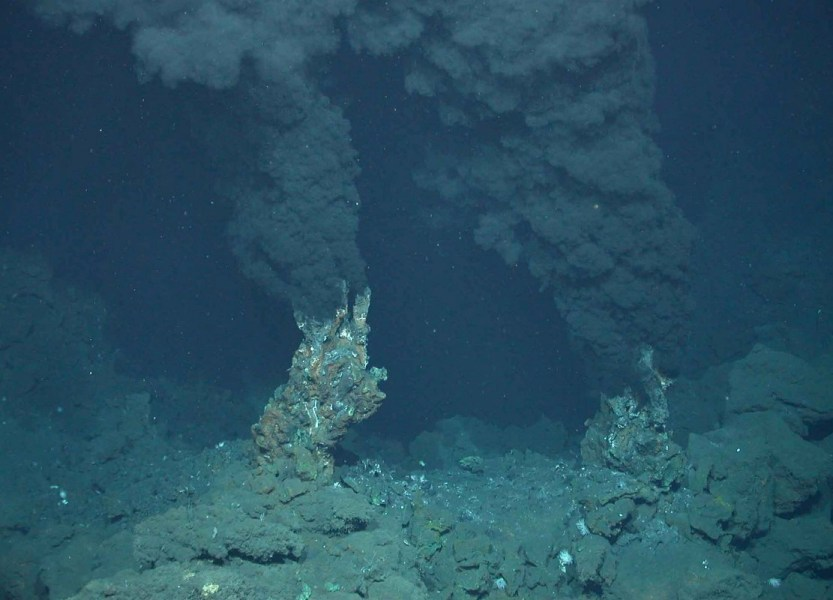
Black Smokers: Spew black iron sulfide forming massive chimneys, the largest found being 18 stories tall!
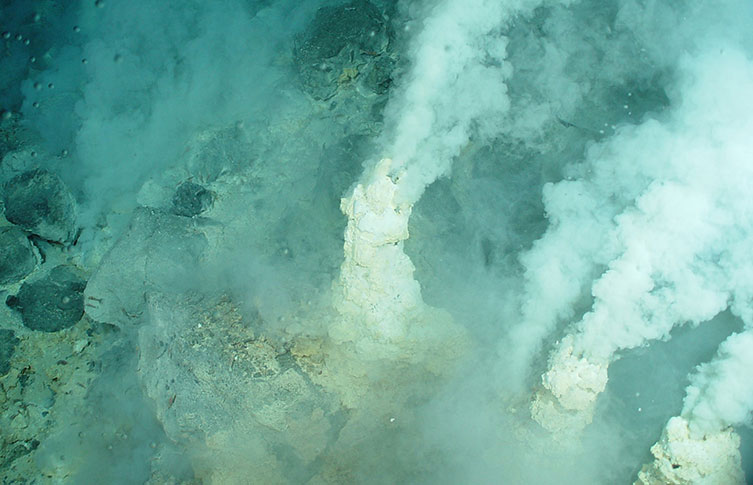
White Smokers: Spew a relatively colder water described as shimmering, forming smaller whiter chimneys of barium, calcium, and silicon.
Life and Diversity at Hydrothermal Vents:
Hydrothermal vents where one of the earliest types of environments to form on earth, existing on earth since the creation of earths ocean 4.6-4 Ga. The chemical-rich soup spewing from hydrothermal vents allowed for vent microorganisms (such as bacteria and archaea) to develop chemosynthesis. While most autotrophs use the sun to carry out necessary chemical reactions, chemotrophs used surrounding chemicals for theirs.
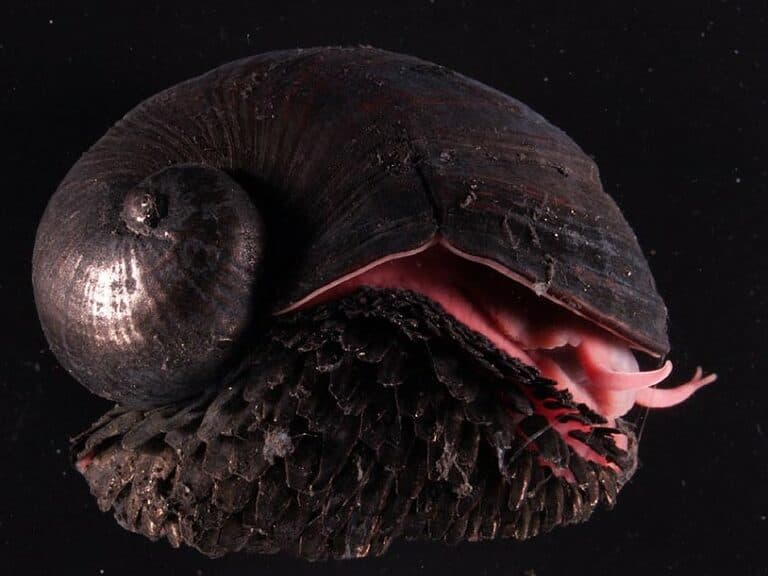
These microbes are the basis of the food web to support the diverse ecosystems of hydrothermal vents. The phylum Proteobacteria and Campylobacterota are both two dominant and widespread examples of microbes found at hydrothermal vents and not only are primary food sources but also form symbiotic relationships with a verity of organisms, having been found inside of cells or surfaces of many invertebrates (such as shrimp, snails, crabs, etc.) allowing for new aquatic niches to be filled and the birth of a never-before-seen ecosystem.
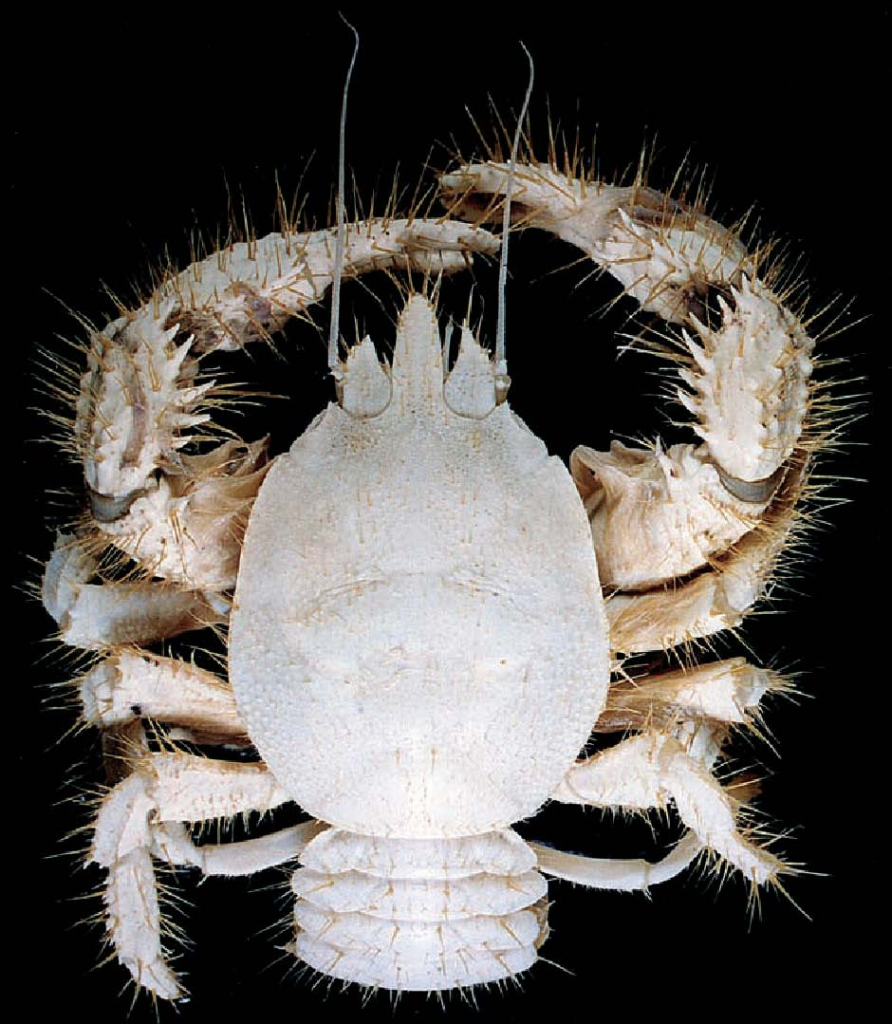
Shinkai crosnier: a squat lobster with a dense array of hairs colonized by chemoautotrophic bacteria
Chrysomallon squamiferum: Known as the volcano snail, it incorporates iron into its shell and relies of an endosymbiotic relationship with chemosynthetic bacteria
When they were first discovered, they reshaped our understanding of life and how it formed. It exposed us to new perspectives on how life can thrive in the deepest parts of the world. So, if it’s possible in the deepest parts of our world, is it possible that life could survive beyond earth?
Sources
Thermal Vents:
- Cowan, Angela M. Edited by Julie Brown. Deep Sea hydrothermal vents. Accessed September 18, 2026. https://education.nationalgeographic.org/resource/deep-sea-hydrothermal-vents/.
- Gronstal, Aaron. “Life in the Extreme: Hydrothermal Vents.” Astrobiology. Accessed September 18, 2026. https://astrobiology.nasa.gov/news/life-in-the-extreme-hydrothermal-vents/.
- Hydrothermal vents. Accessed September 18, 2026. https://oceanexplorer.noaa.gov/wp-content/uploads/2022/10/hydrothermal-vents-fact-sheet.pdf.
Life and Diversity:
- Georgieva, Magdalena N, Crispin T.S Little, Valeriy V Maslennikov, Adrian G Glower, Nuriya R Ayupova, and Richard J Herrington. “The History of Life at Hydrothermal Vents .” Science Direct. Accessed September 18, 2026. https://www.sciencedirect.com/science/article/pii/S0012825221001021.
- Lan, Yi, Jin Sun, Chong Chen, Hao Wang, Yao Xiao, Maeva Perez, Yi Yang, et al. “Endosymbiont Population Genomics Sheds Light on Transmission Mode, Partner Specificity, and Stability of the Scaly-Foot Snail Holobiont.” The ISME Journal 16, no. 9 (June 17, 2022): 2132–43. https://doi.org/10.1038/s41396-022-01261-4.
- Yan, Xiaoman, Qinglei Sun, Ke Xu, Jintao Zhuo, Yuanyuan Sun, Guowei Qian, Xin Zhang, and Li Sun. “Deep-Sea Cold Seep Campylobacterota: Diversity, Growth, Metabolic Characteristics, and Nutrient Production.” Microorganisms 13, no. 5 (April 29, 2025): 1028. https://doi.org/10.3390/microorganisms13051028.

Leave a Reply
You must be logged in to post a comment.