“Deep in the dark waters of Earth’s oceans and seas are bubbling chimneys and cauldrons of energy that support diverse ecosystems unlike anything we see at the surface of our home planet” (Gronstal, 2021)
Stated by NASA Researcher Aaron Gronstal, the quote gives insight into the unique ecosystem of hydrothermal vents. While most of us have heard about the theory of life starting at these exact locations, how many of us know the extent of how life not only evolved there, but thrived?
Hydrothermal Vents
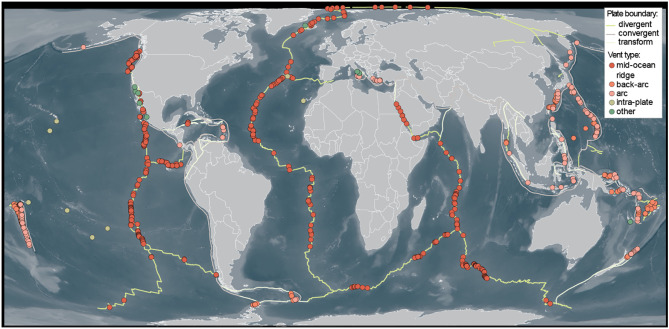
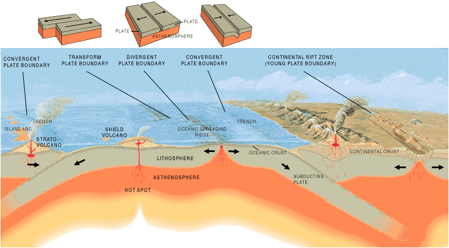
Figure 1: Map of Hydrothermal Vents (Georgieva, 2021)
Figure 2: Types of Tectonic Plate Interactions (Ocean Explorer)
Hydrothermal vents are fissures commonly found at the bottom of the sea floor, spewing super-heated water filled with a wide range of chemicals from the earth’s crust. They are located at plate boundaries, where continental plates collide, scrape, or rip apart from each other (See Figure 1). Depending on the type of plate boundary, magma found within the asthenosphere then swells up into the lithosphere. For divergent plate boundaries, the magma flows upwards and fills the cracks of the separating plates, creating new crust. In convergent plates, the subducting plate forms a mantle wedge in the subduction zone, causing volatiles, such as water and gas to rise into the upper mantle rock, lowering its melting point causing magma to form (Ocean Explorer) (See Figure 2).
Cold sea water fills the newly formed fissures, flowing towards the magma in the oceans crust. As the water approaches the magma, it becomes superheated, some reaching temperatures of 400°C or higher (Cowan), not boiling due to ocean pressures. It absorbs chemicals such as sulfur, copper, zinc, gold, iron, and helium (Ocean Explorer) as it rises to the ocean floor. These chemicals are the backbone to life at these depths, providing the necessary chemicals and organic compounds necessary for supporting life. In addition, allowing for the rapid generation of precipitates from super-heated fluids mixing with the near freezing water, allowing for the formation of chimney-like structures (See figure 3 and 4 for some examples).
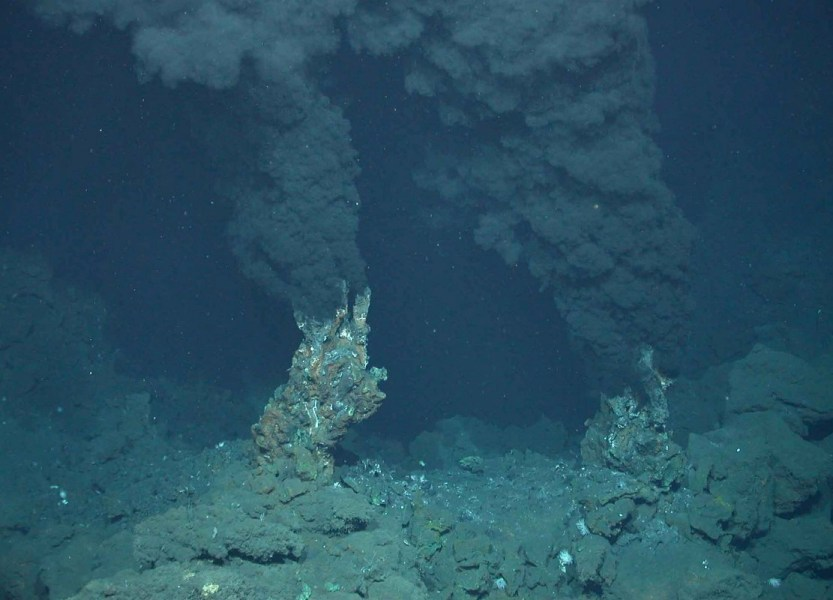
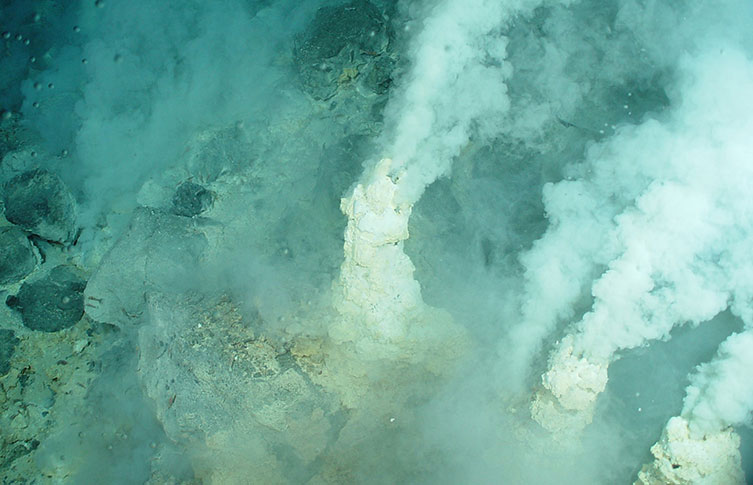
Figure 3: Black Smokers are hydrothermal vents that spew black iron sulfide forming massive chimneys, the largest found being 18 stories tall!(Georgieva, 2021)
Figure 4: White Smokers are hydrothermal vents that spew a relatively colder water described as shimmering, forming smaller whiter chimneys of barium, calcium, and silicon. (Georgieva, 2021)
Life and Diversity at Hydrothermal Vents:
Hydrothermal vents where one of the earliest types of environments to form on earth, existing on earth since the creation of earths ocean 4.6-4.0 Ga (Georgieva, 2021). The chemical-rich soup spewing from hydrothermal vents allowed for vent microorganisms (such as bacteria and archaea) to develop chemosynthesis. While most autotrophs use the sun to carry out necessary chemical reactions, chemotrophs used surrounding chemicals for theirs(Yan, 2025).
These microbes are the basis of the food web to support the diverse ecosystems of hydrothermal vents. The phylum Proteobacteria and Campylobacterota are both two dominant and widespread examples of microbes found at hydrothermal vents and not only are primary food sources but also form symbiotic relationships with a variety of organisms, having been found inside of cells or surfaces of many invertebrates (such as shrimp, snails, crabs, etc.)(Yan, 2025) allowing for new aquatic niches to be filled and the birth of a never-before-seen ecosystem (See figure 5 and 6).
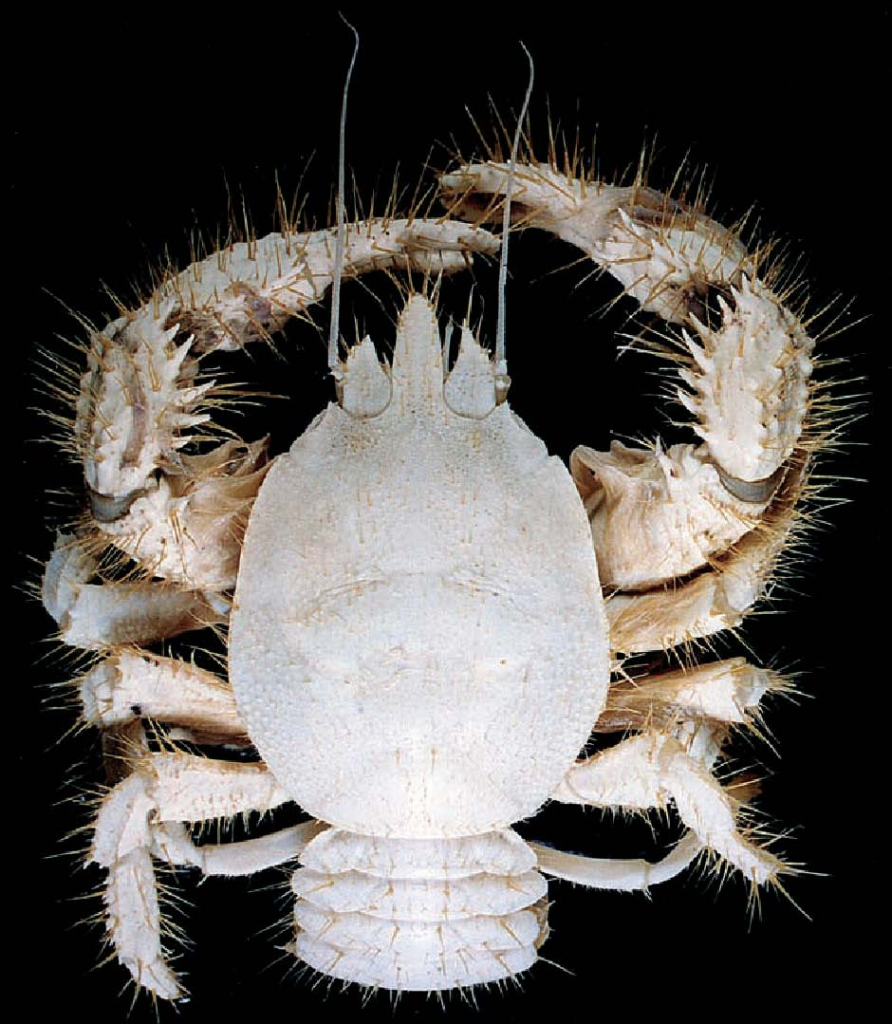
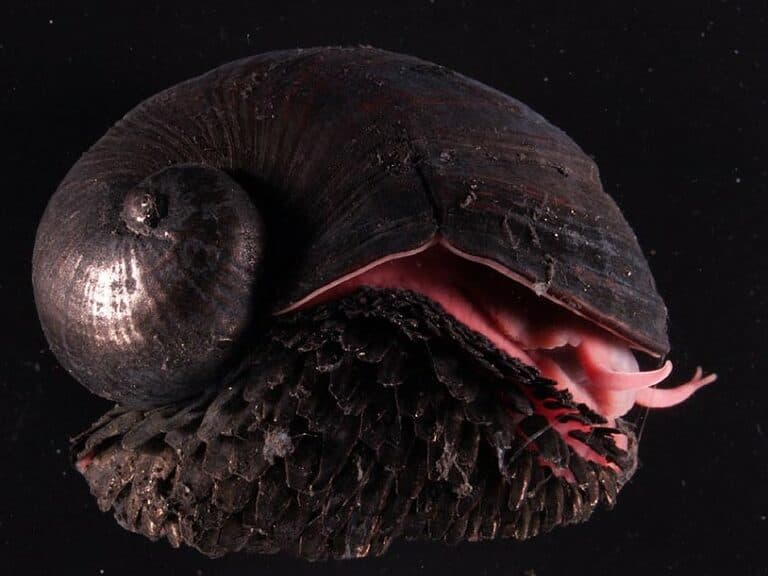
Figure 5: Shinkai crosnier is a squat lobster with a dense array of hairs colonized by chemoautotrophic bacteria (Yan, 2025)
Figure 6: Chrysomallon squamiferum, also known as the volcano snail, it incorporates iron into its shell and relies of an endosymbiotic relationship with chemosynthetic bacteria (Lan, 2022)
When they were first discovered, they reshaped our understanding of life and how it formed. It exposed us to new perspectives on how life can thrive in the deepest parts of the world. So, if it’s possible in the deepest parts of our world, is it possible that life could survive beyond earth?
Sources
- Cowan, Angela M. Edited by Julie Brown. Deep Sea hydrothermal vents. Accessed September 18, 2026. https://education.nationalgeographic.org/resource/deep-sea-hydrothermal-vents/.
- Gronstal, Aaron. “Life in the Extreme: Hydrothermal Vents.” Astrobiology. Accessed September 18, 2026. https://astrobiology.nasa.gov/news/life-in-the-extreme-hydrothermal-vents/.
- Georgieva, Magdalena N, Crispin T.S Little, Valeriy V Maslennikov, Adrian G Glower, Nuriya R Ayupova, and Richard J Herrington. “The History of Life at Hydrothermal Vents .” Science Direct. Accessed September 18, 2026. https://www.sciencedirect.com/science/article/pii/S0012825221001021.
- Hydrothermal vents. Accessed September 18, 2026. https://oceanexplorer.noaa.gov/wp-content/uploads/2022/10/hydrothermal-vents-fact-sheet.pdf.
- Lan, Yi, Jin Sun, Chong Chen, Hao Wang, Yao Xiao, Maeva Perez, Yi Yang, et al. “Endosymbiont Population Genomics Sheds Light on Transmission Mode, Partner Specificity, and Stability of the Scaly-Foot Snail Holobiont.” The ISME Journal 16, no. 9 (June 17, 2022): 2132–43. https://doi.org/10.1038/s41396-022-01261-4.
- Yan, Xiaoman, Qinglei Sun, Ke Xu, Jintao Zhuo, Yuanyuan Sun, Guowei Qian, Xin Zhang, and Li Sun. “Deep-Sea Cold Seep Campylobacterota: Diversity, Growth, Metabolic Characteristics, and Nutrient Production.” Microorganisms 13, no. 5 (April 29, 2025): 1028. https://doi.org/10.3390/microorganisms13051028.
Comments
8 Responses to “Exploring Life in an Alien world: Hydrothermal vents and how they changed how we perceive life”
Nice work Kai!
I love the formatting of your blog and your use of the features such as entering quotes, descriptive and visually informative and vibrant images, it over all makes it very enjoyable to read as a viewer.
Some things I’d like to comment on is the spelling of alien in the title, it is currently spelled as “Alian” this is just a quick typo to fix. Also, in your quote, I was wondering if there was a section to insert underneath the quote itself to mention who said it, as it does not flow the same. Additionally, don’t forget to put quotation marks around the quote itself; it may confuse some readers to begin with!
Also, for your paragraph starting with “Hydrothermal vents are fissures commonly found at the bottom of the sea floor…(See Figure 1),”, insert Figure 1, then continue with the rest of the text with, “In divergent plate boundaries…(See Figure 2)” then insert Figure 2 to have better flow of both visuals and their corresponding text. Also, when mentioning the figures in the text, if they are named (e.g figure 1), the letter “F” should be capitalized.
Lastly, some words are incorrectly used; for example, in the 5th paragraph, line 5 they word “verity” should be “variety”. I also think you must cite your sources within the text itself consistently, as some information is not substantiated. Overall, great work!
– Aanya
Hi Kai,
Your topic is really cool and well articulated!
I did notice a few edits that can be made:
1) For your images ensure they are labeled (i.e. add figure #s to the last 4 images)
2) Write “temps” as “temperatures”
3) Clarify whether Earth’s oceans were created 4.6-4.0 Ga or 4.5 ± 0.1 Ga
Overall, you did a good job communicating information; I learnt about volcano snails!
Skylar Chen
Hi Kai
Great job on your blog post, I found it to be a very interesting read! here are a few peices of feedback:
– Make sure to include figure numbers for all images added and that they are mentioned in text.
– I would encourage the use of peer reviewed articles as sources! Also make sure if an article has a DOI, use it in the citation for example your “Georgieva” source has a DOI
– Instead of separating your sources into sub categories make it one list and include in text citation for each source listed
Overall great job! Happy editing!
Maya Kumar
Hi Kai!
I thoroughly enjoyed reading your post and learning about ways life thrives in even the most extreme places. You’ve chosen a really interesting topic.
One thing I particularly liked was your title: “Exploring Life in an Alien World”. It caught my interest and the quote that followed proved to be an effective hook to get me reading.
I just have some pointers for your editing this week.
– P3 S1: you mistakenly spelled fills as “filles”
– P1 S2: “Nasa” should be NASA, since its an acronym
– P1 S2: “insight into” instead of “insight on” is more gramatically correct
– Several mentions of “Earth” you spelt with a lower case e where it should be capitalized
As for sentence flow and structure:
– P3 S2: Consider rewriting “As it approaches, it gets super-heated up”. This sentence is a bit repetitive. Something like “As the water approaches the magma, it becomes superheated” would make this sentence more concise.
Overall great work with this post! I look foward to seeing any improvements this week.
Hi Kai!
This is a really interesting and informative blog post. A couple suggestions to keep in mind while editing:
– Make sure to revise the information in paragraph 2 for correctness. For example, convergent plate boundaries, by definition, are where two plates collide. Plates will not move apart or slide against each other at convergent boundaries.
– Don’t forget to add in-text citations throughout!
– The last sentence in paragraph 3 is long and gets confusing. Consider splitting it into 2 sentences for clarity. For example, try: “These chemicals are fundamental to the formation of life, providing some of the organic compounds necessary to support living organisms. In addition, they allow for the rapid generation of precipitates from super-heated fluids mixing with near freezing water. This supports the formation of chimney like structures in hydrothermal vents.”
– Leave a comment on your post explaining your motivations and connection to iSci!
Happy editing!
Maegan
Hi Kai!
I thoroughly enjoyed reading through your blog post. I found that the visuals helped break apart the text in a more digestible way and made the information both interesting and accessible.
Moving forward, I believe that there are some minor grammatical errors that can be easily remedied to make the flow of the post better.
– ” Located at convergent plate boundaries, where continental plates collide, scrape, or rip apart from each other, with magma found in the asthenosphere swelling into the lithosphere in a verity of ways” can be reworded to become less chunky, perhaps by adding “They are” located. As well, you can split the sentence into two by saying “Magma can be found” as the start of the second sentence, if you wish. Lastly, I believe there is a typo, with “verity” meaning to be “variety”.
-The scientific names of the crab organisms (under the last pictures) should be italicized.
-Don’t forget in-text citations!
Amazing job otherwise!
Kanya
Hi Kai!
Huge congrats on your first blog post. I know it can be daunting, so way to go! I have a few suggestions for you during your editing process:
– Figure 1 and 2 are quite hard to read. I would suggest you find different, simpler figures with clearer writing if possible!
– You do not have to separate your cited sources into subject matter. Combine it into one list titled “References”
– Overall, I suggest simplifying your layout. While I love how you have distinct sections, I think it can be a bit complicated to take in as a reader. Consider editing the amount of figures you have or removing the subtitles.
Again, amazing job and best of luck in the editing process!
-Keira
Hello iSci!
Thanks to everyone who took time to read and leave a comment on my blog! I really appreciated all the feedback and tried to incorporate as many suggestions as possible.
The topic I wrote about was very special to me and was inspired to write about it after our lectures on life and biodiversity. I have always loved ecology, but my first ever real interest was the wide ranges of life in the ocean. Watching National Geographics “Ocean” documentary fascinated me and it was a joy learning and sparking that love while writing this blog post.
This blog post relates to content covered in Life Science and Earth Science. For Life Science, it relates to biodiversity and evolution, with the wide ranges of animals and microorganisms found and how they evolved and adapted to live in the hydrothermal vents. For Earth Science, it references plate tectonics and how they function, specifically cover divergent and convergent plate boundaries.
Hope you enjoyed my blog!
– Kai Fusch