In 1942, Yale physicians Louis Goodman and Alfred Gilman administered the first form of chemotherapy, having discovered that nitrogen mustards could be used to systematically target and kill cancer cells in the human body (DeVita & Chu, 2008). This marked a revolutionary breakthrough in oncology, initiating the era of modern chemotherapy. Chemotherapy has extended and saved millions of lives since then, but there is still a major concern when it comes to this treatment: the environmental cost (Abuamer, 2025).
Producing anticancer active pharmaceutical ingredients (APIs) is highly inefficient, as small-molecule anticancer agents typically require 10-20 synthetic steps, leading to compounding yield losses (Rose, 2025). Additionally, APIs used in oncology treatments must meet a highly strict standard, causing API production to be even less efficient than the already concerning pharmaceutical average. Furthermore, the waste and disposal of these pharmaceutical agents are entering the natural environment, notably aquatic environments, causing harm to the ecosystems there. Studies have shown traces of cytotoxic cancer treatments in samples from rivers and seawater in multiple countries, and one study in particular followed the effects that incorrectly disposed of anticancer drugs had on crustaceans. They found a significant increase in DNA damage and a decrease in reproductive potential of crustaceans in this environment following exposure to the anticancer drugs etoposide, cisplatin, 5-fluorouracil, and imatinib (Walker & Ghiya, 2021).
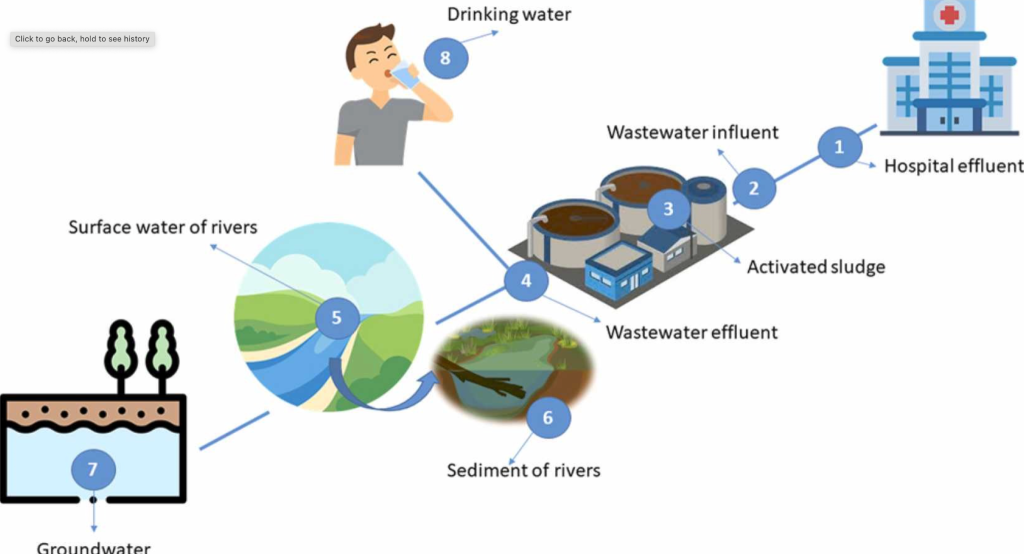
Another growing concern regarding chemotherapy is the disposal of chemical waste into municipal water systems. These chemicals enter water systems primarily through cancer patients’ feces and urine, as conventional wastewater treatment plants are not equipped to fully remove these genotoxic compounds from the water supply. It is estimated that 30-90% of chemotherapy drugs, varying by agent, are excreted unchanged or as active metabolites in feces and urine (Cirstia et al., 2025). Cyclophosphamide and ifosfamide, widely used alkylating chemotherapy medications, are continuously being detected in effluents and surface waters, since they are not degradable via standard wastewater processes (“Cancer Drugs Persist in Water Cycle, Creating Genotoxic Health Risk,” n.d.). Cytostatic drugs and their metabolites then travel through sewage systems into surface water, allowing these DNA-damaging materials to re-enter drinking water systems. Flushing unused or expired chemotherapy medications is also a concern, as this is another pathway for these compounds to enter the sewage system. This raises concerns about potential effects, as cytostatics are inherently genotoxic, and low-dose yet chronic exposure to these chemicals is a public health concern, especially for immunocompromised individuals, pregnant individuals, children, and other members of vulnerable populations (Cirstia et al., 2025).
Although studies on this topic are limited, it is evident that there is a growing concern when it comes to the toll chemotherapy treatments have on the environment. This issue must be examined from a cross-industrial standpoint, as pharmaceutical companies, hospitals, wastewater treatment plants, technology developers, and environmental agencies all have a role to play in mitigating the negative effects of this life-saving yet damaging treatment.
References
Castellano-Hinojosa, Antonio, Manuel J. Gallardo-Altamirano, Jesús González-López, and Alejandro González-Martínez. 2023. “Anticancer Drugs in Wastewater and Natural Environments: A Review on Their Occurrence, Environmental Persistence, Treatment, and Ecological Risks.” Journal of Hazardous Materials 447 (April): 130818. https://doi.org/10.1016/j.jhazmat.2023.130818.
Cirstea, Ilie, Andrei-Flavius Radu, Ada Radu, Delia Mirela Tit, and Gabriela S. Bungau. 2025. “Healthcare Waste Toxicity: From Human Exposure to Toxic Mechanisms and Management Strategies.” Journal of Xenobiotics 15 (5): 155. https://doi.org/10.3390/jox15050155.
Green Chemistry Hub. (n.d.-a). Greenchemsci.com. Retrieved September 21, 2026, from https://www.greenchemsci.com/posts/green-chemistry-metrics-2024-a-comprehensive-review-for-sustainable-drug-development
g-development.
“Green Chemistry Hub.” 2025. Greenchemsci.Com. 2025. https://www.greenchemsci.com/posts/validating-educational-outcomes-in-green-chemistry-metrics-methods-and-impact-for-drug-development.
Li, Dan, Hongxing Chen, Hongsong Liu, Daniel Schlenk, Jingli Mu, Silvia Lacorte, Guang-Guo Ying, and Lingtian Xie. 2021. “Anticancer Drugs in the Aquatic Ecosystem: Environmental Occurrence, Ecotoxicological Effect and Risk Assessment.” Environment International 153 (August): 106543. https://doi.org/10.1016/j.envint.2021.106543.
Sustainability Directory. 2025. “Cancer Drugs Persist in Water Cycle, Creating Genotoxic Health Risk → Health.” News → Sustainability Directory. November 19, 2025. https://news.sustainability-directory.com/health/cancer-drugs-persist-in-water-cycle-creating-genotoxic-health-risk/.
Walker, Andrew, and Suhani Ghiya. 2021. “Chemotherapy Is Harming the Environment: It Is Time for Regulators, Manufacturers and Pharmacy to Take Action.” The Pharmaceutical Journal. June 14, 2021. https://pharmaceutical-journal.com/article/opinion/chemotherapy-is-harming-the-environment-it-is-time-for-regulators-manufacturers-and-pharmacy-to-take-action.
Comments
15 Responses to “For People or Planet: The Environmental Toll of Chemotherapy”
Hi everyone,
Our introduction to sustainable chemistry, specifically the case study on ibuprofen, made me curious about the impacts that pharmaceuticals have on the environment. As I am interested in human health, I started to think about more common or well-known medications and found many interesting articles about the environmental impacts of chemotherapy treatments. In our Earth Science lectures, we talked about the importance of sustainability, and I wanted to explore how drugs both save lives and harm the environment, thus negatively impacting human health in some ways. Looking forward to hearing your feedback!
Hi Isabel,
Great blog post! I really enjoyed reading about the environmental concerns regarding drugs that is considered so “lifesaving”. Here are a few suggestions to help with the editing process:
– Consider adding a figure(s) in your blog post. You discussed many studies, a figure adapted from these studies can be a useful tool to help you explain the research conducted.
– Make sure to update your last (n.d.) citation with the date and authors. Your other (n.d.) article citations should also have a date if it is a published article.
– If space allows, it would be helpful to talk about the current solutions in place to address the environmental costs of chemotherapy. I think it would be interesting to see the “integrated” aspect of current solutions for this integrated problem.
Overall, happy first blog post! Happy editing 🙂
Myan
Hi Myan,
Thank you so much for your feedback! I added a figure, so hopefully that makes the information a bit clearer.
Isabel
Hi Isabel,
This is a great blog post with an interesting topic. Your title caught my eye. Some feedback I have for you is:
– Add a figure! Figure captions (at least for our year) do not count towards the word count, and figures are very useful to visualize what you are trying to share. For example, your description of waste disposal into human water systems is very detailed, and a diagram of this process can help you save your word count while conveying a clearer image to the audience.
– Paragraph 3, the last sentence is a bit wordy, as you repeat “genotoxic” twice. Consider removing the first one. You can also make the last part more concise by saying “immunocompromised and vulnerable populations.”
– The links in your citations should be hyperlinked! aka I should be able to click on them and be redirected to your source 🙂
Great work overall, happy writing!
Angie
Hi Angie,
Thank you for your extremely helpful feedback! I added in a figure and changed my wording to hopefully make things flow better. I also hyperlinked my citations as per your suggestion.
Isabel
Hi Isabel!
I really liked your blog post; this is such an interesting topic!
I just have a couple of suggestions for you!
Firstly, I would recommend starting off your blog with a hook sentence. For instance, “What if the treatment designed to save lives is also leaving a lasting impact on the environment?”
Secondly, this part of the paragraph has no citations: “Cytostatic drugs and their metabolites then travel through sewage systems into surface water, allowing these DNA-damaging materials to re-enter drinking water systems. Flushing unused or expired chemotherapy medications is also a concern, as this is another pathway for these compounds to enter the sewage system. This poses a genotoxic risk to the population, as cytostatics are inherently genotoxic, and low-dose yet chronic exposure to these chemicals is a public health concern, especially for immunocompromised individuals, pregnant individuals, children, and other members of vulnerable populations.” I think it’s better to overcite than to undercite, so I would add in the citations where you got this information.
Lastly, just looking through your post, I would double-check to make sure you are citing all new information! And if you can, I would add in a figure, as this always helps readers better understand your topic.
Overall, this was an amazing post! Congratulations on writing your first of many isci blogs!
Happy editing!
Abbie
Hi Abbie,
Thank you for your detailed feedback! I cited the part of the paragraph you mentioned and added a figure.
Isabel
Hi Isabel,
This is a very interesting topic! I enjoyed reading about the drawbacks of chemotherapy on the environment despite its life-saving purposes in cancer. Here are a few minor suggestions I have:
– P2S2: If space allows, consider adding a sentence or two explaining what you mean by “concerning pharmaceutical average”. Like are you talking about production, efficiency, or yield of APIs?
– P3S1: maybe change “human water systems” to “municipal water systems”
– P3S2: Just to clarify, did you mean treatment plans or treatment plants?
– P3S7: Rather than framing the sentence as an established population-level risk, consider changing it to something like, “This raises concerns about potential genotoxic effects from chronic exposure.
Overall, great blog post! Happy editing!
Maybel
Hi Maybel,
Thank you for your feedback! I found it super helpful that you mentioned specific parts of my blog. I edited based on your feedback and changed my wording based on your suggestions.
Isabel
Hi Isabel,
Amazing job on your blog post. Your writing style is clear and consistent, and this post flowed well and was easy to follow. I have a few suggestions:
P1S3: I would change “one major concerns” to “a major concern”, as there are significant concerns with chemo outside of environmental effects, such as side effects, ect.
P2S1: Be sure to use the plural “are” here to go with the plural APIs, like this:
“Producing anticancer active pharmaceutical ingredients (APIs) are highly inefficient…”
P3S1: Consider using “chemical waste” instead of “chemotherapy waste” in this sentence to reduce repetition.
P4S2: To sound more professional, use the word “examined” instead of “looked at”.
References: Be sure to hyperlink your sources!
Once again, fantastic work! I especially like the way you end your post with a call to action, highlighting a research gap. Great work 🙂
– Clara
Hi Clara,
Thank you for your helpful feedback! I think your suggestions for word choice made things much clearer for my post.
Isabel
Hi Isabel!
I thought this was a great blog post! I really liked how you used specific examples for how chemotherapy impacts the environment because I feel like it made it easier to understand!
A few things that could be improved are:
1) Maybe add a figure caption to help break up some of the text and to help visually explain what is going on. It can help to avoid some confusion when discussing complex topics.
2) I feel like it would be helpful to add a few potential solutions to the issue, as it could help viewers understand how the issue could be addressed, and would help wrap up your blog.
Overall this was a great! I found it to be such an interesting topic, and I thought you did an amazing job. Happy editing!
– Sydney
Hi Sydney,
Thank you for your feedback! I added a figure and caption, so hopefully that helps explain the content of my blog.
Isabel
Hey Isabel! Your topic is very interesting. Although I already knew it was hard to synthesize pharmaceuticals and how wasteful they are, I had never thought about how unsustainable medical practices themselves are. A very cool topic!
Some ways I believe you can improve your blog: I think that splitting the middle two sections of your blog would be beneficial, as it would improve readability, as currently a lot of information is clustered together and may deter readers.
I also believe that an image or even a diagram of API’s pathway into the environment, or even the life cycle of chemotherapy as a drug from its manufacturing, use on patients, and its disposal, would not only retain readers’ attention but also help them understand the flow of your blog even better!
Additionally, I think your work is definitely very formal and well written, but I feel as though some wording choices could be more informal to gain reader attention. Maybe this could include having a well-written hook and conclusion which connect to your theme and or even how the disposal of APIs causes real problems (find real situations rather than just explaining what is happening so readers feel more connected to the subject)!
Anyways, a very interesting topic. Happy Editing!
-Aanya
Hi Aanya,
Thank you for your detailed feedback! I agree; adding a figure definitely helps with understanding the content of my blog, and I rewrote some phrases to help with reader comprehension.
Isabel