Around 2.4 billion years ago (Ga), a toxic byproduct of an ancient ecological catastrophe poisoned the entire planet, specifically the anaerobic life that had dominated early Earth. This lethal element is one most life now depends on: oxygen (Aiyer 2022).
We often talk about what makes us alive, but we rarely question what allowed us to be alive. To begin, cyanobacteria were pivotal to our existence; they were the first to undergo oxygenated photosynthesis, introducing a foreign element to the atmospheric makeup. Although this event poisoned early earth, it was what set the conditions that allowed for life to grow (West 2022). This ecological catastrophe is called the Great Oxidation Event (GOE).
However, what evidence indicates that this event even happened and that Earth’s atmosphere changed around 2.4 Ga?
Cyanobacteria emerged around 2.7–3 Ga and began producing oxygen through oxygenated photosynthesis, which accumulated over around 500 million years . As cyanobacteria released O2, chemical reactions immediately consumed it; reacted with dissolved iron in oceans, oxidized atmospheric methane, and reacted with rocks on land. Around 2.4 Ga, these chemical “sinks” became saturated and could no longer consume oxygen as quickly. This caused atmospheric O2 levels to rise (Aiyer 2022; West 2022).
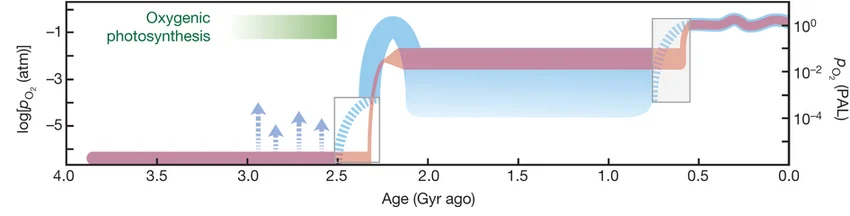
Figure 1. Atmospheric partial pressure of oxygen over Earth’s history. The graph shows the very low levels of atmospheric O₂ before the Great Oxidation Event and the subsequent increase in oxygen levels.
Before the GOE, oceans were anoxic and contained massive amounts of dissolved iron in its reduced form, Fe²⁺. Following the GOE, as free oxygen entered the oceans, it reacted with iron and oxidized it to Fe³⁺, making it insoluble. The oxidized iron precipitated onto the seafloor as minerals like magnetite. Banded Iron Formations (BIFs) formed alternating layers of magnetite and silica in the oceans, eventually creating the striped rocks seen today. These formations provide evidence of oxygen interacting with dissolved iron in ancient oceans, showing how oxygen levels changed after the GOE (Canfield et al. 2013; West 2022).
Prior to the GOE, terrestrial rocks contained reduced iron with grey-green colouration. After the rise of oxygen, iron was oxidized, producing red-orange rocks known as “Red Beds,” which appear in the geological record around 2.4 Ga. Unlike BIFs, which record the interaction between oxygen and iron in ancient oceans, Red Beds provide evidence of oxidation occurring on land. Together, these two types of geological evidence show that the rise of oxygen affected both Earth’s oceans and terrestrial environments (Shawwa et al. 2024).
Before the GOE, the atmosphere contained massive amounts of methane produced by methanogenic archaea. Methane is a greenhouse gas that kept early Earth warm, even though the Sun was 25% dimmer 2.4 Ga than it is today. The formation of hydroxyl (OH⁻) oxidized methane, causing it to disappear from the atmosphere rapidly (Canfield et al. 2013). This caused the Earth to enter a global period of glaciation, termed the “Huronian Glaciation,” around 2.3 Ga. This rapid change in climate serves as indirect evidence of the mass extinction of anaerobic methanogens (Canfield et al. 2013).
The disappearance of the Mass-Independent Fractionation of Sulfur (MIF-S) signal, which existed only if no ozone layer was present, around 2.4 Ga also marked a critical threshold (Crockford et al. 2026). Atmospheric oxygen had reached high enough levels to form a protective ozone layer. This ozone shield stopped the UV-driven chemistry that created the MIF-S signature in older rocks, allowing scientists to use its disappearance as evidence for when oxygen levels had risen enough for an ozone layer to form (Crockford et al. 2026).
So, yes, Earth was poisoned by oxygen around 2.4 Ga. While catastrophic for much of the anaerobic life that dominated the planet, this event changed life’s trajectory. The same “lethal toxin” that caused the mass extinction of an ancient biosphere eventually became essential for aerobic respiration and the evolution of complex life.
References
Aiyer, Kartik. “The Great Oxidation Event: How Cyanobacteria Changed Life.” ASM (2022). https://asm.org/articles/2022/february/the-great-oxidation-event-how-cyanobacteria-change. Accessed September 20, 2026
Crockford, P. W., I. Sugiyama, M. A. Kipp, J. Hao, L. L. Nelson, J. D. Hemingway, S. Wimmer, and M. Fakhraee. 2026. “Revisiting the Greatness of Earth’s Great Oxidation.” Communications Earth & Environment 7, no. 1 (2026): 348.
https://doi.org/10.1038/s43247-026-03518-8 Accessed September 20, 2026
D. E. Canfield et al., “Oxygen dynamics in the aftermath of the Great Oxidation of Earth’s atmosphere,” Proceedings of the National Academy of Sciences of the United States of America 110, no. 42 (2013): 16736–16741, https://doi.org/10.1073/pnas.1315570110. Accessed September 20, 2026
Shawwa, Nabil A., Thomas R. McLoughlin-Coleman, Michael G. Babechuk, Maryam Shahabi Far, James E. Mungall, and Robert H. Rainbird. 2024. “Earth’s Oldest Terrestrial Red Beds as Direct Evidence for the Great Oxidation Event ca. 2.3 Ga.” Precambrian Research 409, article 107423.
https://doi.org/10.1016/j.precamres.2024.107423 Accessed September 20,2026
Wang, Haiyang, and Chao Li. 2026. “Stagewise Oxygenation of the Earth’s Atmosphere and Oceans.” The Innovation 7, no. 9: 101353.
https://doi.org/10.1016/j.xinn.2026.101353 Accessed September 20, 2026
Figure 1: Timothy W. Lyons, Christopher T. Reinhard, and Noah J. Planavsky, “The rise of oxygen in Earth’s early ocean and atmosphere,” Nature 506 (2014): 308, fig. 2, doi.org.
Comments
9 Responses to “Was Ancient Earth Poisoned?”
Hi everyone!
This blog post connects to iSci because it integrates three disciplines; Earth Sciences, Chemistry, and Life Sciences, to understand an event that shaped Earth and life as we know it.
It connects to Chemistry through the photosynthetic reactions of cyanobacteria and how oxygen chemically interacted with iron and other elements, driving the reactions that led to the GOE/were caused by the GOE. To Life Sciences, because it covers a little bit about anaerobic bacteria and methanogenic archaea, as well as how this event caused mass extinction of anaerobic organisms which allowed life to evolve. Most importantly, Earth Sciences because it is how we were able to know all this even happened and manage to date it. I was inspired by Module 3 on Absolute Dating, and I used the content covered to explain how we actually date the rise of oxygen, through Banded Iron Formations, MIF-S signatures, Red Beds, etc.
Hi Hala,
This was a very interesting blog post! It’s cool thinking about how oxygen was initially destructive and yet is also one of the reasons why we are even able to exist on Earth. Here are a few minor suggestions I have:
– consider removing the headings/subheadings and integrate the paragraphs together more smoothly
– References (forgot the e)
– I believe cyanobacteria were the first to perform oxygenic photosynthesis, but not photosynthesis overall, so maybe reframe that sentence to make it more specific
– If possible, including a visual figure showing the timeline of the GOE would be very helpful
Overall, this was a great blog post! I look forward to the final edit
Maybel
Hi Hala,
Overall, your blog post was great, and I like how you wrote it. It was a fun read!
I just have a couple of suggestions for you,
In your second paragraph, don’t forget to cite these sentences: “Cyanobacteria were pivotal to our existence. They were the first organisms to undergo photosynthesis, releasing oxygen that accumulated in the atmosphere, poisoning early Earth but also setting the conditions that allowed human existence.”
Also, with your citations, I don’t think there needs to be a comma between the name and the year, etc. (West, 2022) should be (West 2022).
Lastly, I would combine some of your paragraphs, as some of them only consist of one sentence. For instance, I would combine the banded iron formations with the rock dating.
Overall, great work and happy editing!
Abbie
Hi Hala! Nicely done with your first blog post of this year! So interesting to read about the origins of the oxygen in our atmosphere. BElow are some suggestions to help improve your post:
P1S2: Consider rephrasing to something less human-centric, as it is not just us depending on oxygen, e.g. “that lethal element is something most life now depends on: oxygen”
For your in text citations, chicago author date has no comma, so (West 2022) instead of (West, 2022), same for all following.
In your banded iron formation paragraph heading, I would remove “(BIF’s)” as you later introduce the short-hand.
Your ozone layer turtle, I would write out Mass-Independent Fractionation of Sulfur as, to use a shorthand you must introduce it first, which you do a line below.
If you have space, perhaps before the conclusion, I would love to read more about how earth’s atmosphere got to be what it is now (i.e. a bit more expansion on the shift from the earlier atmosphere you were talking about to now).
Happy editing!
Aven 🙂
Hi Hala,
Excellent job on your first blog post! This is a fascinating topic, and you did a great job integrating multiple scientific disciplines. I have a few suggestions:
P1S2: Don’t forget to cite every time you are relaying information that isn’t common knowledge – I think here qualifies as somewhere a citation is necessary. While everyone knows Oxygen is essential, not everyone knows it was lethal to previous anaerobic life!
P4S2: It may be helpful to specify which kind of chemical reactions consumed the oxygen released by the cyanobacteria.
A few general comments:
– Make sure you are using Chicago Author-Date for in text citations (no comma between author and date)
– Section headings are optional for blog posts. I think you’ve written this in a way that it could flow without them, but if you want to keep them, consider using a heading font to make them clearer 🙂
– Be sure to hyperlink your first source!
Overall, amazing job! Happy editing!
– Clara
Hey Hala!
I really enjoyed reading your blog post, especially how you connected chemistry with changes in Earth’s geology. Your discussion of iron oxidation provided concrete examples of how chemical processes can leave lasting evidence in the geological record. These connections gave your explanation of the Great Oxidation Event a strong scientific foundation, which helped me understand the concept of atmospheric oxygen and how it could affect so many aspects of the natural world.
I have a few suggestions:
(Par 2, S:2–3): “Cyanobacteria were pivotal to our existence” repeats the next sentence’s explanation of how they allowed human existence. I would combine these sentences to improve the flow.
(Par 2, S:3 & Par 4, S:1): Both explain that cyanobacteria produced oxygen through photosynthesis and that it accumulated. I would keep the detailed explanation in paragraph 4 and shorten the explanation in paragraph 2.
(Par 5, S:3): “Formed striped layers” and “created the striped rocks present now” repeat the same idea within one sentence. You could describe the alternating layers once to avoid repetition.
(Par 6, S:2): You could explain more deeply how red beds provide evidence of oxygen in the atmosphere, whereas BIFs reflect processes occurring in oceans. This would clarify what each type of evidence contributes to our understanding of the GOE.
(Par 9, S:1–2): You could explain how increased oxygen availability eventually supported complex life through aerobic respiration. This would strengthen the connection between the GOE and human existence that you introduce at the beginning.
Overall, amazing first blog post! I look forward to reading your revised version! 🙂
– Riyal
Hi Hala,
Great blog post, I can really see how it integrates into iSci! Here are some pointers that you might want to implement:
-P1S2: I would change “The” to “This”
-P2S2: I would start this sentence with “To begin” or something of that sort
-P2S3: I would divide this sentence in two. Have the second one maybe be: “Although this process poisoned early earth, it also set …”
-P3: I would add the word “even” in between event and happened for more emphasis
-I recommend changing the size of your sub-headers to differentiate them from the body text
-I would get rid of “Evidence:” for the purpose of keeping a blog post-like structure
-I recommend adding a figure somewhere in between, visualizing the evidence we have
Otherwise, great job!! Cant wait to see the final draft.
Celine
Hi Hala!
Great post! I liked how you made strong connections between multiple sciences and topics we have learned about. I also that this post was very engaging!
A few suggestions I have are:
– Ensuring that you are using Chicago Author Date citations throughout (I noticed this in the in text citations and reference list)
– Consider making the headings more clear
– Make sure all presented information has a clear citation (I noticed that some sentences were without)
Great first blog post, I enjoyed reading this! 🙂
Tsippora Brown
Hi Hala,
Great first blog post and amazing topic choice! I really enjoyed the discussion of Mass-independent fractionation of sulfur, I didn’t know that was a thing, nor did I know that it is how we know how old the ozone layer is. Pretty cool stuff! I think you integrated concepts from life science and earth science very well too.
I have a few minor suggestions:
General: Please make sure that whenever you have an ion like Fe^2+ you are scripting the 2+ part for formatting purposes. Similarly, when you have a compound like O2, please subscript the 2. Please make sure you are capitalizing “Earth” throughout your blogpost.
Figure 1: please format the figure caption as a figure caption, there should be an option to do that. Also, cite your sources – where did you get this figure from? I think the caption would also benefit with some additional detail, guide the reader through what it is trying to say.
P2: I would mention GOE earlier on in the paragraph and mention what early Earth’s atmosphere looked like before versus after. Example: “Free oxygen, which is now essential to most life on Earth, was nearly absent from early Earth’s atmosphere, that is, until cyanobacteria, the first organisms to undergo oxygenated photosynthesis, introduced the foreign element into the atmospheric makeup. Although this event, termed the great oxidation event (GOE) poisoned early Earth, it produced the conditions that allowed for life as we know it to evolve. ”
P3S2: consider rephrasing to: Although cyanobacteria were producing O2, it was almost immediately consumed by various chemical reactions. O2 reacted with rocks on land, dissolved iron in oceans, and oxidized methane in the atmosphere. It wasn’t till 2.4Ga when these chemical sinks became saturated, and could no longer rapidly consume oxygen that atmospheric O2 levels began to rise.
P7: avoid colloquial language like “crashed into a global glaciation.” Instead, you could try to say: “This caused the Earth to enter a global period of glaciation, termed the “Huronian Glaciation,” around 2.3 Ga. This rapid change in climate serves as indirect evidence of the mass extinction of anaerobic methanogens”
Overall, amazing job! This was a super interesting read and definitely taught me some new things.
Best,
Vani 🙂