
Where did life start on Earth? We have all been taught about the perfect conditions Earth has for life; it’s just the right distance from the Sun, has water and carbon, it’s constantly changing environment, and cycling energy to sustain life (American Museum of Natural History, n.d.). Ever since, humans have been in pursuit to find life as complex as our own; sending out landers, rovers, and watching diligently on deep space telescopes, we have been looking for alien life upon a planet beyond our galaxy. Have we ever considered that maybe the possibility of extraterrestrial life is closer than we think?
The panspermia hypothesis suggests that lifeforms like bacteria had hitchhiked upon comets or asteroids, carrying inhabitants along the way and eventually ending up on Earth (Mortillaro 2020). NASA’s OSIRIS-REx and Japan’s Hayabusa2, over the years, brought asteroids samples to Earth, some containing the building blocks of life. This raises the question of whether these cells or even full lifeforms themselves were delivered onto Earth. Dr. Jason Dworkin, a project scientist on the OSIRIS-REx mission, says it is definitely plausible, as “Early Earth had a bombardment of material” (O’Callaghan 2026). The idea of Mars being the main source of this trans-planetary exchange stems from the fact that it once was potentially perfect for life(Mortillaro 2020).
Hypothetically, microbes within rocks could be protected from UV rays and survive space travel known as lithopanspermia as seen in Figure 1. Researchers even believe microbes can survive space travel through forming a thick aggregate to survive the conditions of space as well, known as massapanspermia. Now, if these life-forms successfully did manage to land and survive on another planet and reproduce, they would require life to survive the space vacuum, temperature fluctuations, and space radiation (Sammicheli and Szanto 2020).
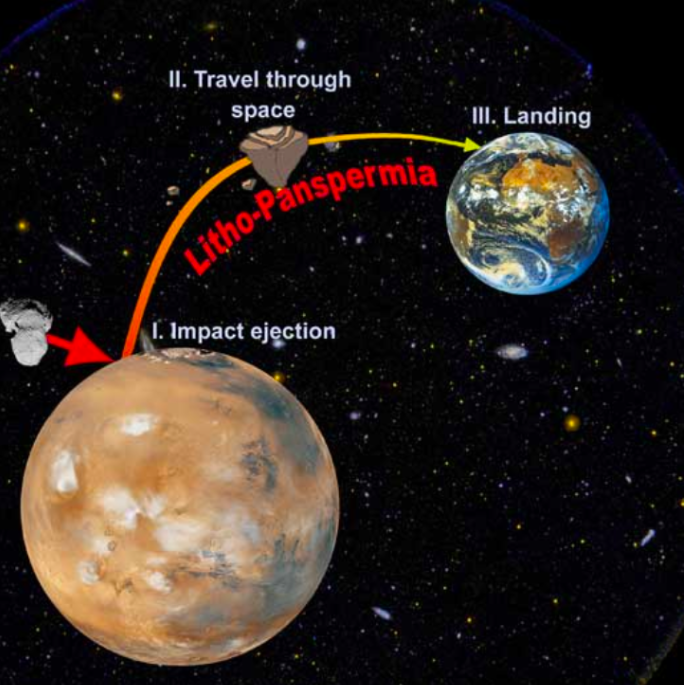
Figure 1: Image showing three stages of lithopanspermia from Mars to Earth from impact ejection, travel through space, and landing onto Earth(Meyer 2008).
To discover its plausibility, a group of Japanese scientists conducted an experiment on the International Space Station, discovering some bacteria can survive in space for up to 10 years. Starting in 2015, they used Deinococcal bacteria— a radiation tolerating bacteria in varying thicknesses outside the space station for one, two, and three years. In the end, bacteria colonies larger than a millimetre can be shielded from space and even up to 10 mm if protected by rocks, giving both massapanspermia and lithopanspermia credibility in their ability to transmit life (Mortillaro 2020).
Now, our common belief of life only exists one time, in specific circumstances; if panspermia is possible, truly life would become a much more common thing than previously thought. Professor Akihiko Yamagishi, a key investigator of the study, hypothesizes that the ongoing convergence of Mars and Earth each year could allow for the transfer of bacteria or self-replicating RNA from Mars to seed Earth (Mortillaro 2020). Even back in 1996, scientists had found traces of microfossil bacteria inside a meteorite from Mars uncovered in Antarctica 10 years prior to its discovery, known as the Allan Hills 84001 (Greene 2017). Now, until we ultimately find proof of panspermia or really that Earth truly is a miracle, this information changes our perceptions of outer space. If Martians were once believed to be the work of Sci-Fi really exist, it may not require a trip across planets, but rather a glance in the mirror.
References
American Museum of Natural History. n.d. “Why is the Earth habitable? | AMNH.” American Museum of Natural History. Accessed September 21, 2026. https://www.amnh.org/exhibitions/permanent/planet-earth/why-is-the-earth-habitable.
Greene, Jim. 2017. “Panspermia | Biology | Research Starters.” EBSCO. https://www.ebsco.com/research-starters/biology/panspermia/.
Meyer, Cornelia. 2008. “Is there anybody out there? An ark of life.” Science in School. https://scienceinschool.org/article/2008/esasuccess/.
Mortillaro, Nicole. 2020. “Could life have started on Mars before coming to Earth? Possibly, new study suggests.” CBC. https://www.cbc.ca/news/science/mars-panspermia-1.5699671.
O’Callaghan, Jonathan. 2026. “Scientists are now seriously asking if humans were seeded by aliens. Here’s why.” BBC Science Focus Magazine. https://www.sciencefocus.com/space/humans-seeded-aliens-panspermia-2.
Sammicheli, Lucie, and Balazs Szanto. 2020. “Bacteria could survive the travel from Earth to Mars, and vice versa, when forming aggregates.” Frontiers. https://www.frontiersin.org/news/2020/08/26/bacteria-could-survive-the-travel-from-earth-to-mars-and-vice-versa-when-forming-aggregates.
Comments
15 Responses to “Are We All Martians?— Panspermia and Our (Possibly) Extraterrestrial Origins. ”
Hey everyone!
After finishing our first Earth Science lecture on Earth’s beginnings and the creation of our solar system, I learned about aggregated pieces of matter forming into our solar system. Later on, we had also discussed in our first Life Science lecture about “What is Life?” and what exactly categorizes life. After culminating the two topics and further research, I became interested in exactly why life exists on Earth and whether it could have originated somewhere beyond our planet. This led me to panspermia and the possibility that life or its building blocks could have travelled through space and eventually reached Earth! Overall, I thought it was a theory I had never heard before and wanted to share my findings and research that has been found to support it till date.
Hi Aanya!
This was a really interesting read! I liked how you started your synopsis with a clear hook. You also used really strong and credible examples (ie., ISS, OSIRIS‑REx, Hayabusa2).
Here are a couple of my suggestions to make it stronger:
– Consider adding a short statement to clear up how panspermia is about the process of life being transported, not the origin of life itself.
– As well, the phrase about Mars “once was potentially perfect for life with its large oceans” is still widely debated. You could rephrase it to keep it accurate without overstating it.
Additionally, just for formatting:
– The citation: “(American Museum of Natural History, n.d.),” should be used without a comma to match your other citations.
– As well, you missed a period in the second last paragraph: “in their ability to transmit life (Mortillaro 2020).”
Otherwise, this is great. It is something I immediately wanted to know more about after reading!
Regards,
Amelia Nolan
Hey Amelia!
Thanks for your recommendations! As for clearing up that panspermia is about the process of life being transported, I believe what I wrote about “The panspermia hypothesis, suggests that lifeforms like bacteria had hitchhiked upon comets or asteroids, carrying inhabitants along the way and eventually ending up on Earth (Mortillaro 2020)” says the same idea already. I have fixed the statement about Mars, my citation, and added the period!
– Aanya
Hi Aanya,
This was a really interesting blog post! I loved learning more about the panspermia hypothesis and you synthesized a lot of complex information really well! That being said, I do have a few comments to help you in your final draft:
1. In P2S2, I think it should be “asteroid” and not plural.
2. In your References, consider hyperlinking the links. Additionally, you can use a header font on References to emphasize that it is a different section as it is a bit hard to tell at the moment.
3. Consider using more academic sources rather than news articles, and if any of your citations have a doi link, ensure you use that in the citation. For example, the ISS experiment referenced in paragraph 4 was published by Kawaguchi et al. in peer-reviewed journals like Frontiers in Microbiology (https://doi.org/10.3389/fmicb.2020.02050).
4. Consider italicizing your figure caption.
5. In P3S3, I think you’re missing a word like “they” before “would require life…”.
6. In P2S1, I don’t think the comma after hypothesis is necessary.
Hope this helps!
– Sanay 🙂
Hey Sanay!
Thanks for the insight! I think asteroids fits better in the sentence grammatically, but thank you for the attention to detail. Other than that I have fixed my blog according to your improvements! Thank you.
-Aanya
Hi Aanya,
This is a very interesting blog post! I never heard of the panspermia hypothesis so it was nice reading more about it. Here are a few minor suggestions I have:
– P3S2: Source?
– P3S2: The sentence is a little repetitive, consider changing it to something like, ” Researchers even believe microbes known as massapanspermia can travel through a thick aggregate of bacteria to survive the conditions of space.”
– Try to integrate Figure 1 into one of your sentences. Also make sure that your figure caption fully explains the different components shown in the image, like the process of ejection, travel, landing
– P4S1: Needs a source
Overall, great blog post! I look forward to the final edit
Maybel
Hey Maybel!
I have added all the citation to the sources, rather than at the end of each sentence, but instead after I am done talking about the specific source as a whole to reduce repetitiveness. So for paragraphs such as P3, have their citation at the end of the paragraph as the whole thing is sourced from one source. Other than that I have made the according changes! Thanks.
-Aanya
Great job with your blog draft Aanya, I think that you chose a highly engaging topic! I just have a couple of suggestions, that you can use to potentially improve your final draft.
– I would recommend that you try to find more credible sites, if possible (for your first in-text citation)
– Also as in paragraph 1, I would refrain from using personal pronouns, in order to make the blog more formal. I would suggest using “humans” or something else more common
– My last suggestion would be to add in a comma into the first sentence of paragraph 3, right before known as.
Nonetheless, you did a great job! Can’t wait to see your final copy!
Sayana 🙂
Hey Sayana, thanks for commenting. My first citation is from a credible source, more specifically the American Museum of Natural History. They have peer reviwed exhibits as well as station curated by many scientists from different fields. Other than that I have made all your changes! Thank you.
-Aanya
Hi Aanya,
Great job on your blog post! It was very interesting to read, and I like how you tied in the “What is Life” lecture! I have a few suggestions that could potentially help you:
P1S2: To help increase readability and flow, consider slightly tweaking this sentence into: “Ever since, we have been in pursuit of finding life as complex as our own. Through processes such as sending out landers, rovers, and watching diligently on deep space telescopes, we have been looking out for any alien life on planets beyond our galaxy.”
P1S3: Another way you could say this sentence that flows a bit better and is in present tense could be: “Have we ever considered that maybe the possibility of extraterrestrial life is closer than we think?”
P5S2: Consider tweaking this sentence into: “Professor Akihiko Yamagishi, a key investigator of the study, hypothesizes that the ongoing convergence of Mars and Earth each year could allow for the transfer of bacteria or self-replicating RNA from Mars to seed Earth (Mortillaro 2020).”
Overall, great work! I really enjoyed reading your post. Keep up the great work!
Hafsa
Hey Hafsa!
Thank you so much on helping me reword some sections of my blog. I believe they really helped the readability and flow of the paragraph. I have added the changes now.
-Aanya
Hi, Aanya.
I really found this to be an interesting read, as the full origins of life on Earth remain mysterious! I did notice some areas that do need a minor touch-up;
-In paragraph one, where it says “its constantly changing environment cycling energy to sustain life” I’m not sure if this is a full statement or if an “and” or a comma is missing, but I think this can be rephrased.
-The last sentence of paragraph 1 can be changed to “Have we ever thought about the possibility that the extraterrestrial life we have been looking for has been closer than we thought?” As I believe “had” in that original sentence was used incorrectly.
-In paragraph 2, you mention the “building blocks of life”. While I assume you mean some kind of cells, I would be sure to mention that in some way, like “they brought back cells, the building blocks of life.” to make it more understandable to a general audience.
-Lastly, just for aesthetic purposes, I’d just shrink your figure a little bit. I think a figure appearing too big sometimes makes them seem a little intense. Definitely a very effective figure, though!
I do like that you mention that an experiment was done by Japanese scientists to further support this possibility of the origins of life, as it definitely strengthens the argument of the blog! This was very well written, Aanya.
Happy editing!
Nolan Flynn
Hey Nolan,
Thanks for the feedback, I have made all the according changes to make sure the blog is more coherent and understandable to a larger auidence.
-Aanya
Hi Aanya,
Great Blog post! I found the theories of massapanspermia and lithopanspermia incredibly thought provoking and I was very interested massapanspermia which I have never heard about. I would suggest working on the flow at certain portions of the blog however.
In the intro paragraph, the phrase “its constantly changing environment cycling energy to sustain life” the “its” is missing its apostrophe, and “environment cycling energy” is not coherent.
Another example of “Had we ever thought about the possibility that the extraterrestrial life we had been looking for had been closer than we thought?” in the intro paragraph has problems with flow too. I would suggest substituting “have” for the first had, in addition the third had in the sentence should be “has” for better flow.
One more note I have is a unit error in paragraph 4, line 7, when you state “even up to 10 if protected by rocks” you lack to give context for what 10 is?
Overall, I really enjoyed the blog post and I will for sure look more into this topic!
Keep up the great work!
– Kai Fusch
Hey Kai!
Thanks for the feedback. I have now specified that it is 10 mm, as well as fixed the apostrophe issues. I also have looked over the grammar and have fixed everything according to your advice! Thanks.
-Aanya