Every gym bro’s dream is to beat their dada in an arm wrestling match. But here’s what he didn’t tell you. He cheated. Big time. The father’s contribution to their offspring’s physical attributes has been assumed to be solely the genome for most of the last century. The story changed in 2010 when researchers tested the impact of a father’s diet on his daughters in a murine model, and found that daughters of a father that was fed a high fat diet developed insulin secretion and glucose tolerance issues (Ng et al. 2010). The fathers, as it turned out, gave a little more than just his genes.
The clearest evidence of what the fathers were giving the offspring appeared last year, where Yin et al. put male mice through a training regiment to improve metabolism, muscular and cardiovascular endurance, and overall functional health, then bred them with untrained females and tested the pups. The offspring of the trained fathers both ran longer, and used glucose better than the offspring of untrained fathers without ever training themselves (Yin et al. 2025). Since there are dozens of cellular factors that could influence those two results, they ran two more detailed tests. First they used mice that overexpress PCG- 1α – a coactivator that controls mitochondria biogenesis and fatty-acid metabolism– and tested their offspring. The fathers with this change passed down their endurance benefits to their pups, though the gene was not inherited. Second, they took small RNA molecules from the trained father and injected them into regular fertilized eggs and got the same benefits that the father had in the new pups. A different lab also achieved a similar result, but through the mechanism of DNA methylation (controlling expression of genes) instead of RNA (Costa-Junior et. al 2022).
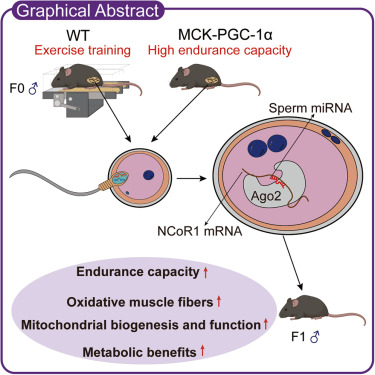
Then what’s so important in the sperm? Sperm contains not just methylated DNA, but also sperm-borne RNA’s, and doing exercise changes what microRNAs are part of the sperm package. MicroRNAs enter the embryo during fertilization and suppress NCoR1, a corepressor that silences the action of PCG- 1α, influencing the embryonic transcriptional focus towards mitochondrial production. The new pup then is born with improved oxidative metabolism and energy usage efficiency (Yin et al. 2025). This same NCoR1 mechanism was also found to carry a metabolic disorder from father to offspring (Chen et al. 2015).
Wait, does this mean Lamarck is right? Not quite. The sperm was already inside the training father, so exposure to different microRNAs was an environmental effect on the zygote, and not the inheritance of an acquired trait. These added traits are not heritable, as mammals remove most epigenetic markers from the genome twice, in the germline, and during fertilization (Horsthemke 2018). In an already fertilized sperm cell, adding new RNA molecules dodges both removal processes directly. But results still conflict, with one study showing that paternal exercise pushed offspring toward lower energy expenditure and higher obesity risk (Murashov et al. 2016).
Altogether, paternal exercise can reform what RNA exists in the sperm, and that RNA change, can influence the endurance, and metabolism of mice. The same microRNAs that appear in the sperm of well-trained human males. Though these studies were all only conducted in mice, the implications are that the same results could be seen in humans. So if you still can’t beat your dad, here’s a new excuse: he stopped training right before you were born and now you’re destined to lose to him forever :(.
References
Chen, Q., Yan, M., Cao, Z., Li, X., Zhang, Y., Shi, J., Feng, G., Peng, H., Zhang, X., Zhang, Y., Qian, J., Duan, E., Zhai, Q., & Zhou, Q. (2016). Sperm tsRNAs contribute to intergenerational inheritance of an acquired metabolic disorder. Science, 351(6271), 397–400. https://doi.org/10.1126/science.aad7977
Costa-Júnior, J. M., Ferreira, S. M., Kurauti, M. A., Bernstein, D. L., Ruano, E. G., Kameswaran, V., Schug, J., Freitas-Dias, R., Zoppi, C. C., Boschero, A. C., Oliveira, C. A. M. de, Santos, G. J., Carneiro, E. M., & Kaestner, K. H. (2021). Paternal exercise improves the metabolic health of offspring via epigenetic modulation of the germline. International Journal of Molecular Sciences, 23(1), 1. https://doi.org/10.3390/ijms23010001
Horsthemke, B. (2018). A critical view on transgenerational epigenetic inheritance in humans. Nature Communications, 9(1). https://doi.org/10.1038/s41467-018-05445-5
Murashov, A. K., Pak, E. S., Koury, M., Ajmera, A., Maneesh Jeyakumar, Parker, M. O., Williams, O., Ding, J., Walters, D. M., & P. Darrell Neufer. (2016). Paternal long‐term exercise programs offspring for low energy expenditure and increased risk for obesity in mice. 30(2), 775–784. https://doi.org/10.1096/fj.15-274274
Ng, S.-F., Lin, R. C. Y., Laybutt, D. R., Barres, R., Owens, J. A., & Morris, M. J. (2010). Chronic high-fat diet in fathers programs β-cell dysfunction in female rat offspring. Nature, 467(7318), 963–966. https://doi.org/10.1038/nature09491
Yin, X., Anwar, A., Yan, L., Yu, R., Luo, Y., Shi, L., Li, B., Chen, J., Liang, G., Chen, Y., Tang, J., Liang, J., Kan, Y., Zhang, Z., Zhou, X., Ma, J., Ji, C., Wang, Y., Zhang, Q., … Chen, X. (2025). Paternal exercise confers endurance capacity to offspring through sperm microRNAs. Cell Metabolism. https://doi.org/10.1016/j.cmet.2025.09.003


Leave a Reply
You must be logged in to post a comment.