Molecular Looksmaxxing: Exploring Why the Overuse of Dietary Supplements and Peptides Has Risen and its Environmental Impact

Have you ever asked yourself why “mogging” others seems so important in today’s digital day and age? Humans have evolved uniquely in terms of sexual selection competitiveness as a natural selection method, but in the past few years there has been a significant change in the criteria for modern beauty standards and expectations with the rise of digital media’s social influence. The increase in strictness of male beauty standards has called for a rise in the use of dietary supplements using a high waste output manufacturing process. Is it that the more we evolve to rely on sexual selection in a “male loneliness epidemic,” the more we pressure certain industries to manufacture with the sacrifice of our environmental impact?

The concept of maintaining a proper physical image’s importance has only grown since the start of the decade’s major shift to online spaces due to the global pandemic, and has yet to decline since young adults have acclimatized to finding interpersonal connections online. The physical standards people hold themselves to have shifted to be more monolithic than before, and has increased the amount of judgement one might receive on their figure thanks to the increasingly rigid rules. According to an article from Sports Medicine – Open, a study concluded that “image-centric social media use is positively associated with the use of dietary supplements and AAS among young male gym users” (Hilkens et al. 2021), which sensically explains the rise in use of collagen peptides, creatine, and magnesium glycinate as “looksmaxxing” became a trend. This association is displayed in the figure below:
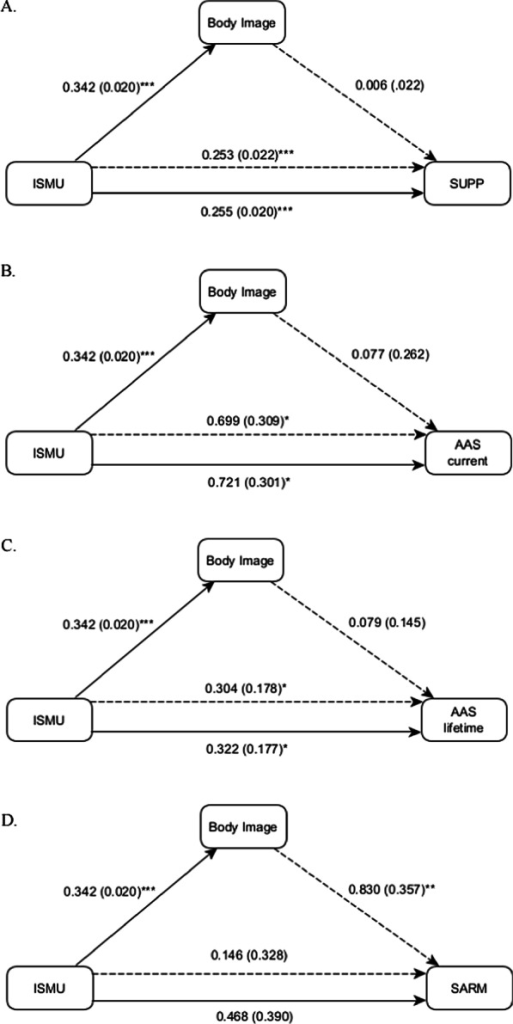
Figure 1: A statistical mediation model showing the links between image-centric social media use (ISMU) to self reported body image ratings and several performance enhancing substances such as dietary supplements (SUPP), anabolic steroids (AAS), and SARMs (Hilkens et al 2021)

However, this still begs the question: “why does physical beauty matter so much to humans in sexual selection?” Interestingly enough, it has to do with the competition aspect of sexual selection, which has been amplified by the “scarcity” set in social media’s “manosphere.” Due to human’s monogamous nature and male competition, men are actually very limited when it comes to “distributing [their] genetic benefits” (Puts 2016), so when the fear of not finding a partner is introduced, the standards men hold for themselves to ensure they are desirable to a mate reaches an extreme. Hence, the increase of dietary supplements’ supply and demand.

This presents an extreme issue; the manufacturing processes of peptide supplements have a large environmental factor. Due to the need for extensive coupling agents to form amide bonds, high amounts of waste in solvents, and toxic reagents (Isidro-Llobet et al. 2019), the process remains wasteful especially considering the scale of production coming from the new magnitude of demand. Traditional synthesis methods have poor mass efficiency and environmental footprint, averaging a process mass intensity (PMI) of around 13,000, while other processes like synthesizing small molecules have an average PMI of 300, and most pharmaceuticals have an average of 8,300 (Kekessie et al. 2024). Thankfully there has been a recent rise in research related to finding a more environmentally friendly process (Sharma 2026).

In conclusion, how humans have evolved to navigate sexual selection in monogamy, alongside the increase in intensity of beauty standards through digital media have resulted in the increase of dietary supplemental use and its subsequent ecological footprint. Only as the trend continues to grow rapidly, technology is struggling to keep up and find an applicable, greener alternative to the currently wasteful process of supplement manufacturing.

References

Hilkens, Luuk, Maarten Cruyff, Liesbeth Woertman, Jeroen Benjamins, and Catharine Evers. “Social Media, Body Image and Resistance Training: Creating the Perfect ‘Me’ with Dietary Supplements, Anabolic Steroids and Sarm’s.” Sports Medicine – Open 7, no. 1 (November 10, 2021): 7–81. https://doi.org/10.1186/s40798-021-00371-1.

Hojo, Keiko, Asaki Hara, Hiroyuki Kitai, Mare Onishi, Hideki Ichikawa, Yoshinobu Fukumori, and Koichi Kawasaki. “Development of a Method for Environmentally Friendly Chemical Peptide Synthesis in Water Using Water-Dispersible Amino Acid Nanoparticles.” Chemistry Central Journal 5, no. 1 (August 25, 2011): 5–49. https://doi.org/10.1186/1752-153x-5-49.

Isidro-Llobet, Albert, Martin N. Kenworthy, Subha Mukherjee, Michael E. Kopach, Katarzyna Wegner, Fabrice Gallou, Austin G. Smith, and Frank Roschangar. “Sustainability challenges in Peptide Synthesis and purification: From R&D to Production.” The Journal of Organic Chemistry 84, no. 8 (March 22, 2019): 4615–28. https://doi.org/10.1021/acs.joc.8b03001.

Kekessie, Ivy, Katarzyna Wegner, Isamir Martinez, Michael E. Kopach, Timothy D. White, Janine K. Tom, Martin N. Kenworthy, et al. “Process Mass Intensity (PMI): A Holistic Analysis of Current Peptide Manufacturing Processes Informs Sustainability in Peptide Synthesis.” The Journal of Organic Chemistry 89, no. 7 (March 20, 2024): 4261–82. https://doi.org/10.1021/acs.joc.3c01494.

Puts, David. “Human Sexual Selection.” Current Opinion in Psychology 7 (February 5, 2016): 28–32. https://doi.org/10.1016/j.copsyc.2015.07.011.

Sharma, Anamika, Ashish Kumar, L. Ravithej Singh, Priyanka Kushwaha, Beatriz G. de la Torre, and Fernando Albericio. “Embracing PMI: Advancing Sustainability in Peptide.” Organic Process Research & Development 30, no. 8 (July 20, 2026): 2346–59. https://doi.org/10.1021/acs.oprd.6c00206.

Comments

10 Responses to “Molecular Looksmaxxing: Exploring Why the Overuse of Dietary Supplements and Peptides Has Risen and its Environmental Impact”

  1. Judy Hammour Avatar
    Judy Hammour

    Hi iSci,

    I’m excited to say this is my first blog post, inspired by a conversation I had with a classmate regarding sexual selection while learning about the theory of evolution, as well as some green chemistry.

    Any feedback would be appreciated, thanks!

  2. Sophia Yang Avatar
    Sophia Yang

    Hi Judy,

    I loved your first blog post! This was a very intriguing post, and I loved your title. Here are some suggestions I had:

    – You could also find specific quantifiable data to further strengthen your point. You referenced how other studies found a correlation, but perhaps you could find the exact statistical evidence that led the researchers to their conclusions.

    – If your word count permits, you could add more specific information on the synthesis methods and the process relating to green chemistry. For example, mention what the specific toxic reagents are or if there are any byproducts related to the synthesis. You could also include more information about how the new process is better for the environment.

    Again, this was a very, very interesting topic and I thoroughly enjoyed reading your post.

    Keep it up 🙂

    Sophia

    1. Judy Hammour Avatar
      Judy Hammour

      Found it! Thanks for the feedback Sophia, I would have loved to expand on the different synthesis methods (solid-phase, liquid-phase, chemoenzymatic, etc.) but I was VERY limited with the word count. if you’re interested, I recommend reading this:

      https://pubs.acs.org/joceah/article/84/8/4615/1308774/Sustainability-Challenges-in-Peptide-Synthesis-and

  3. Hava Quail Avatar
    Hava Quail

    Hi Judy!

    Congratulations on your first blog post! I really enjoyed reading it!

    I have a few suggestions for you while you edit:)

    -P1S3 consider removing “very” before high, it makes the sentence less wordy and easier to read without taking away any significance to the sentence itself.
    -P2, this may be technical, but consider adding in COVID-19 global pandemic, not just global pandemic
    -Your figure is quite small and blurry making it hard to understand even with the detailed figure caption, is there a way you can get a better resolution image or choose a different one that is more clear?
    -Don’t forget to mention your figure in the paragraph before it!
    -Double check your reference list and in-text citations, I do not see an intent-citation for “Sharma, Anamika, Ashish Kumar, L. Ravithej Singh, Priyanka Kushwaha, Beatriz G. de la Torre, and Fernando Albericio. “Embracing PMI: Advancing Sustainability in Peptide.” Organic Process Research & Development 30, no. 8 (July 20, 2026): 2346–59. https://doi.org/10.1021/acs.oprd.6c00206.” make sure you only have sources in your references that are featured in text.

    Great work!

    -Hava

    1. Judy Hammour Avatar
      Judy Hammour

      Thank you so much for your feedback! I would have never caught the missed citation without someone else pointing it out so thank you so so so much!

  4. Berk Coskun Avatar
    Berk Coskun

    Hi Judy,

    Great first post! I loved the humorous but relatable topic and especially enjoyed the section where it connects to green chemistry and sustainability.

    As for some small suggestions that you can improve on:

    – Consider changing the dimensions of Figure 1, possibly downloading it differently, or changing it outright (only if there is another equivalent alternative). My only worry is that it is a little hard to read the chart due to its quality and/or proportions of image.

    – P3S1 you might want to add quotation marks around your question.
    – P3S3 you should change “competition between men” to “male competition” so that you don’t use “men” twice in the same sentence back to back.
    – For the section on green chemistry of the manufacture of peptide supplements, you could use some metrics to strengthen your argument (word count permitting).

    Awesome job!
    Berk 🙂

    1. Judy Hammour Avatar
      Judy Hammour

      Managed to fit it in! Thanks for the feedback!

  5. Vani Chowdhary Avatar
    Vani Chowdhary

    Hi Judy,

    Great first blog post! I loved reading about the ‘selection pressures’ that have led to the rise of looksmaxxing and learning a bit about what that means for our environment. I also really enjoyed your intro and conclusion paragraph and loved how they were succinct and explained the topic well while engaging the audience.

    Minor suggestions:
    – Consider rephrase P1S4 from “Is it that the more we evolve to rely on sexual selection in a “male loneliness epidemic,” the more we pressure certain industries to manufacture with the sacrifice of our environmental impact?” to “Does an increasing reliance on sexual selection in a ‘male loneliness epidemic’ pressure industries towards environmentally harmful activities?” Even if you do not use my version of this sentence, I think it would benefit from being a bit shorter/punchy?

    -In P2S1: you mention than increasing reliance of young adults on finding interpersonal connections online, is there a particular source for this? While this may seem obvious to us, it is important to cite a source for this information. I would also consider rephrasing P2S1 to: “The importance of maintaining a “proper physical image” has only grown since the start of the decade, when a major shift to online spaces normalized finding and creating interpersonal connections on online spaces.”

    -P2S2: is there any data supporting that beauty standards/physical standards have become more monolithic?

    – P2S3: Instead of mentioning the journal article, it is often better to mention the authors of the study, “A study by Hilkens et al. (2021) found that…” I would also recommend introducing Figure 1 in this sentence since this is where you first talk about the association between supplements and social media usage. “, which sensically explains the rise in consumption of collagen peptides, creatine, and magnesium glycinate as elucidated by figure 1.”

    -Figure 1: consider enlarging it to make the figure easier to read, it’s okay if it takes a while to scroll through.

    – P3S2: briefly define manosphere if you have the space to do so.

    -P4S1: Rephrase to “This presents an extremely large environmental issue as the manufacturing process of peptide supplements is extremely resource intensive and produces large amounts of waste”

    -P4S3: define process mass intensity. what does it represent? how should the reader interpret this data? Is a small PMI good or a large one?

    – P4: Generally, you only speak to the manufacturing process of peptide supplements, however earlier in your blog post you mention other supplements like creatine, and magnesium glycinate, are these similarly resource intensive? I would recommend mentioning the environmental impact of these supplements as well if you have the space!

    Again, amazing first blog post! I look forward to reading your revised one.

    Best,
    Vani 🙂

  6. Ella Nayagar Avatar
    Ella Nayagar

    Hi Judy,
    This post is great! The topic is super interesting and you explained it really well, especially considering the limitation of the word count.

    I have no major suggestions, just a few nitpicky ones:
    – Beginning of paragraph 2, “The concept of maintaining a proper physical image’s importance” was a little bit of a confusing string of words to read, for me at least. It could possibly be changed to “The perceived importance of maintaining a proper physical image” (or something along those lines) for clarity.
    – Figure 1 is hard to read, maybe make it a bit larger?

    Overall though, I definitely enjoyed reading this!!
    Happy editing,
    Ella

  7. Alice Buckley Avatar
    Alice Buckley

    Hi Judy!

    Great blog post! This is a really important topic in this day and age. I had a few minor suggestions in addition to what other commenters have said:

    – For the sentence, ” Due to the need for extensive coupling agents to form amide bonds, high amounts of waste in solvents, and toxic reagents (Isidro-Llobet et al. 2019), the process remains wasteful especially considering the scale of production coming from the new magnitude of demand” you might want to add a comma after “wasteful”.

    – Some of the sentences are a bit wordy, and I found I was having to read over them a few times to fully understand. Especially here: “Due to human’s monogamous nature and male competition, men are actually very limited when it comes to “distributing [their] genetic benefits” (Puts 2016), so when the fear of not finding a partner is introduced, the standards men hold for themselves to ensure they are desirable to a mate reaches an extreme.” It might be better to refrain from directly quoting a source unless you need that specific wording, because I think it might be clearer with something more simple.

    Overall I really enjoyed reading this! We should discuss the manosphere in greater depth sometime 🙂

    Alice

Leave a Reply