How does a species without spoken language organize thousands of individuals into a highly specialized and productive society? The caste system among leafcutter ants seems almost too neat, with thousands of workers dividing labour among cutting leaves, caring for broods, tending the fungus garden, foraging, and defending the nest. Interestingly, the social system by which they are organized is a decentralized “superorganism” where an ant’s role can be understood through developmental biology, chemistry, and physics.
The first part of the answer is established before an ant leaves the nest. In Acromyrmex echinatior, researchers found that when large workers were removed, larvae became more likely to develop into large-worker phenotypes, suggesting that the colony’s existing workforce has an influence on the roles of the next generation (Hughes and Boomsma 2007). Furthermore, in Atta vollenweideri, development also determines what a worker can physically do. Newly emerged workers produce less than 10 mN of bite force, while mature foragers produce around 100 mN, making young workers physically incapable of leaf-cutting (Püffel et al. 2023).
However, the caste system is not simply dependent on physical traits that either enable or inhibit the organism from completing specific roles; the colony also needs a way to detect what is happening around it and respond accordingly. Leafcutter ants use stridulation, rubbing body parts together to produce vibrations that travel through the substrate. They possess a specialized structure on their abdomen composed of a sharp scraper, known as the plectrum, and a finely ridged file. This anatomy exemplifies stick-slip friction, the exact same mechanical phenomenon that allows a violin bow to create sound from a string. In Atta sexdens, ants can locate the source of a vibration by comparing tiny differences in when the signal reaches their legs (Hager, Kirchner, and Kirchner 2017).
To add to this, Hager, Kirchner, and Kirchner found that an alarm chemical could alter how A. sexdens responded to vibrations (2017). It must be understood that a signal is not a mere translation into a fixed response, such as “vibration = complete task X”. Instead, the meaning of a signal can depend on other information that the ant is receiving at the same time. Ants are able to detect extremely similar hydrocarbons on the cuticle of other ants, including molecules that are extremely similar but differ in subtle structural features. Sharma et al. found that Camponotus floridanus could even distinguish enantiomers or “mirror molecules” of a candidate queen pheromone (2015). This level of chemical discrimination implies that ants are distinguishing between closely related molecular signals and carrying out different responses to each one rather than solely detecting whether a chemical is present or absent in their surroundings.
These signals do not produce the same response in every worker. Instead, their effects can differ between individuals according to response-threshold models. Notably, the same stimulus may cause one worker to respond while another remains inactive until the conditions change, meaning task allocation can emerge from many individual responses. (Beshers and Fewell 2001). Likewise, certain biological mechanisms can make a particular behavior more or less likely in an individual ant. In Atta cephalotes, the neuropeptides NPA and CCAP were associated with different worker behaviors. Experimentally reducing NPA increased brood care in Major workers, while adding NPA to Minor workers reduced brood care. Similarly, increasing CCAP increased leaf-moving behavior in some workers, while reducing CCAP decreased it (Gilbert et al. 2025). Figure 1 below summarizes these baseline behaviors and the behavioural changes caused by neuropeptide manipulation.
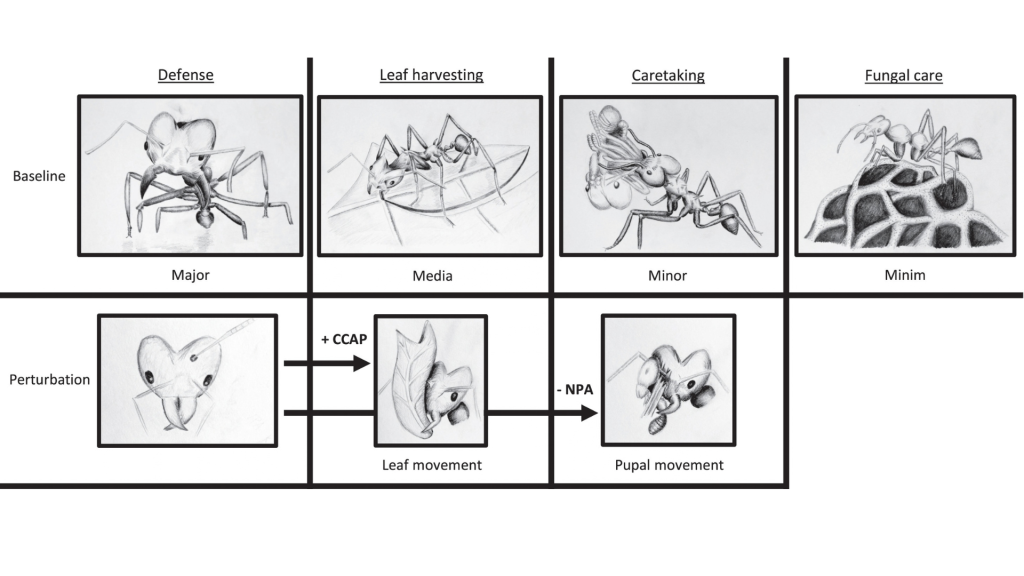
All in all, the division of labour that makes these colonies so productive is not dependent on a set of explicit instructions. Rather, morphological development determines what an ant is equipped to do, chemical and physical signals are used to facilitate communication, and response thresholds and internal biological mechanisms guide behavior.
References
Beshers, Samuel N., and Jennifer H. Fewell. 2001. “M ODELS of D IVISION of L ABOR in S OCIAL I NSECTS.” Annual Review of Entomology 46 (1): 413–40. https://doi.org/10.1146/annurev.ento.46.1.413.
Gilbert, Michael B., Karl M. Glastad, Maxxum Fioriti, et al. 2025. “Neuropeptides Specify and Reprogram Division of Labor in the Leafcutter Ant Atta Cephalotes.” Cell 188 (15): 3974–91.e21. https://doi.org/10.1016/j.cell.2025.05.023.
Hager, Felix A., Lea Kirchner, and Wolfgang H. Kirchner. 2017. “Directional Vibration Sensing in the Leafcutter Ant Atta Sexdens.” Biol Open 6 (12): 1949–52. https://doi.org/10.1242/bio.029587.
Hughes, William O. H., and Jacobus J Boomsma. 2007. “Genetic Polymorphism in Leaf-Cutting Ants Is Phenotypically Plastic.” Proceedings. Biological Sciences (England) 274 (1618): 1625–30. PubMed Central. https://doi.org/10.1098/rspb.2007.0347.
Püffel, Frederik, Lara Meyer, Natalie Imirzian, Flavio Roces, Richard Johnston, and David Labonte. 2023. “Developmental Biomechanics and Age Polyethism in Leaf-Cutter Ants.” Proc. R. Soc. B 290 (2000): 20230355. https://doi.org/10.1098/rspb.2023.0355.
Sharma, Kavita R., Brittany L. Enzmann, Yvonne Schmidt, et al. 2015. “Cuticular Hydrocarbon Pheromones for Social Behavior and Their Coding in the Ant Antenna.” Cell Reports 12 (8): 1261–71. https://doi.org/10.1016/j.celrep.2015.07.031.


Leave a Reply
You must be logged in to post a comment.