Every time you drink a soda, you may consume phosphorus- but where does it come from? Not only does the element contribute to all cellular processes, but it is also primarily found in the bones, working hand in hand with calcium (Wickham 2014). Phosphates, on the other hand, are compounds that contain phosphorus and oxygen- being important components of the backbones of DNA and RNA, raising the question of where this element originates (Minchin and Lodge 2019).
The making of Pangea is the result of large-scale amalgamation of continents; this paleotectonic evolution altered sedimentary formation due to changes in land and sea distribution. During the Permian, which occurred during the time Pangea existed, it was the geological period of maximum phosphorus deposition (where minerals accumulate and form rock layers.) There were many favourable environmental conditions for the phenomenon, such as oceanic upwelling, where nutrient-rich water rises and replaces surface water that moved away. Additionally, sea level fluctuations contributed to the concentration and enrichment of phosphorus sediments (Trappe 2002). Over time, these phosphorus-rich sediments form phosphate rock deposits which can be extracted through mining for fertilizer and other phosphorus-containing products (Filippelli 2020).
Phosphate rock is commonly used to produce fertilizers, as it reacts with sulfuric acid to produce a superphosphate fertilizer (Vallero 2018). Additionally, phosphorus is contained in beverages we know and love, such as sodas- the mineral contributes to preservation and flavour. As individuals take in these sources of phosphate, it ends up in sewage streams and as human waste. But how can we reuse the consumed phosphorus instead of mining for more?
Monitoring and measuring phosphorus is vital to successfully recycle it. Data demonstrates that 20% to 50% and 35% to 55% of eutrophication is from the contribution of nitrate and phosphate in water bodies (Akinnawo 2023). To elucidate, magnesium ammonium phosphate hexahydrate (MgNH₄PO₄ ⋅ 6H₂O) is a phosphate mineral (also known as struvite) found in urine. The mineral releases nutrients that can be potentially harmful to waterways by promoting algae growth, etc. (Gonçalves et al. 2026). With this challenge, researchers collected human urine before it was lost in wastewater and stored samples at ambient temperature (average 25ºC.) The characterization of the minerals was performed using X-Ray Diffraction (XRD), quantifying different phases in the crystalline structure. Alongside the XRD, they used nuclear magnetic resonance to study the chemical environment of the phosphorus. It was found that struvite was the main phosphorus-containing compound (Gonçalves et al. 2026). Furthermore, at neutral pH, it was uncovered that 61% of phosphorus in the recovered material dissolved within 10 days, supporting its potential to be reused as a nutrient (See Figure 1). This study paved the way for nutrient recycling research and demonstrated that phosphorus can be recovered from human urine.
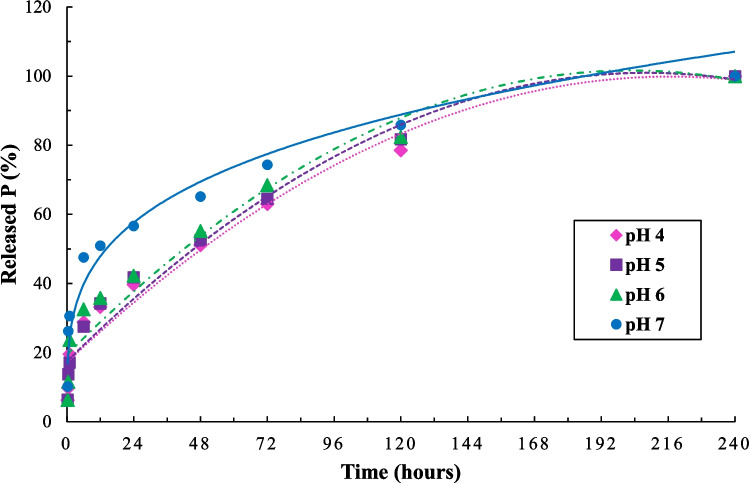
Figure 1- Phosphorus release from struvite is represented by a set of curves with different pH levels, increasing as time (in hours) passes. The graph demonstrates that the release of the phosphorus was heavily influenced by the pH of the aqueous medium in the struvite. Across all the pH levels, there was an increase in phosphorus release, however neutral pH (7.0) displayed the highest level of release (Gonçalves et al. 2026).
Ultimately, when thinking of retrieving phosphorus, understanding the value of phosphorus resulting from Pangea highlights the importance of resource recycling research. Phosphorus recovery can reduce our dependence on mining and implement a cyclical process that prevents pollution in waterways and more.
References
Akinnawo, Solomon Oluwaseun. 2023. “Eutrophication: Causes, Consequences, Physical, Chemical and Biological Techniques for Mitigation Strategies.” Environmental Challenges 12 (August): 100733. https://doi.org/10.1016/j.envc.2023.100733.
Filippelli, Gabriel M. 2011. “Phosphate Rock Formation and Marine Phosphorus Geochemistry: The Deep Time Perspective.” Chemosphere 84 (6): 759–66. https://doi.org/10.1016/j.chemosphere.2011.02.019.
Gonçalves, Ricardo Franci, Regiane Pereira Roque, Yuri Nascimento Nariyoshi, Renata Estevam, and Honerio Coutinho De Jesus. 2026. “Struvite Precipitation from Source-Separated Human Urine: Mineralogical Characterization, Phosphorus Release Kinetics, and Heavy Metal Safety Assessment.” Environmental Science and Pollution Research 33 (5): 1639–51. https://doi.org/10.1007/s11356-025-37380-6.
Minchin, Steve, and Julia Lodge. 2019. “Understanding Biochemistry: Structure and Function of Nucleic Acids.” Essays in Biochemistry 63 (4): 433–56. https://doi.org/10.1042/EBC20180038.
Trappe, Jörg. 2000. “Pangea: Extravagant Sedimentary Resource Formation during Supercontinent Configuration, an Overview.” Palaeogeography, Palaeoclimatology, Palaeoecology 161 (1–2): 35–48. https://doi.org/10.1016/S0031-0182(00)00116-4.
Vallero, Daniel A. 2008. “Sources of Air Pollution.” In Fundamentals of Air Pollution. Elsevier. https://doi.org/10.1016/B978-012373615-4/50011-X.
Wickham, Erica. 2014. “Phosphorus Content in Commonly Consumed Beverages.” Journal of Renal Nutrition 24 (1): e1–4. https://doi.org/10.1053/j.jrn.2013.10.002.
Comments
11 Responses to “Don’t Take Phosphorus for Granite!”
Hey iSci friends!
This blog topic on the origins of Phosphate and how it can be recycled was inspired by drinking Coca Cola! As I was checking the ingredients for this beverage, I noticed it contained Phosphoric acid. By learning about the importance and its relevance in our daily lives, that’s how it sparked my idea for this blog post.
Understanding how Pangea affected how we mine and use phosphate today emphasizes important contents in Earth Science. Of course, Phosphate is a chemical compound which is an immediate connection to Chemistry, however relying on a sustainable chemistry lens allows us to comprehend how it can be reused. The concept can be connected to the Life Cycle Assessment method learned in class, including: environmental toxicity and eutrophication as a subcategory. Mining for this resource is valuable, and it can be an intricate process for recovery, therefore it reminds us to not take Phosphorus for granted!
Hi Euna!
I really enjoyed reading your blog post 🙂
I loved how you connected phosphorus to both its geological origins and its importance today. The example showing that 61% of the recovered phosphorus dissolved within 10 days was especially effective because it provided clear evidence that phosphorus can potentially be recycled and reused.
One area that could potentially be expanded on is the transition between the geological history of phosphorus and its modern uses. The discussion moves fairly quickly from Pangea and tectonic plates to phosphate fertilizers, so I think that adding a sentence explaining how these ancient phosphorus-rich rock deposits eventually become resources that humans mine today would make the connection clearer. I also think the eutrophication section could explain the environmental effects in a little more detail. You mention that nutrients can cause algae growth, but briefly explaining how that algae growth can negatively affect aquatic ecosystems would make the environmental importance of phosphorus recovery even clearer. Overall, I thought the article did a great job showing how recycling phosphorus could address both resource scarcity and environmental pollution.
Hi Jua!
Thanks for the feedback, I also agree that my transition from the elements’ geological history to its relevance to the modern world today was abrupt. In P2S5, I added the sentence “Over time, these phosphorus-rich sediments form phosphate rock deposits which can be extracted through mining for fertilizer and other phosphorus-containing products” to introduce my idea of its modern use.
Although your feedback on explaining the negative impacts of algae growth would contribute to an in-depth blog post, I decided to keep my discussion focused on the importance of phosphorus as a resource and potential for recovery, instead of the environmental impacts.
Thanks for your tips, I’m glad you enjoyed my reading!
Hi Euna!
Amazing blog post, I really enjoyed reading it! As someone who loves geology, your title really made me laugh! Here are a couple of suggestions that will make your post even better:
(1) Add a figure! A picture is worth a thousand words and is a great standard practice in blog posts. It makes them more visually engaging and a figure caption is a great way to get more specific or even get around the limiting word count.
(2) Your references should be bolded and have a different font size; reference other blog posts to see the standard practice.
(3) P1: I don’t know if you should be bolding words, italicization for emphasis might be a better bet. But also, you could do without either!
Once again, good job – I can’t wait to read the final copy!
Happy editing,
Farwa 🙂
Hi Farwa!!
I’m glad you enjoyed reading! I’ve gone ahead and added a figure (graph with a caption) in my post. I also agree, it makes the post visually engaging and helps the audience understand what information I am trying to convey.
I have also enlarged the text for the references, I will definitely remember that tip for future writing. Lastly, I have emphasized the description of phosphorus and phosphate in their respective sentences instead of bolding them.
Thank you for your feedback, I’m glad you enjoyed the blog post!
Hi Euna,
Your title is so creative and drew me in! I think your blog post was really interesting. Here are a few suggestions to keep in mind while you edit:
– Chemical compounds and elements generally do not need to be capitalized.
– In-text citations with single authors do not need commas between the name and date. So it should look like this (Last name Year).
– I think it would be really good if you have a figure, maybe explaining how the collision of tectonic plates leads to the exposure of rocks rich in phosphorus.
Overall, great work! I can’t wait to read the final.
Tessa
Hi Tessa,
Haha I’m glad you enjoyed the title! I fixed the capitalization on the compounds and elements, this is definitely important to keep in mind for future scientific writing. I have also removed the commas between the name and dates for the in-text citations. Last but not least, instead of explaining Pangea as a whole, I narrowed the event down to a specific moment called the “Permian,” explaining how specific environmental conditions led to the phosphorus-rich rocks.
Thanks for your feedback!
Hi Euna
Great job on your blog post! I found it to be a very interesting read!
– I would make sure your use the DOI link from your journals to use in your references
– I believe “phosphorus” should not be capitalized in a running sentence
– P1S4: Perhaps moving this sentence further up in the paragraph will help with flow, this sentence also needs a citation
– P4S2: add “%” after 20 and 35
– P4: There are some in text citation missing here
Overall, great job! Happy editing!
Hey Maya!
I’m really glad you enjoyed the blog post! I have included the DOI link for all my references, making sure they are formatted properly. I also made sure to remove capitalization for all elements and compounds. For the sentence about phosphates being the backbones of DNA and RNA, I did not move it up the paragraph, but I added more text to explain the significance of why it is important to know the origins of the compound.
I have also added the “%” for the data and included more citations in P4 to make sure my information is backed up by reliable data and sources.
Thanks for your suggestions!
Hi Euna,
Great blog post! I always love reading anything related to Earth Science, and the ideas explored in this blog were very interesting.
Here are some suggestions as you move on to editing:
– I would recommend changing the first sentence of paragraph 2 to be: “The elements’ prevalence dates back to the beginning of Earth.”, to help improve the grammar/flow.
– I would clarify the difference between phosphorus and phosphate more in the first paragraph, as it is a bit confusing to read currently. This could be done by changing the last sentence of P1 to be “Phosphates on the other hand, are compounds that form when phosphorus binds with oxygen. These compounds also make up the backbones of DNA and RNA.” Also, double check that you are referring to phosphate and phosphorus correctly, as there were some instances where I was unsure if you meant to use the other word.
– In P2 sentence 4, I would add in “the average price of phosphate” to ensure readers know what resource you are referring to for pricing!
Overall, great work, and good luck editing!
– Alexandra 🙂
Hi Alexandra!
I’m glad you enjoyed my writing, Earth science is definitely interesting to learn about. I did remove P1S1, and replaced it with a question. I also proofread my work to make sure there weren’t any confusions between phosphorus and phosphate for the reader. By clarifying the data for the average price of phosphate, it ultimately helped with clarity and flow.
Thanks for you suggestions!