Holy Cow! Cockroach Milk and the Future of Food

Would you drink cockroach milk if scientists called it a superfood? Imagine walking into a supermarket and seeing it beside regular milk. Although it may sound a bit absurd, one species of cockroach produces exactly that: Cockroach milk! This embryonic milk has drawn the attention of experts due to its strange nutritional structure. Rather than laying eggs, the Pacific beetle cockroach known as the Diploptera punctata, gives birth to live young. The young then develop in a brood sac that functions similarly to a uterus and placenta, where the mother produces a nourishing liquid during pregnancy (Jennings et al. 2020).

The growing embryos drink this liquid which then subsequently generates microscopic crystals in their midguts. These crystals store a number of important nutrients together because they are composed of proteins, carbs and lipids (Banerjee et al. 2016). Fatty acids are bound by the folded structure of the proteins, and linked carbohydrates and other nutrients aid in the formation of a dense packed crystal. As the crystals are digested they provide the embryos with a steady supply of nutrients. Researchers estimated that one crystal has more than three times the energy in an equivalent mass of dairy milk, according to estimates (Banerjee et al. 2016).
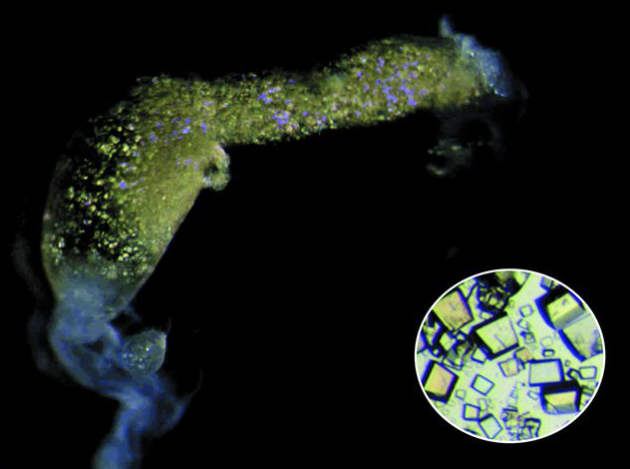
Figure 1. Milk-protein crystals inside the midgut of a developing Diploptera punctata embryo, with an enlarged view of the extracted crystals shown in the inset (Banerjee et al. 2016).

This high energy “cockroach milk” has led some researchers and news sources to call it a possible “superfood” (Niaz, Zaplatic, and Spoor 2018). More generally, because many insect species require less space, water, and food than traditional cattle, they are being studied as potential food sources (van Huis et al. 2013). This presents an interesting possibility, instead of collecting crystals from individual cockroaches, researchers may someday examine their structure to use biotechnology to create similar nutrient storage systems.

However, something is not a useful food just because of its energy density. Cockroach milk has not yet been proven safe for human consumption by researchers, and it would be challenging to gather enough crystals directly from cockroaches. Concerns including allergies, contamination, regulation, large scale production and the acceptance from consumers may arise from insect-based foods (Kłobukowski, Śmiechowska, and Skotnicka 2025). Additionally, the environmental advantages found for commonly farmed insects also cannot automatically be applied to cockroach milk.

Even while cockroach milk won’t be found in supermarkets anytime soon, its structure may still be valuable to future food research. Studying this unique nutritional system may lead to new methods of food production and effective distribution, as hunger and food shortages continue to be major global issues (van Huis et al. 2013). Cockroach milk itself may not feed the futures,but the underlying technology behind it might.

References

Banerjee, Sanchari, Nathan P. Coussens, François-Xavier Gallat, Nitish Sathyanarayanan, Jandhyam Srikanth, Koichiro J. Yagi, James S. S. Gray, et al. 2016. “Structure of a Heterogeneous, Glycosylated, Lipid-Bound, In Vivo-Grown Protein Crystal at Atomic Resolution from the Viviparous Cockroach Diploptera punctata.” IUCrJ 3 (4): 282–293. https://doi.org/10.1107/S2052252516008903. 

Jennings, Emily C., Matthew W. Korthauer, Jacob M. Hendershot, Samuel T. Bailey, Matthew T. Weirauch, José M. C. Ribeiro, and Joshua B. Benoit. 2020. “Molecular Mechanisms Underlying Milk Production and Viviparity in the Cockroach, Diploptera punctata.” Insect Biochemistry and Molecular Biology 120: 103333. https://doi.org/10.1016/j.ibmb.2020.103333. 

Kłobukowski, Filip, Maria Śmiechowska, and Magdalena Skotnicka. 2025. “Edible Insects from the Perspective of Sustainability: A Review of the Hazards and Benefits.” Foods 14 (8): 1382. https://doi.org/10.3390/foods14081382. 

Niaz, Kamal, Elizabeta Zaplatic, and Jonathan Spoor. 2018. “Highlight Report: Diploptera functata (Cockroach) Milk as Next Superfood.” EXCLI Journal 17: 721–723. https://doi.org/10.17179/excli2018-1437. 

van Huis, Arnold, Joost Van Itterbeeck, Harmke Klunder, Esther Mertens, Afton Halloran, Giulia Muir, and Paul Vantomme. 2013. Edible Insects: Future Prospects for Food and Feed Security. FAO Forestry Paper 171. Rome: Food and Agriculture Organization of the United Nations. https://www.fao.org/4/i3253e/i3253e.pdf. 

Comments

7 Responses to “Holy Cow! Cockroach Milk and the Future of Food”

  1. Hassan Rasheed Avatar
    Hassan Rasheed

    Hey iSci,
    I found cockroach milk while searching for an unusual science topic and became interested in how it connects to reproduction, molecular structure, and sustainable food research. I was curious to see if scientists could learn from and replicate the mechanism to get the benefits from cockroach milk without having it actually put on supermarket shelves.

    Looking forward to the feedback!
    Hassan Rasheed

  2. Kimi Wong Avatar
    Kimi Wong

    Hi Hassan!

    I thoroughly enjoyed reading through your blog post! I found the topic of cockroach milk rather amusing. Here is some feedback if you find it applicable.

    – In your second paragraph, “Researchers estimated that…according to estimates” felt strange and abrupt, I don’t think you need to restate that it was an estimate.
    – In the final paragraph, “Even while…” I feel like saying even while flows oddly, consider replacing it with even though
    – In the final paragraph, there needs to be a space between “…feed the futures, but the…”

    That’s all! This was a wonderful post to read through, can’t wait to read your final draft!

    Best,
    Kimi Wong

  3. Ilyas Ayub Avatar
    Ilyas Ayub

    Hey Hassan, fun read, the title pulled me in and I didn’t expect cockroach milk to be this interesting. Liked how you connected the biology to the bigger sustainability and biotech picture.

    A few suggestions:

    – Paragraph 1 mentions the milk’s “strange nutritional structure” but doesn’t say what’s strange about it yet.
    – In paragraph 4 you list allergies, contamination, and consumer acceptance. Maybe you could mention which one do researchers see as the biggest obstacle? Calling that out could strengthen it.
    – The conclusion could mention your opening question about whether people would actually drink it which would tie it back nicely.

    Overall solid post. Great job.

    Ilyas

  4. Carolinna Machado Pereira Avatar
    Carolinna Machado Pereira

    Hi Hassan, great blog post!
    What a novel and interesting topic. Below are a few suggestions to help with your editing:

    –> The scientific name of the Pacific beetle cockroach should be italicized throughout.
    –> In the last sentence of your second paragraph, “estimated” appears twice. You can remove “according to estimates” to avoid redundancy.
    –> This is just a suggestion, but maybe to make your blog post a more integrated with other sciences you could expand on the chemical features of the crystals that make them so energy-dense.

    Overall, this was a really interesting post. Happy editing!
    – Carolinna Machado

  5. Vanessa Salazar Avatar
    Vanessa Salazar

    Hi Hassan,

    I really enjoyed reading your blog about the benefits of cockroach milk and its implications. Your title and photo were very eye-catching! I have a few notes that I think can help your blog. I would recommend using synonyms in your paragraphs to avoid seeming repeitive in your sentence structure. For example, in the second paragraph and last sentence, you state: “Researchers estimated… according to estimates”. I would consider finding a synonym for the word “estimate”. Moreover, I think it is helpful to read sentences outloud to avoid run-on sentences and ensure clarity. One of your sentences in the third paragraph and last sentence states: “This presents an interesting possibility, instead of collecting crystals from individual cockroaches, researchers may someday examine their structure to use biotechnology to create similar nutrient storage systems.” You could separate this sentence into two sentences so it is more clear. Overall, I would recommend reading over your blog for any grammar or clarity issues. I really enjoyed reading your blog, and I am excited to see the finished product! 🙂

    Kind regards,

    Vanessa Salazar

  6. Teddy Mao Avatar
    Teddy Mao

    Hi Hassan,

    Your post so far was a very interesting read!
    I have a small suggestion for the final bit of your post,

    I think the conclusion could be slightly more specific about what researchers could learn from the crystals. When you mention they could discover “new methods of food production,” maybe a small mentioning what that might look like through from other bug or similar species being applied for food research would make this seem a bit more realistic?

    Looking forward to the final product,
    Teddy

  7. Ria Chhabra Avatar
    Ria Chhabra

    Hi Hassan,

    This was such a fascinating topic and I really enjoyed reading your blog post! Here are a few suggestions:

    1. Paragraph 1: Be sure to italicize the genus and species name.
    2. Paragraph 2, second sentence: You can consider using the full word “carbohydrates” to maintain the semi-formal tone of your piece.
    3. Paragraph 4, sentence 1: Consider rephrasing this for clarity. Perhaps you can say “although this food may have a high energy density, more research is still required to bring cockroach milk to the market”

    Happy editing,
    Ria

Leave a Reply