Can electricity read your mind?: Electrodermal Activity

No matter how great your poker face might be, your skin can’t keep a secret. A window into the human mind through physiology exists beyond crystal balls, witches, or horrific psychological control. The very electricity that we associate with changing brain activity in horror movies can serve as a hidden gateway into your mind. 

Electrodermal activity (EDA) recordings, particularly of palmar and plantar skin, are one of the original methods of recording psychophysiological responses, like stress, having been used as an evaluative tool in psychophysiological research since the late 19th century (Boucsein et al. 2012). Today, EDA is a useful, noninvasive, and low-cost way of studying emotional and sympathetic responses during cognitive or emotional stimulation (Banganho et al. 2022; Rahma et al. 2022). EDA serves as a valuable diagnostic tool utilized in research on stress, anxiety, and even neurological conditions like epilepsy (Banganho et al. 2022). 

Underlying these applications is a physiological link between the sympathetic nervous system (SNS) and the integumentary system, through the skin (Greco et al. 2016). EDA is controlled by the SNS, or fight-or-flight response, which exhibits particular bodily responses, like stress, upon detection of a threat-like stimulus. Eccrine glands, or sweat glands, are supplied by nonmyelinated class C fibers, which are regulated by the hypothalamus, alongside components of the limbic and reticular system. The SNS innervates eccrine glands through cholinergic fibers and adrenergic fibers. Cholinergic fibers are key in the body’s thermoregulation, causing varying discharge of sweat with changes in temperature. On the other hand, adrenergic fibers present on the soles and palms activate during emotional stress, allowing them to be leveraged when determining psychological arousal through EDA (Banganho et al. 2022). 

The physical mechanism of EDA lies in the structure of the skin and its likeness to an electrical network of resistors and capacitors. The skin’s resistance varies according to ionic concentration in components like blood, sweat, and interstitial fluid, while membranes behave as capacitors by storing electric potential through ion-selective permeability. Sweat ducts contain ionic fluid, and upon sympathetic activation, increased eccrine sweat gland activity leads to changes in the skin’s electrical conductance. Since conductance is related to resistance inversely through the relationship conductance = 1/resistance, a decrease in electrical resistance through sweating increases skin conductance. These changes can be seen as an EDA signal, where the stimulus inducing the change in conductance is also causing the emotional arousal (Figure 1) (Banganho et al. 2022; Greco et al. 2016). 
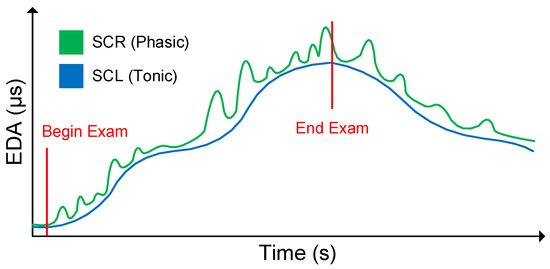
Figure 1: Mathematical deconvolution of raw skin conductance into its two distinct components: tonic and phasic. EDA measurements are captured exosomatically, where electrodes are placed on the fingers, a small external electrical signal is applied, and the skin’s response as raw skin conductance is measured. Raw electrodermal signals are separated into skin conductance levels (SCL), displaying tonic or background signals, and the skin conductance response (SCR), which is representative of a phasic, or temporary, change in conductance induced by a stimulus (Greco et al. 2016; Rahma et al. 2022; Winter et al. 2020).

EDA ultimately provides an advantageous means of understanding human psychophysiology through the nervous system. While its longstanding role in research as a measure of physiological arousal has proven useful, it lacks the ability to distinguish between emotions and mental states. Further innovation and improvement in this area of diagnostics may yield results specifying emotional states and expand the breadth of its application in psychological and neurological assessments.

References

Banganho, Antonio, Marcelino Santos, and Hugo Placido da Silva. 2022. “Electrodermal Activity: Fundamental Principles, Measurement, and Application.” IEEE Potentials 41 (5): 35–43. https://doi.org/10.1109/mpot.2020.2983381.

Boucsein, Wolfram, Don C. Fowles, Sverre Grimnes, et al. 2012. “Publication Recommendations for Electrodermal Measurements.” Psychophysiology 49 (8): 1017–34. https://doi.org/10.1111/j.1469-8986.2012.01384.

Greco, Alberto, Gaetano Valenza, and Enzo Pasquale Scilingo. 2016. Advances in Electrodermal Activity Processing With Applications for Mental Health. Springer.

Posada-Quintero, Hugo F., and Ki H. Chon. 2020. “Innovations in Electrodermal Activity Data Collection and Signal Processing: A Systematic Review.” Sensors 20 (2): 479. https://doi.org/10.3390/s20020479.

Rahma, Osmalina Nur, Alfian Pramudita Putra, Akif Rahmatillah, et al. 2022. “Electrodermal Activity for Measuring Cognitive and Emotional Stress Level.” Journal of Medical Signals and Sensors 12 (2): 155–62. https://doi.org/10.4103/jmss.JMSS_78_20.

Winter, Michael, Rüdiger Pryss, Thomas Probst, and Manfred Reichert. 2020. “Towards the Applicability of Measuring the Electrodermal Activity in the Context of Process Model Comprehension: Feasibility Study.” Sensors 20 (16): 4561. https://doi.org/10.3390/s20164561.

Comments

6 Responses to “Can electricity read your mind?: Electrodermal Activity”

  1. Ann Philip Avatar
    Ann Philip

    Hey iSci!

    EDA is something I remember reading about as a diagnostic tool in a psych class a few years ago. I never truly understood how it could be used to study psychological conditions or how its mechanisms worked. Once I looked deeper, I found the underlying physics super interesting, which inspired me to write this post combining psychology, physics, and a bit of neurology! I hope you enjoy reading my post, and please let me know if you have any editing suggestions, especially any suggestions that might help me cut down on my word count :).

    Ann

  2. Aven Leblanc Avatar
    Aven Leblanc

    Hi Ann,

    Nicely done with your blog! I think this topic is so cool, and it was awesome to read more about how EDA can be used. Below are some suggestions to help improve your blog:

    P2S2/3: I think these two sentences can be combined, to reduce redundancy. Perhaps something like: “Today, EDA provides a lower cost, non-invasive window into emotional and sympathetic arousal, aiding research on stress, anxiety, and neurological conditions like epilepsy (Banganho et al., 2022; Rahma et al., 2022).”.

    P3S3: pluralise system, “… limbic and reticular systems”.

    P4S4: I would reword this, for clarity/flow, maybe: “Conductance is inversely proportional to resistance, meaning that a decrease in resistance through sweating causes an increase in skin conductance.”

    Figure 1 S2: instead of “skin’s response as raw skin conductance is measured” I would say “skin’s response is measured as raw skin conductance”.

    Overall, super well written!

    Happy editing,

    Aven 🙂

  3. Ria Chhabra Avatar
    Ria Chhabra

    Hi Ann,

    This was such an interesting topic and I really enjoyed reading it! Your introduction was absolutely amazing and immediately captured my interest! Here are a few suggestions:

    Paragraph 1, sentence 1: this sentence seems a little bit long. Perhaps you can separate it into two or remove some clauses.
    Paragraph 2, sentence 2: similar comment here. I think you could remove either “stress” or “particular” to make the sentence a bit more concise.
    I love how you define cholinergic and adrenergic fibers! That was very helpful for readers.
    Paragraph 4: Perhaps you can say the word “equals” instead of writing the equation in the text.
    Figure caption: if you are citing multiple sources to explain the image, it might be good to add the in-text citation where you found this image into the first sentence of the caption.

    Happy editing,
    Ria

  4. Sayana Suthaharan Avatar
    Sayana Suthaharan

    Awesome work with your draft Ann, I really enjoyed the topic and thought it was certainly an engaging one! I just have a couple of recommendations that you can choose to use, word-permitting!

    – In P1S3, I would recommend adding a comma after the word “movies” for better readability

    – (P2S1) I would also recommend defining “palmar and plantar skin” for those who may not have background research on the topic, as context.

    – I would also recommend splitting up P4S2 into two different sentences for better flow.

    Happy editing!
    Sayana 🙂

  5. Charles Bowen Avatar
    Charles Bowen

    Hi Ann,

    This was a really interesting and well-written blog post! I enjoyed how you made connections between multiple different disciplines. A few suggestions for your final draft:

    – Consider connecting your first two paragraphs, or including your initial mention of EDA recordings in your introduction, as it doesn’t currently have a ‘connection’ to the rest of your piece.
    – Consider rephrasing P3S2 for clarity by removing commas – this could look like “[…], which activates stress-induced bodily responses upon detection of a threat-like stimulus.”
    – In your conclusion, consider expanding on what types of applications we might see if the future (if you have the word count)! This is a really interesting point and I’d love to see more.

    Overall fantastic work! I’m really looking forward to reading your final post.

    Happy editing!
    Charlie

  6. Gurdit Sra Avatar
    Gurdit Sra

    Hi Ann,

    Great post! The resistor-capacitor comparison made the physics click for me.

    Two things:

    In P3S4, you say cholinergic fibers handle thermoregulation and adrenergic fibers handle emotional arousal. Since EDA is measured on the palms, it might help to say a line about how researchers separate the two, or if both are at play in a reading.
    Your conclusion says EDA can’t distinguish between emotions, but your figure already splits the signal into tonic and phasic parts. Tying those together would make the limitation land harder.

    Happy editing!

    Gurdit

Leave a Reply