Quick! You have an assignment due in 1 hour. What’s the first thing you’re doing? Well, for those of us with long hair, we’re probably tying it up into a ponytail. Now, with your hair out of the way, suddenly you’re ready to take on the challenge. Have you ever wondered why that is? I propose that the answer may be a little more scientific than you think.
Let’s consider Pavlov’s findings with classical conditioning. Although his experiment with his dog established the attachment between neutral stimuli and reflexes, another separate experiment proved the attachment between neutral stimuli and emotional states (Watson & Rayner 2000). When an infant was repeatedly shown a white animal, such as a rabbit or a rat, followed by a loud banging of a metal bar being struck with a hammer, he gradually began to fear white animals, and would begin crying at the mere sight of one (Watson & Rayner 2000). Now take away all the ethical and moral violations within this experiment, and swap the animal for a hair tie. If you tie up your hair before every lab, exam, or deadline, the act becomes a neutral stimulus that triggers now conditioned responses, such as focus and/or stress arousal. As a result, repeatedly tying your hair in preparation to deeply concentrate on an objective gives the ponytail the ability to put your mind into “work-mode”.
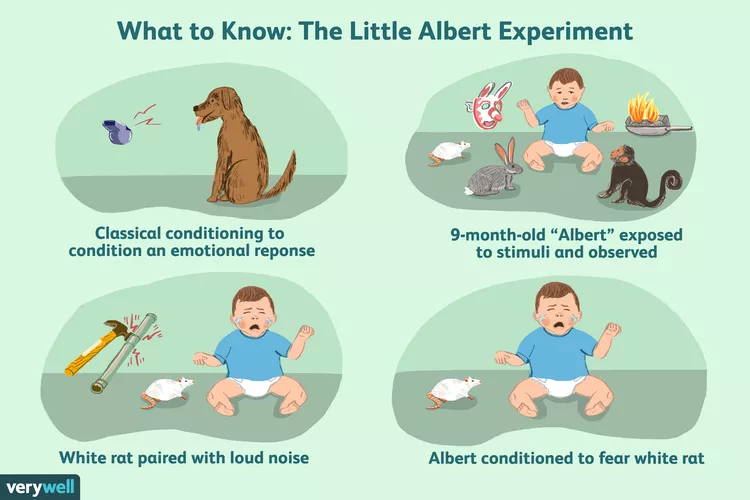
Figure 1: The top left bubble shows the final result of Pavlov’s experiment, and the remaining bubbles, from left to right, illustrate the results of Watson and Rayner’s experiment, “Little Albert” (Olah 2026)
Now here’s a surprise: your hair is an organ—well, at least the follicle is. Each one is wrapped in low-threshold mechanoreceptors that can be activated by simple mechanical stimuli, such as deflecting the hair follicles (Li et al. 2011). Loose hair that brushes your face and neck fires these receptors constantly. Though most of that signal is filtered out through sensory adaptation, each deflection is an interruption that competes for your attention (Wark et al. 2007). It is this kind of noise that makes us say we’re “overstimulated”. That’s the other great thing about ponytails; they remove that noise.
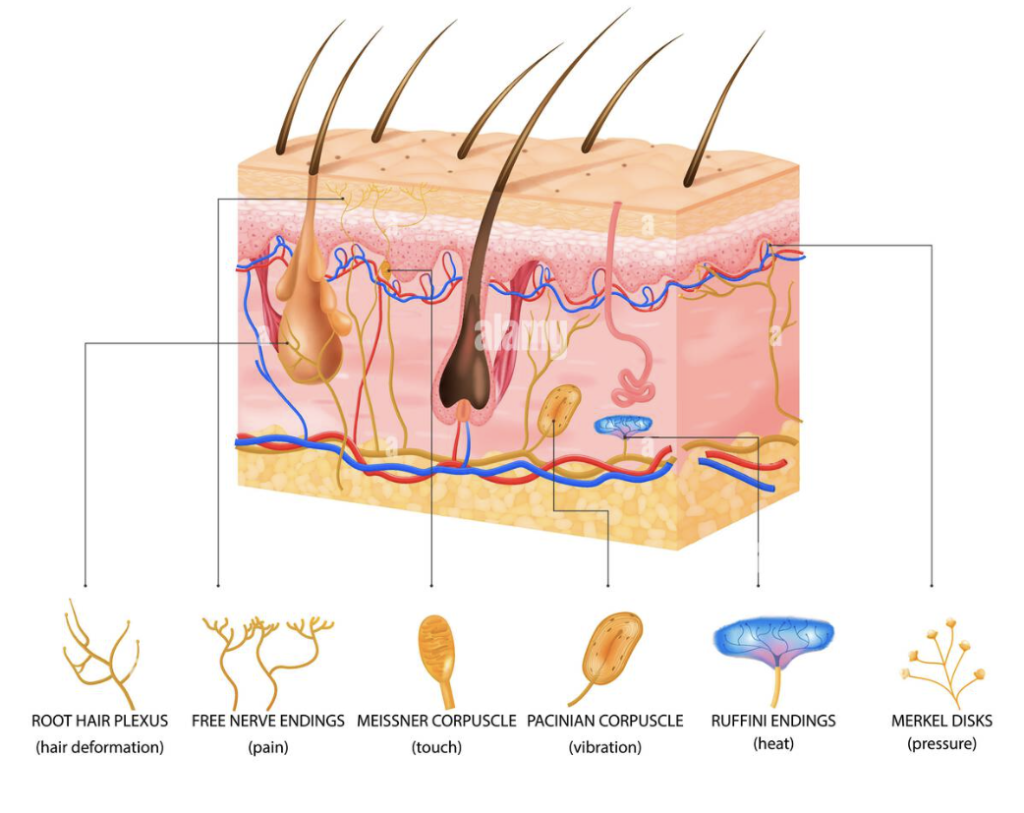
Figure 2: Diagram of the different mechanoreceptors located underneath the skin, wrapped around the hair follicle. Root hair plexus responds to hair deflection (“Skin Sensory Receptors” 2020)
Therefore, I believe that classical conditioning and our sensory receptors work together to make ponytails equal productivity. A quieter somatosensory environment makes work feel easier, which in turn strengthens the conditioned response of feeling more focused, and maybe a little stressed too.
So next time you reach for the hair tie on your wrist, remember it is a neuroscience and psychological theory in disguise.
References
Li, Lishi, Michael Rutlin, Victoria E. Abraira, et al. “The Functional Organization of Cutaneous Low-Threshold Mechanosensory Neurons.” Cell (United States) 147, no. 7 (2011): 1615–27. https://doi.org/10.1016/j.cell.2011.11.027.
Olah, Jessica. “What Was The Little Albert Experiment?” Verywell Mind, June 20, 2026. https://www.verywellmind.com/the-little-albert-experiment-2794994.
“Skin Sensory Receptors.” Alamy, June 15, 2020. https://www.alamy.com/skin-sensory-receptors-concept-with-nerve-and-hair-flat-vector-illustration-image470828422.html?imageid=AFCB11B5-F7AC-4B1A-9C82-AB26E96993F2&pn=1&searchId=0c45826b8e5d32d45fd900171fbbd910&searchtype=0.
Wark, Barry, Brian Nils Lundstrom, and Adrienne Fairhall. “Sensory Adaptation.” Current Opinion in Neurobiology (England) 17, no. 4 (2007): 423–29. https://doi.org/10.1016/j.conb.2007.07.001.
Watson, John B., and Rosalie Rayner. “Conditioned Emotional Reactions.” The American Psychologist (Washington) 55, no. 3 (2000): 313–17. https://doi.org/10.1037/0003-066X.55.3.313.


Leave a Reply
You must be logged in to post a comment.