Quick! You have an assignment due in 1 hour. What’s the first thing you’re doing? Well, for those of us with long hair, we’re probably tying it up into a ponytail. Now with your hair out of the way, suddenly you’re ready to take on the challenge. Have you ever wondered why that is? I propose that the answer may be a little more scientific than you think.
Let’s consider Pavlov’s findings with classical conditioning. Although his experiment with his dog established the attachment between neutral stimuli and reflexes, another separate investigation, called The Little Albert Experiment, proved the attachment between neutral stimuli and emotional states (Watson & Rayner 2000). In this experiment, an infant was repeatedly shown a white animal, such as a rabbit or a rat, followed by a loud banging of a metal bar being struck with a hammer. As a result, the infant gradually began to fear white animals, and would begin crying at the mere sight of one (Watson & Rayner 2000).
Now consider this phenomena— without all of the ethical and moral violations of the associated experiment—as it applies to the act of tying up hair as a neutral stimulus. If you tie up your hair before every lab, exam, or deadline, the act becomes a conditioned stimulus that triggers now conditioned responses, such as focus and/or stress arousal. As a result, repeatedly tying your hair in preparation to deeply concentrate on an objective gives the ponytail the ability to put your mind into “work-mode”.
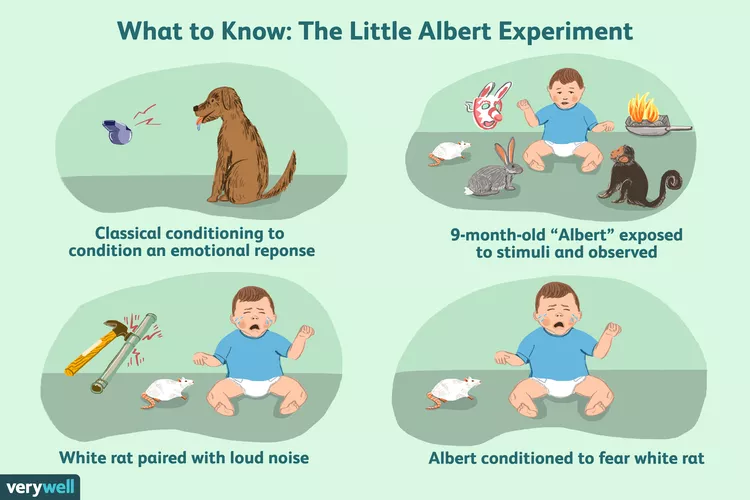
Figure 1. The top left bubble shows the final result of Pavlov’s experiment, where the dog was conditioned to associated food with a neutral stimulus. The remaining bubbles, from left to right, illustrate the stages of Watson and Rayner’s experiment, “Little Albert” (Olah 2026).
However, psychology doesn’t work alone to help us get things done. That’s where neuroscience comes in with a surprise: your hair is an organ—well, at least the follicle is. Each one is wrapped in low-threshold mechanoreceptors that can be activated by simple mechanical stimuli, such as deflecting the hair follicles (Li et al. 2011). Loose hair that brushes your face and neck fires these receptors constantly, specifically the root hair plexus nerves. Although most of these signals are filtered out through sensory adaptation, each deflection is an interruption that competes for your attention (Wark et al. 2007). It creates the kind of noise that makes us say we’re “overstimulated”. That’s the other great thing about ponytails; they remove that noise.
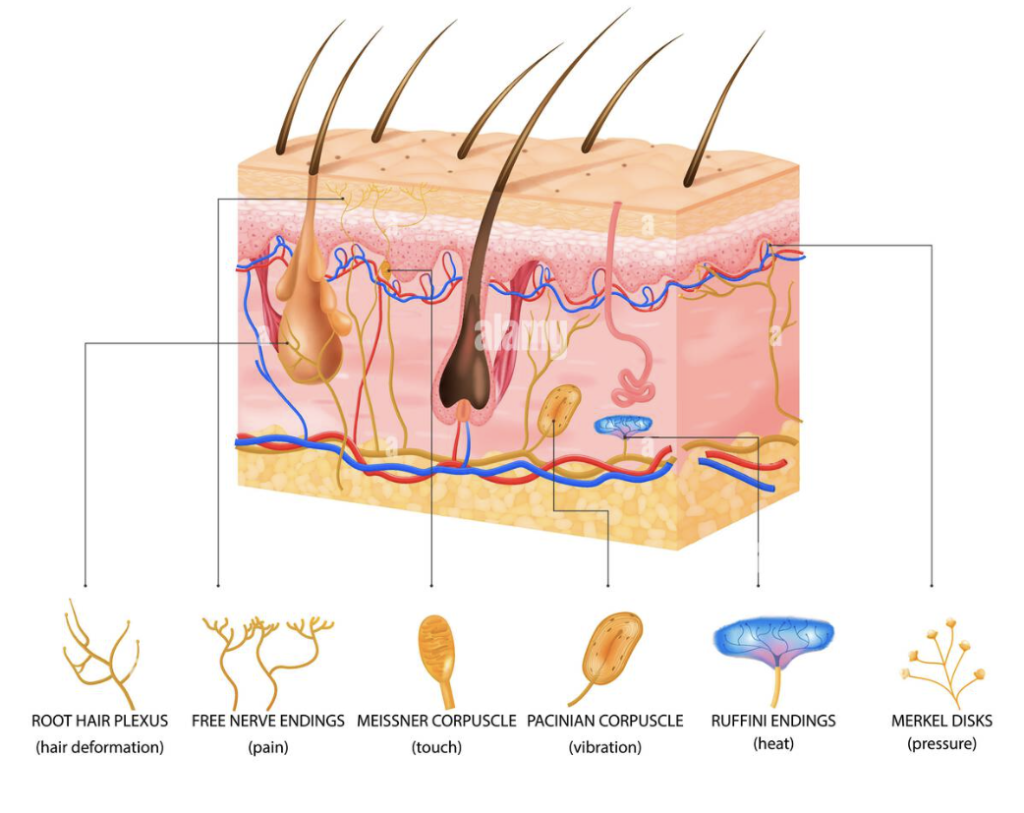
Figure 2. Diagram of the different mechanoreceptors located underneath the skin, wrapped around the hair follicle. The root hair plexus, which responds to hair deflection, is illustrated in yellow at the base of the hair follicles (“Skin Sensory Receptors” 2020).
Therefore, I believe that classical conditioning and our sensory receptors work together to make ponytails enhance productivity. A quieter somatosensory environment makes work feel easier, which in turn strengthens the conditioned response of feeling more focused, and maybe a little stressed too.
So next time you reach for the hair tie on your wrist, remember it is a neuroscience and psychological theory in disguise.
References
Li, Lishi, Michael Rutlin, Victoria E. Abraira, et al. “The Functional Organization of Cutaneous Low-Threshold Mechanosensory Neurons.” Cell (United States) 147, no. 7 (2011): 1615–27. https://doi.org/10.1016/j.cell.2011.11.027.
Olah, Jessica. “What Was The Little Albert Experiment?” Verywell Mind, June 20, 2026. https://www.verywellmind.com/the-little-albert-experiment-2794994.
“Skin Sensory Receptors.” Alamy, June 15, 2020. https://www.alamy.com/skin-sensory-receptors-concept-with-nerve-and-hair-flat-vector-illustration-image470828422.html?imageid=AFCB11B5-F7AC-4B1A-9C82-AB26E96993F2&pn=1&searchId=0c45826b8e5d32d45fd900171fbbd910&searchtype=0.
Wark, Barry, Brian Nils Lundstrom, and Adrienne Fairhall. “Sensory Adaptation.” Current Opinion in Neurobiology (England) 17, no. 4 (2007): 423–29. https://doi.org/10.1016/j.conb.2007.07.001.
Watson, John B., and Rosalie Rayner. “Conditioned Emotional Reactions.” The American Psychologist (Washington) 55, no. 3 (2000): 313–17. https://doi.org/10.1037/0003-066X.55.3.313.
Comments
17 Responses to “Got a Hair Tie? Asking for My Sanity”
Hi iSci!
As someone with long hair, a find that it gets a bit annoying to deal with. The struggle that comes with it inspired me to research more about why I feel not just more comfortable, but productive with my hair tied up. Using the topic of classical conditioning we learned about in our psychology class, and the functions of neurons we’ve began discussing, I learned some pretty interesting things that I’m excited to share with you through this post!
Any and all constructive comments are welcome!
Thank you,
Zara
Hi Zara!
Congrats on your first blog post. I love the way you connected an everyday experience to something scientific, and I think your realisation about why we tie our hair up was spot on. I have some suggestions:
P1: I’m not sure how Rapunzel’s dance abilities connect to the rest of your post. Consider removing this reference, instead creating a hook about putting your hair up before a lab or exam, and renaming your post accordingly.
P2S2: Remove the ‘as well’ at the end of this sentence, as it isn’t necessary. Also, add a citation at the end of this sentence, even if it’s the same one as you use later on (eg: Watson & Rayner 2000).
P2S4: While this sentence is funny and true, it is a little too personal and doesn’t align with the scientific writing style expected in blog posts. Consider removing it, and starting your next paragraph with “A more relatable example of this phenomena is the act of tying hair up. If you…”.
Figure 1: This figure is not scientific and doesn’t add to the content of the post; consider removing it.
P3S1: Take out ‘here’s a surprise’, and begin with ‘Hair follicles are organs…”
General comment: Blog posts usually take on a more professional tone. While the first paragraph, or ‘hook’ can be more fun and casual, the rest of the post should be scientifically written. This generally includes not using personal pronouns, and removing sentences that do not hold information, making writing more concise.
Great job overall. You clearly communicated the science behind overstimulation as well as Pavlov’s experiments. I look forward to reading the final draft! Happy editing 🙂
– Clara
Hi Clara,
Thank you for all of your feedback! I especially appreciated your first recommendation, and believe it elevated the content of my post significantly!
I have also applied your suggestions regarding my citation, grammar, and figure choice.
Regarding P2S4 (Now P3S1), I have decided to keep the humour in it, but make it more scientifically connected. Our blog post guidelines state that our writing does not have to be humourless, as long as it is appropriately done. I believe this is applicable to my writing, as I think this sentence does a good job of helping readers follow along with the topic and remain engaged.
I also appreciate your general feedback, but I’d like to note one thing: Chad has said to my cohort specifically that scientific writing does not mean that we cannot use personal pronouns. Also, I’ve tried my best to remove any unnecessary sentences, but some are arguably needed to improve the readability of the post, as they help the transition between topics. Since blog posts aren’t as formal as the usual scientific resource, I think my tone works well to engage the iSci audience, while remaining scientifically informational overall.
If there is anything I’ve missed, please do clarify! Thank you again for all of the advice.
Zara
Hi Zara, I enjoyed how you used neuroscience and psychology into delve deeper into a seemingly regular habit. I have a few suggestions for edits.
– P2: The transition between Pavolv and Watson and Rayner’s experiment is a little abrupt. Consider “Watson and Rayner proved the attachment between neutral stimuli and emotional states.”
– P3: (Wark et al, 2007) should be (Wark et al. 2007)
– Figure 2: Consider making the caption more descriptive by identifying which receptors respond to hair movement.
Overall, great work on your first post!
Veer
Hi Veer,
Thank you for the feedback! I’ve edited my blog post accordingly.
Thank you,
Zara
Hi Zara!
I really enjoyed reading your blog post! I thought it was interesting how you connected an everyday habit, like tying up your hair, to concepts we have been learning about in psychology and neuroscience. Your explanation of classical conditioning was especially engaging, and I liked how you connected sensory adaptation to the idea of reducing distractions while studying. Here is just a few things to change:
-Make the transition between the first paragraph and the scientific explanation smoother so the introduction connects more naturally to the main topic. You could also consider shortening a few sentences to make the writing more concise and easier to follow.
-(Wark et al, 2007),” the citation should be written as “(Wark et al. 2007).” I would also recommend checking comma placement throughout the post and breaking up some longer sentences to improve readability.
– Some phrases, such as “Now here’s a surprise” and “That’s the other great thing about ponytails,” are quite conversational, so you could replace them with more formal transitions to make the scientific writing flow better.
Overall, I thought this was a creative and engaging way to explore the science behind an everyday experience. Great job!
Hi Tvara,
I appreciate you feedback, and have carried out your advice regarding the citation fix.
About the introduction and scientific explanation transition, I am quite happy with it! I can’t really see a way for me to link my hook and my explanation any more clearly. If you have a suggestion, I’d be open to it though!
As for the tips regarding sentence-shortening and comma placements, I’ve read through my post a couple of times and edited what I could find. In case I’ve missed something specific you were referring to, any clarification would be appreciated!
Finally, I’ve edited the phrase “Now here’s a surprise” to flow more smoothly with my previous paragraph. However, the latter phrase you mention is a stylistic choice I’ve chosen to keep. Our blog post guidelines state that our writing does not have to be stiff. Also, keeping in mind that blog posts—even scientific ones—are a little more informal than articles and other sources of that nature, I believe that this sentence does not take away from my scientific writing. In fact, I think it improves engagement with my audience, especially those who can relate to my statement.
Again, thank you for all of your feedback!
Zara
Hi Zara,
The topic of your blog post was so interesting and I love how you blended psychology and biology in the context of Rapunzel! Here are a few suggestions:
Figure 1: Consider using a diagram of classical conditioning or the white rabbit experiment.
P3: How is each follicle wrapped in mechanoreceptors? Is there a more specific word you could use instead of “wrapped”?
References: be sure to italicize the journal name such as The American Psychologist
Happy editing,
Ria
Hi Ria,
Thank you so much for your feedback! I’ve applied your tips regarding Figure 1 and the reference list.
Though I agree that I could replace “wrapped” to make the placement of the mechanoreceptors more specific, the replacement would be more anatomical jargon, such as “arborized”, that I don’t want to overwhelm the reader with! Keeping in mind that my audience included busy iSci students who may not be familiar with such terms (as I wasn’t prior to writing this blog), I believe Figure 2 should be effective in helping the reader visualize how the receptors are positioned in relation to the follicle.
I could still use those terms and explain their meaning, but I’d like to stay on the topic of hair and how it relates to our productivity as much as I can.
Again, thank you for your feedback!
Zara
Hi Zara,
Very good first post! This is by far the most engaging and easy to follow blog post i’ve read! You did a very good job avoiding using jargon and your post would be easily understood by the vast majority of audiences.
Good luck editing
Thank you so much Charlie!
Hello Zara,
I really liked this post! This topic felt very unique and the blog was easy to follow.
My one remark is that in your second figure caption you name the root hair plexus and this seemed a little out of place as it had not been mentioned previously. You could talk about how it relates to hair deflection in the paragraph above and reference the figure to further illustrate the point.
Overall well done!
Dana
Hi Dana,
I found your advice to be super important. I’ve now specified the name of the receptors responsible for hair deflection in my paragraph, and have also clarified it in my figure caption!
Thank you,
Zara
Hi Zara,
This was a very interesting and well written blog post! Here’s some suggestions as you move onto editing:
– Figure 1 caption: Consider describing what Pavlov’s initial experiment was to provide more context! Figure captions are not a part of the word count, so it is a good way to include more details in your post. Ex: “The top left bubble shows the final result of Pavlov’s experiment, where dogs were conditioned to associated food with a neutral sound. The remaining bubbles, from left to right, illustrate the results of Watson and Rayner’s experiment, “Little Albert”.
– This is a small wording thing, but for you second last paragraph, I would suggest changing “ponytails equal productivity” to “ponytails increase productivity”, to help improve the flow of the writing.
Overall, this post was super interesting, and I had never considered how much our brain relies on conditioned associations for productivity!
Good luck editing.
Alexandra 🙂
Thank you for your feedback Alexandra! I’ve applied all of your advice to the post now 🙂
Hi Zara,
I love the title, it’s a great hook!
I just have a couple of suggestions for you:
First, I would explain the first figure more within the caption. I’d suggest explaining what each box specifically means.
Second, for the second figure, I would also explain it a bit better by adding what each component means. I would also try to find a photo without a watermark.
I loved how you wrote this! It was super interesting, and the final sentence was great!
One last thing: for the references, make sure you unlink them!
Happy editing!
Abbie
Hi Abbie,
Thank you for your feedback! I’ve successfully applied your advice regarding my references.
I have also elaborated on Pavlov’s experiment in Figure 1’s caption, however, I have chosen not to do the same for each bubble illustrating The Little Albert Experiment. This is simply because I explain it in my paragraph, and would like to avoid being repetitive. Also, I believe the captions for the bubbles within the figure should be sufficient in helping the reader understand what is happening in each stage.
As for your second point, I have made sure to clarify the receptor I refer to in my writing in the figure caption now. I chose not to elaborate on the remaining receptors, as they are not relevant to the example of hair deflection that I am focusing on.
Finally, I have decided to keep the photo with the watermark, as I believe this image is the best illustration of what I discuss. I also will not remove the watermark from the image, as the owner has deliberately placed it there and I believe doing so would be an issue of academic integrity.
I appreciate all of your feedback and believe it was very helpful!
Thank you so much,
Zara