Imagine having a headache, reaching for a painkiller, and feeling better shortly after taking it. Nothing particularly unusual there. Except the pill contained no active medication. No ibuprofen, no acetaminophen, nothing designed to relieve pain. So what exactly made your headache go away?
This phenomenon is known as placebo analgesia, pain relief associated with an inactive treatment. Expectations can influence pain, but the more interesting question is how that influence becomes physiological. Research suggests that in some circumstances, anticipating relief activates the body’s own opioid system.
In 1999, Martina Amanzio and Fabrizio Benedetti tested this connection using experimentally induced arm pain. Volunteers who expected an injection to relieve their pain tolerated it longer, even though the injection contained only saline. But when the researchers gave them naloxone, which blocks opioid receptors, the increase in pain tolerance disappeared (Amanzio and Benedetti 1999; Figure 1). This suggested that endogenous opioids, chemicals naturally produced by the body to regulate pain, were involved. Rather than relying solely on people’s descriptions of relief, the researchers had disrupted a pathway that appeared to produce it.
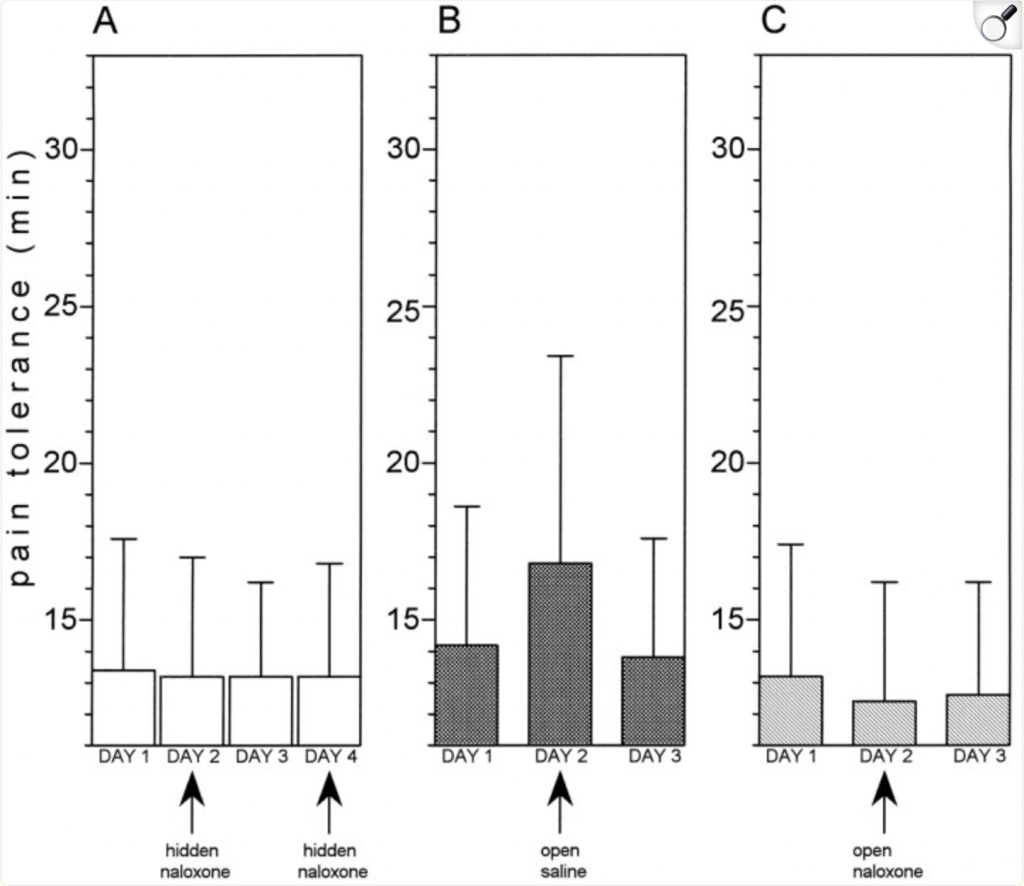
The experiment demonstrated what happened when opioid signalling was blocked, but not where the response occurred in the brain. In 2005, Jon-Kar Zubieta and colleagues took a different approach. Using positron emission tomography (PET) scans, they measured changes in opioid receptor binding while volunteers experienced pain, with and without a placebo. Their technique relied on a radioactive tracer that competes with the body’s natural opioids for receptor binding. The placebo condition was associated with greater opioid-system activity in several brain regions involved in emotion and pain processing (Zubieta et al. 2005). Although the study involved only fourteen volunteers, it provided further evidence that expectations can be associated with measurable changes in brain chemistry.
This distinction matters because placebo relief is sometimes dismissed as something people imagine. Neither experiment proves that placebos will relieve everyone’s pain, and neither suggests that an inactive pill can treat the cause of a headache. But the findings give clinicians a reason to take patients’ expectations seriously, including how treatments are explained and discussed. The experience of pain is shaped by more than the painful stimulus itself, and understanding that relationship could change how we approach its treatment.
Works Cited
Amanzio, Martina, and Fabrizio Benedetti. 1999. “Neuropharmacological Dissection of Placebo Analgesia: Expectation-Activated Opioid Systems Versus Conditioning-Activated Specific Subsystems.” Journal of Neuroscience 19 (1): 484–94. https://doi.org/10.1523/jneurosci.19-01-00484.1999.
Zubieta, Jon-Kar, Joshua A. Bueller, Lisa R. Jackson, et al. “Placebo Effects Mediated by Endogenous Opioid Activity on μ-Opioid Receptors.” Journal of Neuroscience, August 24, 2005. https://www.jneurosci.org/content/25/34/7754.

Leave a Reply
You must be logged in to post a comment.