Human immunodeficiency virus (HIV) and acquired immunodeficiency syndrome (AIDS) have claimed 44.1 million lives since it became a recognized pandemic in 1983 (Sharp and Hahn 2011; Swinkels et al. 2026). Comparing this to smallpox, which had an estimated mortality of 500 million over the span of 3000-4000 years, AIDs is killing at a much higher rate (Berche 2022). Due to its initial prevalence in gay populations, HIV received large amounts of stigma within social and medical settings. In today’s world, that has spread to include injecting drug users and commercial sex workers who are predisposed to HIV/AIDS stigma due to present discrimination and stereotypes (Mahajan et al. 2008). Continued discrimination reduces the funding, research, and treatments available for those who desperately need them.
HIV is a lentivirus (a slow-acting single-stranded virus) transmitted through blood and genital secretions that infects T-cell lymphocytes(“Lentivirus – an Overview | ScienceDirect Topics,” n.d.). The cells are then replicated, spreading the virus while triggering the immune system to attack T-cells, ultimately leading to AIDS (Figure 1). The challenge with HIV is that it attacks our immune system, weakening our defence against all pathogens (Melhuish and Lewthwaite 2022).
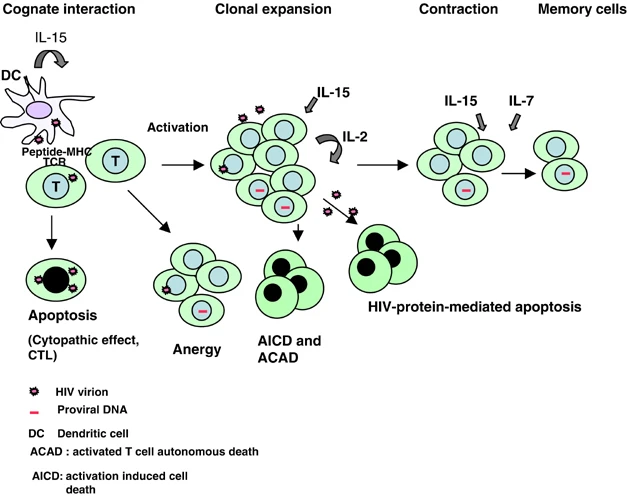
Figure 1: Dendritic cells infected with the HIV virus infect CD4+ (T cells). The T cells will either undergo programmed cell death (apoptosis) as a result of destructive changes to the cell, or undergo clonal activation. Replicated CD4+ cells can undergo differentiation into memory cells, preserving the virus long-term. This process is dictated by interleukins (ILs), IL-15 and IL-2 are responsible for cell proliferation, while IL-7 contributes to memory cell development(Gougeon 2005).
Due to its complex involvement with the immune system, HIV treatment has needed to evolve alongside our understanding. Initial treatment began as a monotherapy in the 1980s – a single type of drug therapy, with Lenacapavir as a newer promising drug from 2022 (“Definition of Monotherapy – NCI Dictionary of Cancer Terms – NCI” 2011; Mehtani et al. 2025). To improve treatment efficacy, a push was made for combination therapy. This began in the mid-1990s with three active drugs from a minimum of two drug classes. Combination therapy, however, led to negative side effects and a shift to two antiretroviral drugs instead of three, with promising results (Gibas et al. 2022). Organizing treatment could be hard for patients, specifically those who were unhoused or had difficulty accessing treatment. As such, single-tablet regimens combined the antiretrovirals (either 2 or 3) of different classes into an individual daily pill (Cutrell and Bedimo 2016). The newest form of HIV treatment is known as long-acting options. Patients are given continous injections that last longer between treatments, with intervals from two weeks to two months depending on the drug prescribed. The caveat with this form of treatment is that it must be performed by a healthcare professional rather than at home (National Institutes of Health n.d.).
All HIV patients experience side effects related to their treatment, but that is still preferable to their other option, death. With the number of people who are affected by HIV, we must continue our research and fight stigma to help save lives.
References
Berche, Patrick. 2022. “Life and Death of Smallpox.” Presse Medicale (Paris, France : 1983) 51 (3): 104117. https://doi.org/10.1016/j.lpm.2022.104117.
Cutrell, James, and Roger Bedimo. 2016. “Single-Tablet Regimens in the Treatment of HIV-1 Infection.” Federal Practitioner 33 (Suppl 3): 24S-30S.
“Definition of Monotherapy – NCI Dictionary of Cancer Terms – NCI.” 2011. nciAppModulePage. February 2. https://www.cancer.gov/publications/dictionaries/cancer-terms/def/monotherapy.
Gibas, Kevin M., Sean G. Kelly, Jose R. Arribas, et al. 2022. “Two-Drug Regimens for HIV Treatment.” The Lancet. HIV 9 (12): e868–83. https://doi.org/10.1016/S2352-3018(22)00249-1.
Gougeon, M. L. 2005. “To Kill or Be Killed: How HIV Exhausts the Immune System.” Cell Death & Differentiation 12 (1): 845–54. https://doi.org/10.1038/sj.cdd.4401616.
“Lentivirus – an Overview | ScienceDirect Topics.” n.d. Accessed October 23, 2026. https://www.sciencedirect.com/topics/pharmacology-toxicology-and-pharmaceutical-science/lentivirus.
Mahajan, Anish P., Jennifer N. Sayles, Vishal A. Patel, et al. 2008. “Stigma in the HIV/AIDS Epidemic: A Review of the Literature and Recommendations for the Way Forward.” AIDS (London, England) 22 (Suppl 2): S67–79. https://doi.org/10.1097/01.aids.0000327438.13291.62.
Mehtani, Nicky J., Janet Grochowski, Anthonia Chimezie, Alix Strough, Sarah Strieff, and Monica Gandhi. 2025. “HIV Viral Suppression With Unintentional Lenacapavir Monotherapy in Adherence-Challenged Patients: A Case Series.” Open Forum Infectious Diseases 12 (6): ofaf330. https://doi.org/10.1093/ofid/ofaf330.
Melhuish, Anne, and Penny Lewthwaite. 2022. “Natural History of HIV and AIDS.” Medicine, Sexually Transmitted Infections and HIV & AIDS Part 2 of 2, vol. 50 (5): 298–303. https://doi.org/10.1016/j.mpmed.2022.02.011.
National Institutes of Health. n.d. Accessed October 22, 2026. https://hivinfo.nih.gov/understanding-hiv/fact-sheets/long-acting-hiv-medicine.
Sharp, Paul M., and Beatrice H. Hahn. 2011. “Origins of HIV and the AIDS Pandemic.” Cold Spring Harbor Perspectives in Medicine: 1 (1): a006841. https://doi.org/10.1101/cshperspect.a006841.
Swinkels, Helena M., Andrew D. Nguyen, Taraz Samandari, and Peter G. Gulick. 2026. “HIV and AIDS.” In StatPearls. StatPearls Publishing. http://www.ncbi.nlm.nih.gov/books/NBK534860/.
Comments
13 Responses to “Evolution of HIV Treatments”
Hi iSci,
I hope that you enjoy reading my blog post. I was inspired partly by an immunology course that I am taking and partly by how stigma impacts our understanding and willingness to help, as we discuss in climate change.
Thanks for reading,
Izzy
Hello!
I enjoyed your blog post! It was nice to learn about the history of HIV treatment!
I liked how you mentioned the stigma around LGBTQ+ members and sex workers, but the point kind of drops off and doesn’t really connect to how this impacted the evolution of HIV treatment. It might be good to mention how this impacted the development of HIV treatments.
Happy editing!
Thank you for the feedback. I have incorporated it into the final paper
Hello Isabella!
This was a really well-written blog post. I really liked the fact that you addressed the stigma and discrimination surrounding sex workers and other communities. I also found your figure caption to be quite informative when understanding the figure. My only suggestion is that you state that HIV is a lentivirus (first paragraph, sentence 5), but you don’t define what a lentivirus is. I think it would be beneficial to add a sentence defining the term.
Thank you for the feedback. I have incorporated it into the final piece
Hi Izzy,
Great work with your blog post! This is a really informative and important topic, especially because of how many new treatments are emerging for HIV. A few suggestions for your final post:
– In your figure, I would cite the original paper author and year, rather than the figure title from the paper itself. This just makes it slightly clearer if someone was to go back and look for the source of the figure!
– In paragraph 1, make sure you capitalize the ‘S’ in AIDS (sentence 2).
– Consider expanding more on the interleukins mentioned in the figure itself, as the figure is really complex and it would support reader understanding.
Fantastic work overall! I’m really looking forward to reading your final post.
Happy editing!
Charlie
Thank you for the feedback. I have incorporated it into the final piece.
Hello,
Overall pretty good, I liked how you went over the history of HIV along with the treatment.
I noticed a few things:
1. You have the citation:
“Definition of Monotherapy – NCI Dictionary of Cancer Terms – NCI.” 2011. nciAppModulePage. February 2. https://www.cancer.gov/publications/dictionaries/cancer-terms/def/monotherapy.
You don’t really need to cite where you got a definition for a word. This can just be removed
2. Some of your sentences is pretty repetitive or confusing:
“Initial treatment began as a monotherapy – a single type of treatment with Lenacapavir as a newer promising treatment”
You use the word treatment three times here which is both repetative and makes the sentence lose the point you are trying to convey.
“This, however, led to negative side effects and a shift to two antiretroviral drugs instead of three, with promising results”
What is this referring to? I’m guessing the three drug treatment but just say that. I try to avoid using “this” at the beginning of sentences.
3. You citation:
“Long-Acting HIV Medicine | NIH.” n.d. Accessed October 22, 2026. https://hivinfo.nih.gov/understanding-hiv/fact-sheets/long-acting-hiv-medicine.
This has no author. I checked and saw that it is a US government website meaning this should be included in the citation.
Overall, this is a pretty good blog post and I’m excited to see the final draft.
Ephrem Awad
Thank you for the feedback. I have taken it into account for the final paper.
Hello Isabella!!
I really enjoyed the intro paragraph, this is an important issue, and I really like that you hit us with stats right of the bat, expressing its severity! You also hit it from a scientific, political, and humanities perspective, which was amazing!
A few suggestions:
– I would maybe define CD4+ lymphocytes and Lenacapavir.
– This sentence, “This, however, led to negative side effects and a shift to two antiretroviral drugs instead of three, with promising results” is a little hard to follow, I would maybe say “… these two drugs producing positive results”. Or maybe just break the two ideas into two seperate sentences.
– I would reword the sentence “Patients are given injections from two weeks to two months depending on the drug prescribed” to “Patients are given continous injections that last longer between treatments, intervals from two weeks to two months depending on the drug prescribed.”
Amazing Job!! – Ava Petteplace
Thank you for the feedback. I have incorporated it into the final paper.
Hello Isabella,
Thanks for this post. Organizing it around the shift from monotherapy to long-acting injectables makes it easy to follow.
One suggestion: the sentence “Initial treatment began as a monotherapy… with Lenacapavir as a newer promising treatment” makes it sound like Lenacapavir was the first monotherapy. Lenacapavir is recent (approved in 2022), but the first monotherapy was AZT in the late 1980s. Splitting this into two sentences would fix the timeline. Your Mehtani et al. (2025) source supports the newer drug point, not the historical one.
Great work overall. I look forward to the final version.
Thank you for the feedback. I have incorporated it into the final paper.