Imagine having a headache, reaching for a painkiller, and feeling better shortly after taking it. Nothing particularly unusual there. Except the pill contained no active medication. No ibuprofen, no acetaminophen, nothing designed to relieve pain. So what exactly made your headache go away?
This phenomenon is called placebo analgesia, pain relief associated with an inactive treatment. Although the pill contains no painkiller, expecting relief can change how pain is experienced. One possible explanation involves endogenous opioids, the body’s natural pain-relieving chemicals. These chemicals attach to proteins called opioid receptors on nerve cells, helping reduce the transmission of pain signals. This means the body has its own system for regulating pain, which expectations may help activate.
A 1999 experiment investigated this connection using volunteers experiencing experimentally induced arm pain. When participants were told that a saline injection would relieve their pain, they tolerated the discomfort for longer, despite receiving no painkilling medication. Researchers then tested whether the body’s opioid system was responsible by administering naloxone, a drug that blocks opioid receptors. With those receptors blocked, the same suggestion of relief no longer increased pain tolerance (Amanzio and Benedetti 1999; Figure 1). Because naloxone interferes with opioid signalling, the disappearance of the placebo response provides evidence that the body’s natural opioids contributed to the pain relief associated with expectation.
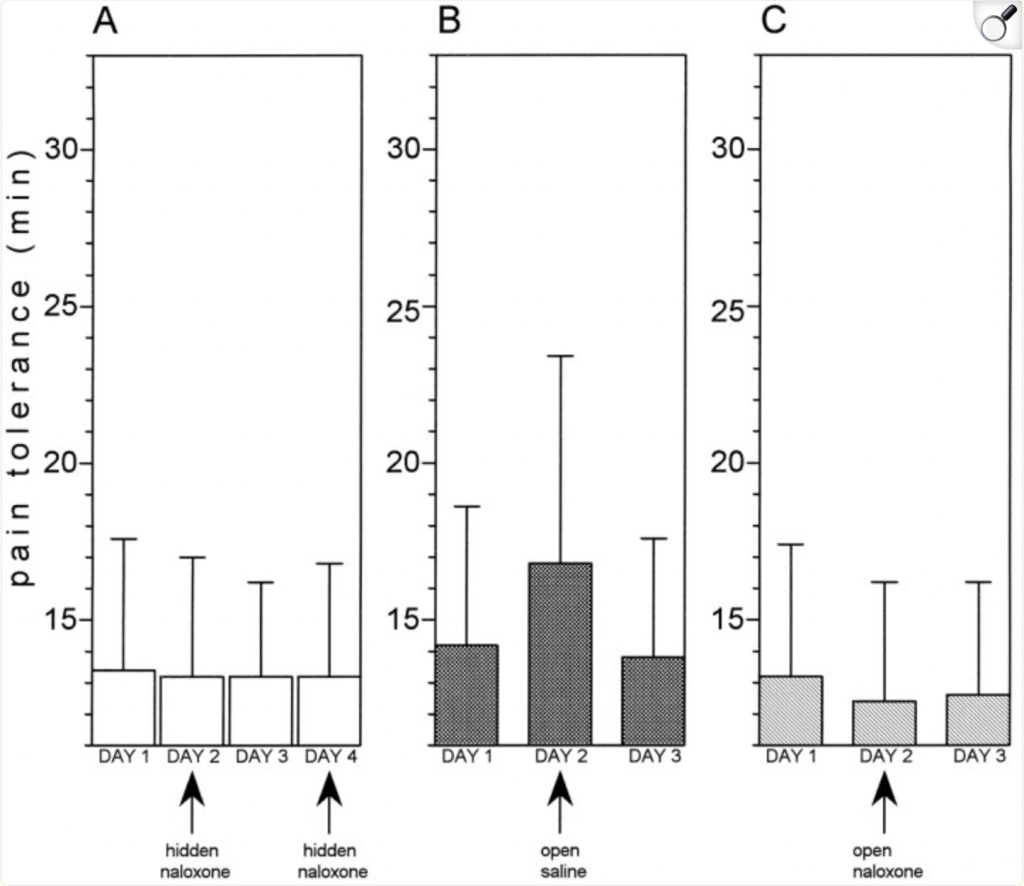
The experiment showed that opioid receptors were involved, but not where in the brain the response occurred. A 2005 study examined this using positron emission tomography, a brain-imaging technique that measures changes in opioid receptor binding. Researchers used a radioactive tracer that attaches to opioid receptors. When the body’s natural opioids occupy more of these receptors, less tracer can bind. During placebo treatment, researchers observed changes consistent with increased opioid activity in brain regions involved in processing pain and emotion (Zubieta et al. 2005). These findings supported the earlier experiment through a different approach. While naloxone showed what happened when opioid signalling was blocked, brain imaging revealed where changes in opioid activity occurred during placebo analgesia.
Both experiments involved temporary pain in healthy volunteers, leaving questions about patients who experience pain over longer periods. A 2016 trial examined people with chronic lower-back pain, comparing usual treatment with usual treatment supplemented by pills openly identified as placebos. After three weeks, patients taking the placebo pills reported greater improvements in pain and their ability to manage daily activities (Carvalho et al. 2016). Interestingly, knowing the pills were inactive did not prevent improvement. However, patients also received an explanation of how placebo effects might work. The study therefore cannot establish whether the improvement came from taking the pills, the expectations created by that explanation, or a combination of factors. It also did not test whether opioid activity was responsible.
For clinicians, this research raises an important consideration about how patients experience treatment. Expectations can develop through previous experiences and conversations with healthcare providers, even when patients receive active medication. The findings suggest that these expectations may influence pain alongside the medication itself. Understanding this relationship could help clinicians communicate more thoughtfully about treatment without exaggerating the relief patients can expect.
Works Cited
Amanzio, Martina, and Fabrizio Benedetti. 1999. “Neuropharmacological Dissection of Placebo Analgesia: Expectation-Activated Opioid Systems Versus Conditioning-Activated Specific Subsystems.” Journal of Neuroscience 19 (1): 484–94. https://doi.org/10.1523/jneurosci.19-01-00484.1999.
Carvalho, Cláudia, Joaquim Machado Caetano, Lidia Cunha, Paula Rebouta, Ted J Kaptchuk, and Irving Kirsch. “Open-Label Placebo Treatment in Chronic Low Back Pain: A Randomized Controlled Trial.” Pain, December 2016. https://pmc.ncbi.nlm.nih.gov/articles/PMC5113234/.
Zubieta, Jon-Kar, Joshua A. Bueller, Lisa R. Jackson, et al. “Placebo Effects Mediated by Endogenous Opioid Activity on μ-Opioid Receptors.” Journal of Neuroscience, August 24, 2005. https://www.jneurosci.org/content/25/34/7754.
Comments
11 Responses to “Just What the Doctor Didn’t Order”
Hey iSci!
My interest in this topic started during our Sustainable Chemistry unit when we were learning about ibuprofen synthesis. Although we focused on how ibuprofen is produced, it got me curious about pain relief more generally. I started looking into the placebo effect and thought it connected well to Psychology, particularly how expectations can influence our perception of pain. I found it interesting how the chemistry behind pain regulation connects with the psychological side of experiencing pain, so I decided to write about that!
I’m excited to hear your feedback!
– Gelila Mekre
Hi Gelila,
Great job on this blog post! I really like this topic and I can definitely see how you connected it to sustainable chem. Please see attached a couple of comments/suggestions:
– avoid rhetorical questions in your blog posts, like the last sentence in the first paragraph – it can be considered unprofessional in more academic writing
– great hook!
– you briefly mention the opioid system but don’t really expand on it. I think this is a great opportunity to touch on it, adding some more references while you’re at it!
– third paragraph: if you are lacking in words, you don’t need to cite the authors of the paper’s full names. Just saying “experimenters” is okay, especially if the in-text citation states their names right after.
Other than that, great job on this blog post! Happy editing:)
Janaay
Hi Janaya!
Thank you for your feedback! I agree that the explanation of the opioid system could use more detail, so I’ll expand on how it contributes to pain regulation. I’ll also shorten the introduction to the 1999 study to make room for that.
I understand your point about rhetorical questions in academic writing, but I think I’ll keep this one because it introduces the central question of my post and suits the more conversational style of a science blog.
Thanks again for taking the time to read it!
– Gelila
Hi Gelila!
Super interesting blog post, I loved your introduction and it was super interesting to learn about the study done by Martina Amanzio and Fabrizio Benedetti. I have a few suggestions.
– In P3 I found it a bit hard to understand how exactly the opioid receptors are linked to pain regulation. If you expand on what exactly opioids do in terms of pain regulation, maybe in a simple sentence, it would provide a little bit more clarity in understanding why naloxone would cause the higher pain tolerance to disappear.
– In your figure caption, you wrote “(A) Naloxone administered without participants’ knowledge did not significantly change pain tolerance. (B) Saline presented as a painkiller increased tolerance.” I would change the tolerance at the end of your explanation on (B) to pain tolerance to keep it consistent with the terminology you used in (A).
Otherwise, you did a great job!
Stephanie
Hi Stephanie!
Thank you for the suggestions! I agree that I could explain the connection between opioid receptors and pain regulation more clearly, as it is important for understanding the naloxone experiment. I’ll add a sentence to clarify that relationship.
I’ll also make the wording in my figure caption consistent.
Thank you!
– Gelila
Hi Gelila!
Great work on your first blog post!! I really enjoyed the read. I really like learning alternatives to pain relief that does not require any medication!
I have just a few suggestion to consider while you edit!
– Another comment mentioned avoiding rhetorical questions in a blog, but I actually disagree! I think it fits really well with your blog, definitely personal preferences though!
– P3S4 avoid starting a sentence by saying “This suggested” what does “This” refer to? Consider saying “phenomenon” or something along those lines to reduce ambiguity
– You only mention position emission tomography so you don’t have to put the acronym form (PET)!
– I don’t think two citations is enough, is there any other papers that reference the info that you have used?
Overall great work!!!
- Hava
Hi Hava!
Thank you for your feedback! I agree with your point about the wording of “This suggested.” Looking back, I can see how the reference is unclear, so I’ll revise it.
I’ll also remove the PET acronym since I don’t use it again. You also make a good point about the references, so I’ll look into finding another source that could support and expand on my explanation of the opioid system.
I appreciate your perspective on the rhetorical question as well. I felt it worked with the introduction, so I think I’ll keep it!
Thanks again!
-Gelila
Hi Gelila!
I thoroughly enjoyed reading your blog post! I thought the connection between psychological expectations and the body’s opioid system was especially interesting. I’ve also always been intrigued by how our minds and expectations can actually affect us physically, showing that sometimes, its just your mindset.
One suggestion I have is to expand a little on how these findings might apply to actual medical settings. Since both studies were conducted under controlled experimental conditions, it would be interesting to discuss whether patients experiencing chronic pain might respond differently to placebos than volunteers experiencing experimentally induced pain. I think this would add another layer to your discussion of the clinical implications and the limitations of the research.
Overall, great work!
– Jahaan
Hi Jahaan!
Thank you for the feedback! I think you raise a good point about the difference between experimentally induced pain and chronic pain. My conclusion briefly discusses the clinical implications, but I agree that it doesn’t fully address how the controlled conditions of these experiments might limit their application to patients.
I’ll look over that section to make the distinction clearer.
Thanks again for your suggestion!
-Gelila
Hello Gelila,
Your title was really interesting and your introduction really captivated the audience in my opinion. Great work!
In Paragraph 1, you can be clearer in your explanations in the concepts you described, as I had trouble understanding the idea.
“One explanation involves endogenous opioids, chemicals our bodies naturally produce that bind to opioid receptors and help reduce pain signalling.”
I would consider rephrasing this sentence or expanding on what endogenous opiods and opiod receptors are.
Your figure explains the section well. If you have space, adding another figure for your other study could help with explaining the concept and also making your blog more engaging.
Overall, great work! I enjoyed reading your blog, happy editing!
Kind regards,
Vanessa Salazar
Hi Vanessa,
Thank you for your feedback! I agree that my explanation of endogenous opioids could have been clearer, so I revised that section to make the concepts easier to understand. I also considered adding another figure, but decided to keep the original since it illustrates the main experimental comparison. I felt the second study could be explained clearly through the writing without needing an additional visual.
Thanks again for your suggestions!
– Gelila